The USA Leaders | May 15, 2026
Quick Facts: The 60-Second Investor Brief
| Element | Detail |
| Who | Stellantis (NYSE: STLA) & China’s Dongfeng Group |
| What | Strategic Revitalization of the 34-year DPCA Joint Venture |
| Where | DPCA Manufacturing Hub, Wuhan, China |
| Total Investment | ~$1.1 Billion USD (8B+ CNY); Stellantis share: ~$145M |
| Vehicle Lineup | 2 Peugeot Electric SUVs + 2 Jeep Electric Off-Roaders |
| Market Play | Built in China for domestic sales and Global Export |
| Timeline | Production begins H1 2027 |
The Wuhan-to-Toledo Connection: A New Era for Jeep
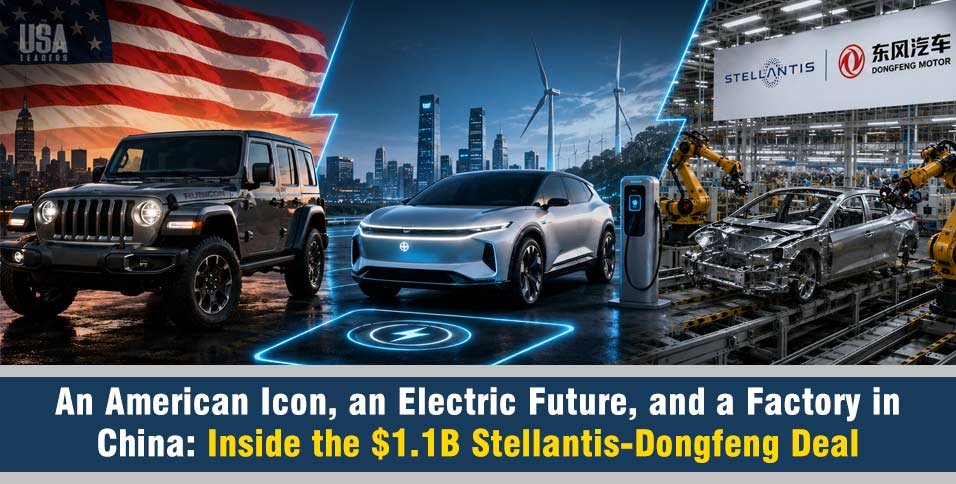
Here is a sentence that would have sounded like automotive science fiction five years ago: Jeep, the quintessential American brand born in Toledo, Ohio, is about to build its next generation of electric vehicles in Wuhan, China, to supply the global market.
On May 15, 2026, Stellantis and Dongfeng Group turned “what if” into “what’s next.” The two giants signed a strategic cooperation agreement to expand their 34-year partnership, centering on the Dongfeng Peugeot Citroën Automobile (DPCA) joint venture. For US-based professionals and NYSE: STLA investors, this isn’t just another overseas factory update; it’s a radical rethinking of how an American icon survives the electric transition.
The Strategy: “Asset-Light” Meets Industrial Muscle
In the consulting world, “synergy” has been replaced by “efficiency” as the king of KPIs. Stellantis CEO Antonio Filosa is leaning hard into this trend. While many Western firms are navigating a consulting slowdown and Big Four layoffs by pulling back, Stellantis is doubling down via a clever, capital-efficient structure.
The Math for US Readers:
- Total Deal: ~$1.1 Billion USD.
- Stellantis Contribution: ~$145 Million USD (roughly 130 million euros).
Stellantis is essentially chipping in 13 cents for every dollar invested, with Dongfeng and the Hubei provincial government carrying the bulk of the cost. For the price of a few Super Bowl ad campaigns, Stellantis gains access to a world-class EV supply chain. It’s a “brand-heavy, capital-light” entry that protects the balance sheet while securing cutting-edge tech.
The Product Roadmap: From Beijing Concepts to Global Streets
The Wuhan plant is pivoting away from the internal combustion engine to focus on New Energy Vehicles (NEVs).
1. Peugeot’s International Growth
Initially, the venture will produce two all-new Peugeot electric SUVs. Based on design language from the 2026 Beijing Auto Show, these are aimed at the tech-heavy Chinese middle class but are destined for Europe, South America, and the Middle East.
2. The Electric Jeep Pivot
For Americans, this is the headline. The deal includes two Jeep-branded off-road NEVs starting in 2027. While the press release focuses on “global markets,” the potential for these vehicles to reach North American shores, despite the complex 2026 tariff environment, remains the “elephant in the room” for regulators and consumers alike.
Why Wuhan? The Policy and AI Advantage
Location selection is never sentimental. This move is driven by the AI pivot and the density of China’s EV ecosystem.
- Incentive Ecosystem: Hubei Province and Wuhan municipality offer some of the world’s most aggressive manufacturing subsidies.
- Supply Chain Density: China’s lead in battery chemistry and electric motor production allows for lower per-unit costs that simply can’t be matched in the West currently.
- Tech Integration: The deal includes a non-binding MoU to deepen R&D, likely integrating Dongfeng’s “intelligent vehicle” tech with Stellantis’s global software platforms.
The CEO Verdict: A Win-Win Exchange
The leadership teams aren’t hiding the nature of this “second honeymoon.”
“Stellantis and Dongfeng are ready to further leverage their strengths and introduce all-new vehicles with cutting-edge EV technologies from brands that customers worldwide trust and love,” said Stellantis CEO Antonio Filosa.
Dongfeng Chairman Qing Yang was even more direct, noting the deal forges a path of “complementary strengths,” where Dongfeng provides the tech and manufacturing, and Stellantis provides the global brand equity.
What US Investors (STLA) Should Watch
As a Senior Investigative Analyst, I see three critical factors for Wall Street to track:
- The Tariff Wildcard: If US-China trade tensions escalate further in 2027, the “export” logic of building Jeeps in Wuhan for global sale could face significant headwinds.
- Execution Risk: Joint ventures in China are notoriously difficult to manage. The deal is signed, but “implementation agreements” are still pending.
- The Contrarian Signal: While other Western automakers are quietly reducing Chinese exposure, Stellantis is leaning in. If they can leverage Chinese costs to save an American brand’s margins, it’s a masterstroke. If they lose brand prestige in the process, it’s a gamble.
The Bottom Line:
Stellantis isn’t just building cars in China; they are using China as a high-tech workshop to build a global future for Jeep and Peugeot. In 2026, that’s not just business, it’s industrial survival.
Also Read – Best Hybrid Cars 2026: Which Automakers Own the Road?