The USA Leaders | May 13, 2026
| Quick Facts | Details |
| Parties | Bristol-Myers Squibb (BMS, USA) & Jiangsu Hengrui Pharma (China) |
| Total Value | Up to $15.2 billion |
| Programs | 13 (oncology, hematology, immunology) |
| Rights | BMS gets global ex-China for most; Hengrui retains China |
| Payments | Upfronts + milestones + royalties (details undisclosed) |
| Announcement | May 12, 2026 |
| Sources | BMS Release, BioPharm, Reuters |
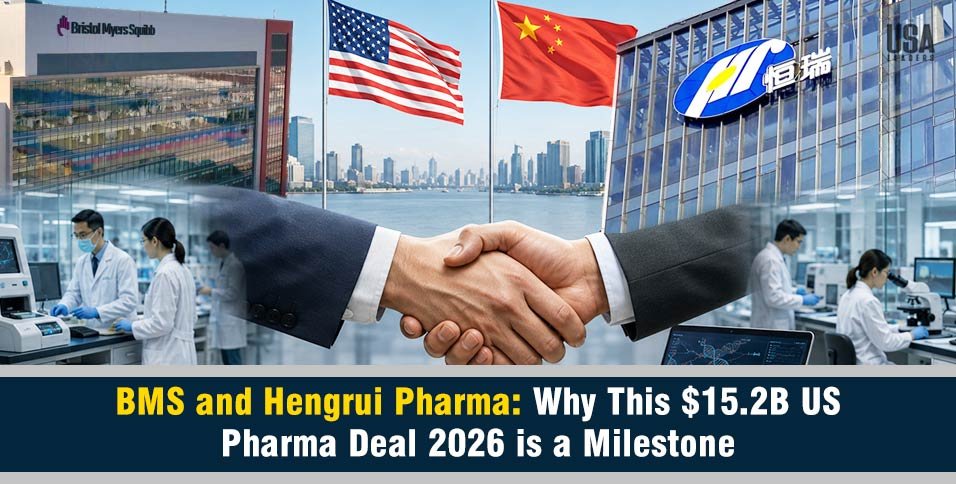
On May 12, 2026, the pharma world focused on one name: Bristol Myers Squibb. The New Jersey–based company announced a major partnership with China’s Hengrui Pharma, worth up to $15.2 billion. The deal includes 13 drug programs aimed at treating cancer, blood disorders, and immune diseases, with the potential to help millions of patients worldwide.
To understand the scale, $15.2 billion is more than the entire economy of Iceland. It’s also one of the biggest US–China pharma deals in recent years, showing how global drug development is changing in 2026.
So what does this agreement include? Who are the companies involved? And why does it matter for patients, investors, and the future of medicine? Here’s a simple breakdown.
The agreement includes 13 drug programs across three disease areas, with $950 million in guaranteed near-term payments from BMS. The deal is expected to close in the third quarter of 2026, pending regulatory approval.
What Is the Bristol Myers Squibb–Hengrui Deal?
This deal is a co-development and licensing partnership. Bristol Myers Squibb (BMS) and Hengrui will collaborate to develop 13 early-stage medicines for serious diseases that currently lack effective treatments or have limited options.
How the 13 drug programs are split:
- From Hengrui (4 drugs)
Cancer and blood disease treatments developed by Hengrui. BMS will have rights to sell them outside China. - From BMS (4 drugs)
Immune disorder medicines from BMS. Hengrui will develop and sell these in mainland China, Hong Kong, and Macau. - Joint Development (5 drugs)
Five brand-new medicines that both companies will discover and develop together using Hengrui’s research platforms.
Hengrui said these drug candidates could be first-in-class or best-in-class, meaning they may offer new or better ways to treat diseases compared to current medicines.
“By leveraging complementary capabilities across geographies, we aim to accelerate early clinical learning and make informed decisions that support driving top-tier growth in the next decade.”
Robert Plenge, Chief Research Officer, Bristol Myers Squibb
How Does the Money Actually Work?
It’s not a $15.2 billion check. Here’s the real breakdown.
The headline number of $15.2 billion is real, but it’s a potential maximum, not a guaranteed payout. Think of it like a bonus structure: the more milestones the drugs hit, the more money flows.
| Payment Type | Amount & Timing |
| Upfront payment (day one) | $600 million, paid by BMS to Hengrui immediately |
| First anniversary payment | $175 million, paid one year after the deal closes |
| Second anniversary payment | $175 million contingent payment in 2028 |
| Total guaranteed near-term | Up to $950 million |
| Milestone payments | Paid as each drug hits clinical, regulatory, and sales targets |
| Royalties | Tiered royalties to Hengrui on sales outside its home territories |
| Maximum possible value | ~$15.2 billion (if every drug succeeds globally) |
It’s a smart, well-balanced deal for both companies. BMS avoids paying huge upfront costs for unproven science, while Hengrui earns major rewards only if the drugs succeed and sell well. This kind of shared risk and reward is what strong biotech partnerships are built on.
Why BMS Is Partnering with a Chinese Company: The Bigger Picture
China’s fast-growing biotech industry is changing the global drug market. This partnership is not a one-off deal.
It reflects years of progress in China’s pharmaceutical sector, with growth accelerating rapidly in 2025.
China Biotech Licensing Boom — Key Numbers
- Chinese pharma companies saw a major jump in outbound licensing in 2025. Deal value rose 161% to nearly $136 billion, with $7 billion in upfront payments across a record 157 deals.
- More than 60 partnerships were signed with US and European drugmakers in 2025, and over 24 more have already been completed in the first half of 2026.
- China’s share of global licensing deal value grew sharply from just 1% in 2019 to about 28% by 2024, showing a dramatic shift in just five years.
For BMS, this deal fits its strategy as key drug patents expire. Instead of spending billions on building new drugs internally, the company is using Hengrui’s efficient research capabilities to strengthen its early-stage drug pipeline.
Hengrui is also experienced in global partnerships. Since early 2025, it has signed several major cross-border deals, including agreements with GSK and Merck & Co. and a major obesity-drug licensing deal with US-based Kailera Therapeutics. What makes the BMS deal different is that it includes BMS’s own immunology assets, not just a cash investment.
What Does This Mean for Cancer and Disease Treatment?
This deal is not just about business; it’s about helping patients get better medicines.
Cancer is still the world’s second leading cause of death. Blood cancers like leukemia and lymphoma often have no cure. Immune diseases, from arthritis to rare inflammatory conditions, affect millions of people worldwide.
All 13 programs focus on these serious conditions where current cancer treatments are limited, have strong side effects, or don’t exist at all. This situation is known as an “unmet medical need,” and partnerships like this aim to solve exactly that.
These drugs are in early testing, so not all will succeed. But even if just two or three make it through, they could make a real difference for patients.
5 Key Things Investors Should Watch
1. Q3 2026 Deal Approval
The deal still needs antitrust approval. Any delay or rejection would be important news for BMY investors.
2. Clinical Trial Progress
All 13 programs are in early stages. Meaningful results are expected in 2–4 years, so patience will be important.
3. Hengrui’s Share Price
Hengrui’s stock jumped after the announcement. Future gains will depend on early trial results.
4. BMY’s Pipeline Strategy
BMY shares have traded between $42.52 and $62.89 in the past year. This deal may signal a larger shift toward China-based partnerships.
5. Long-Term Royalty Potential
Royalties from successful cancer drugs could be very large. Even a few approvals could generate billions in yearly revenue.
The Bottom Line
The BMS–Hengrui deal is more than just 13 drug programs. It reflects a new way of innovating in pharma, where global drug companies partner with top scientific talent worldwide instead of working alone.
For BMS, this approach helps strengthen its drug pipeline while reducing early-stage risk. For Hengrui, it confirms that China’s drug research is now globally competitive and opens the door to reaching patients worldwide.
The $15.2 billion figure is the maximum potential value, but the key signal is the $600 million already committed. Investing that much before trial results shows strong confidence from both companies.
In drug development, that level of commitment matters.
Also Read – Best Cancer Hospitals In US 2026: Top-Ranked Centers for Treatment