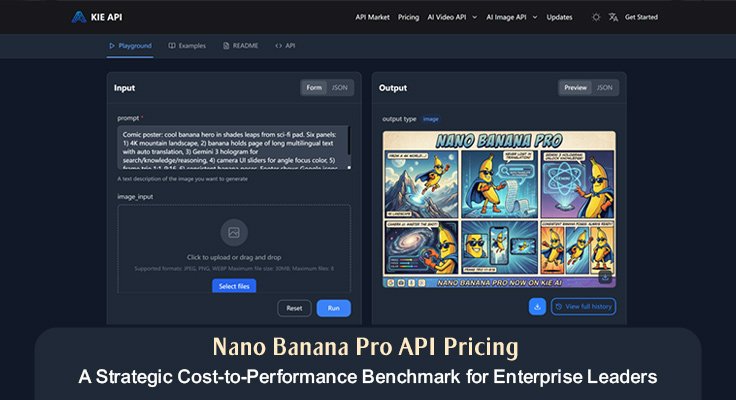
Enterprise infrastructure is rapidly shifting toward programmatic content pipelines. For organizational leaders, selecting a generative interface like the Nano Banana Pro API is a strategic decision that directly impacts technical agility and brand authority. Built on the Gemini 3.0 Pro Image API framework, this interface provides the reasoning power necessary for professional-grade output that respects physical logic and design hierarchies.
Evaluating Generative Infrastructure via the Gemini 3.0 Pro Image API
The requirement for high-volume technical content has moved beyond manual creation toward scalable programmatic pipelines. In an enterprise environment, the choice of a generative interface is a strategic decision that affects brand consistency and technical scalability.
Transitioning from Experimental AI to Industrial-Grade API Pipelines
Traditional design workflows are often bottlenecked by human intervention, which is inherently linear and difficult to scale. By moving to a programmatic pipeline via the Nano Banana Pro API, technical teams can define their brand’s visual DNA through code. This allows for the automated generation of unique assets that share a unified lighting scheme and composition logic. This shift is fundamental for organizations looking to scale their digital presence across multiple regions without a linear increase in headcount.
The Role of Advanced Reasoning in Enterprise Content Consistency
The Nano Banana Pro API, built on the Gemini 3.0 Pro Image API framework, provides a layer of physical reasoning that standard models often lack. This professional-tier logic allows the system to interpret complex prompts as a structured intent, ensuring that output is logically sound and physically coherent across global campaigns. For leaders, this means a reduction in visual hallucinations and an increase in the reliability of automated asset generation.
Technical Fidelity Standards: The Impact of Nano Banana Pro 4k on Brand Authority
In high-stakes industries, visual quality is inextricably linked to perceived reliability. Standard resolution outputs often fall short of the requirements for high-density digital displays or premium marketing materials.
Meeting High-Density Display Requirements for Professional Tiers
The Nano Banana Pro 4k standard addresses the limitations of standard resolution outputs by providing native 4K density directly through the API. This ensures sharp micro-details required for enterprise-level marketing and sales teams. By generating assets natively at this resolution, technical teams avoid the artifacts often introduced by external upscaling tools, maintaining the highest possible standard for technical illustrations and corporate branding.
Typographic Stability and Global Localization Accuracy
A recurring pain point in automated asset production is the rendering of text. The Nano Banana Pro API provides stabilized typography and improved alignment, ensuring that labels, signs, and UI elements within images remain perfectly readable across more than 65 languages. This capability is essential for leaders managing global localization efforts, as it ensures that technical terminology and brand names are presented accurately in every market without manual post-production.
Functional Agility through the Nano Banana Pro AI Image Editing API
Operational efficiency requires more than just generation; it requires the ability to programmatically refine existing assets. The Nano Banana Pro AI image editing API allows development teams to perform surgical updates to visual assets without losing structural coherence.
Scene-Aware Refinement vs. Manual Post-Production Workflows
The Nano Banana Pro AI image editing API utilizes scene-aware logic to blend changes into the existing lighting and perspective. This significantly reduces the time spent on manual post-production, allowing technical teams to iterate on product designs or environmental assets via code. If a product feature changes, the API can update existing assets across the entire library, ensuring that all marketing materials remain current and accurate.
Maintaining Asset Longevity through Programmatic Iteration
By using multiple reference images in a single API call, developers can lock in specific features and stylistic markers, ensuring that the visual identity of a product remains unwavering across global campaigns. This programmatic iteration extends the life of existing asset libraries, as images can be updated and repurposed for different markets or campaigns without starting the creative process from scratch.
Comparative Unit Economics: Analyzing Nano Banana Pro API Pricing across Platforms
For enterprise leaders, the feasibility of an AI-driven production pipeline is determined by its unit economics. A technical stack must not only be powerful but also financially sustainable at high volumes. Evaluating the cost-per-asset across different providers reveals a significant variance in the financial efficiency of generative infrastructures.
Market Benchmarks for 1K and 2K Standard Resolution
A direct comparison of current market rates for 1K and 2K outputs reveals a clear cost-to-performance advantage for optimized infrastructures. For standard resolution requests, many industry aggregators maintain a higher baseline price point that can become prohibitive at scale.
Kie.ai: The Nano Banana Pro API is priced at 0.09 dollars per image for 1K and 2K outputs. For high-volume drafting tasks and low-stakes prototyping, the standard Nano Banana API is available for 0.02 dollars per image. This tiered approach allows enterprises to allocate resources effectively based on the required fidelity of each project.
Google Official: Standard rates for this specific infrastructure typically sit at 0.134 dollars per image for 1K or 2K output. While authoritative, this pricing represents a higher baseline for technical teams managing massive content pipelines.
Third-Party Aggregators: Platforms like Fal.ai and Replicate.com typically charge 0.15 dollars per image for their standard tiers. On Fal.ai, users may find pricing structures where 1.00 dollar runs a model approximately 7 times, which equates to roughly 0.14 to 0.15 dollars per request. When these costs are scaled across thousands of assets, the difference in unit economics becomes a primary factor in the total cost of ownership (TCO) for the marketing stack.
Scaling Efficiency: The Economic Logic of High-Volume 4K Production
The return on investment (ROI) is most apparent when scaling to professional-grade 4K resolution. High-resolution assets are computationally intensive, and traditional providers often double or triple their rates to accommodate the increased processing requirements.
Kie.ai: The Nano Banana Pro 4k output is provided at 0.12 dollars per image. This price point is specifically engineered to make 4K the default standard for professional content production, rather than a luxury tier reserved for selective use.
Google Official: 4K generation through official channels is priced at 0.24 dollars per image. This follows a standard doubling of the 1K rate, which can quickly exhaust the budgets of technical content teams.
Replicate.com: This platform charges 0.30 dollars per 4K asset, a significant premium that reflects the high computational cost of 4K generation on non-optimized infrastructure.
Fal.ai: Similar to Replicate, 4K output on Fal.ai is charged at double the standard price, resulting in 0.30 dollars per image. Furthermore, if the request requires web-search capabilities for grounding or context, an additional surcharge of 0.015 dollars is often applied.
Risk Management and Deployment: From API Key Security to Rapid Integration
Successful deployment requires a focus on security and speed-to-market. Enterprise leaders must ensure that their technical teams have the tools to manage access and implement workflows with minimal friction.
Governance and Security of the Nano Banana Pro API Key
Integration begins with the acquisition of a dedicated Nano Banana Pro API key from the management console. This allows for granular tracking of usage and expenditure across different projects or departments. For large technical teams, this level of oversight is essential for maintaining security and ensuring that API credits are being used effectively across the enterprise marketing stack. Centralized management of the key enables better auditing and cost allocation, providing leaders with the visibility needed to manage technical debt and operational spend.
Accelerating the Development Cycle with a Nano Banana Pro API Tutorial
To ensure a rapid transition from testing to production, technical teams can utilize a structured Nano Banana Pro API tutorial. By following standardized JSON request formats and parameter definitions for aspect ratio control and consistency logic, a development team can implement a fully automated 4K production pipeline in a single sprint. This reduces the learning curve for developers and allows the business to focus on creative strategy rather than technical hurdles, accelerating the time-to-value for the entire AI investment.
Conclusion: Strategic Infrastructure Selection
In a competitive digital landscape, the ability to automate high-fidelity visual production is a significant technical advantage. By prioritizing the reasoning power of the Gemini 3.0 Pro Image API and the cost-efficient pricing available on Kie.ai, development teams can build more reliable content pipelines that support long-term brand authority. As the industry demand for high-resolution assets grows, mastering Nano Banana Pro AI image generation will be the definitive step toward achieving scalable creative excellence and long-term infrastructure efficiency for the modern enterprise.