American manufacturing has always depended on companies that know how to turn practical skill into measurable value. Not every important manufacturer is visible to the public. Some operate behind the scenes, making the components that help vehicles move, medical equipment function, defense systems perform, and industrial products hold up under pressure.
That kind of work rarely gets the spotlight, but business leaders understand its importance. A manufacturer that can reduce waste, improve part consistency, support high-volume production, and help customers solve design problems does more than make parts. It helps other companies compete.
In industries where quality, lead times, material costs, and supplier reliability all matter, leadership is not just about size or market visibility. It is about process discipline, technical knowledge, and the ability to keep improving while staying grounded in real production needs.
Here are several ways U.S. impact extrusion companies are showing what modern manufacturing leadership looks like.
They Turn Specialized Processes Into Practical Business Value
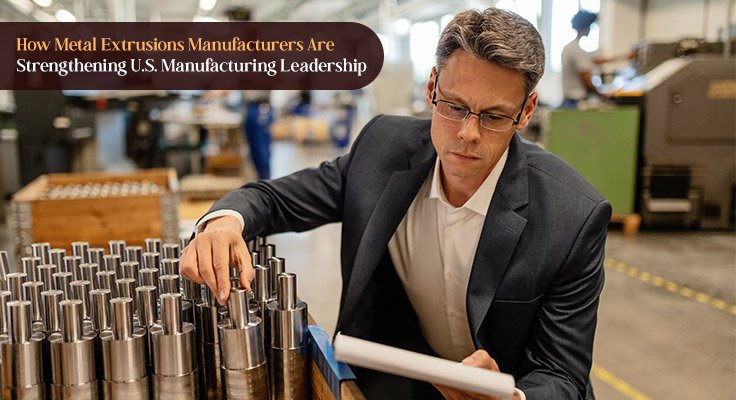
Metal extrusions manufacturers play an important role when companies need parts that are strong, repeatable, and efficient to produce at scale. Impact extrusion is especially valuable because it forms metal close to its finished shape instead of relying heavily on machining away excess material.
That matters to buyers, engineers, and operations teams because every production choice has a business consequence. More machining often means more scrap, more time, more tooling complexity, and more cost. A near-net-shape process helps reduce those pressures when the part design is a good fit.
For business leaders, this is a reminder that manufacturing innovation does not always look flashy. Sometimes it shows up in a part that uses less material, moves through production faster, and performs more consistently in the field.
The strongest suppliers do not simply quote a drawing. They look at the part, the material, the volume, the tolerances, and the customer’s current process. Then they help identify whether a better production path exists.
That kind of leadership is quiet, but it is highly valuable.
They Help Customers Think Beyond the Lowest Piece Price
A common mistake in manufacturing purchasing is focusing too narrowly on the price of a single part. A cheaper component is not always cheaper once scrap rates, rework, delays, assembly problems, and quality issues enter the picture. Experienced U.S. manufacturers help customers look at total value instead of unit price alone. That includes:
- Material utilization
- Production repeatability
- Secondary machining requirements
- Assembly efficiency
- Quality inspection needs
- Delivery reliability
- Long-term performance in the field
This is where Metal extrusions manufacturers can bring a practical leadership mindset to the conversation. When a component can be formed closer to its final shape, companies often gain more than a lower material bill. They gain a cleaner production path and a more predictable supply chain.
Good manufacturing partners understand that customers are not only buying parts. They are buying confidence. They need to know that a component will arrive on time, meet specifications, and perform as expected once it reaches the next stage of production. That confidence has real business value.
They Support Critical Industries That Depend on Precision
Some manufacturing sectors have little room for inconsistency. Automotive companies need durable, lightweight, high-volume components. Medical suppliers need reliable parts where leaks, weak joints, or delivery delays create serious problems. Defense and industrial markets need components built around strength, accuracy, and repeatability.
Impact extrusion fits many of these demands because it can create hollow, thin-walled, symmetrical, and high-strength parts with strong dimensional control. In practical terms, that means manufacturers can support a wide range of applications without treating every part as a one-off challenge.
This kind of production capability matters because critical industries need suppliers that understand pressure. Not just mechanical pressure, but operational pressure. Customers often deal with tight timelines, changing demand, compliance needs, and product performance expectations.
A supplier with in-house engineering, tooling knowledge, machining capacity, finishing capabilities, and quality control resources can help reduce friction across the production process.
For leaders in critical industries, that combination is worth paying attention to. It helps turn manufacturing from a bottleneck into a more reliable part of the business strategy.
They Keep Engineering Close to the Shop Floor
One of the clearest signs of a strong manufacturing culture is the connection between engineering and production. When engineers understand what happens on the shop floor, they make better recommendations. When operators and tooling teams are part of the feedback loop, designs become more realistic and production becomes more stable.
This matters because a drawing is only one part of the story. A component also has to be formed, handled, inspected, finished, packed, and delivered. Small design decisions can affect every one of those steps.
- Manufacturers with deep process knowledge help customers evaluate details such as:
- Whether the geometry fits impact extrusion
- Which material supports the part’s strength needs
- Where tolerances are essential and where they create unnecessary cost
- Which secondary operations are required
- How tooling choices affect timeline and repeatability
- Whether volume justifies a more efficient production method
This is where manufacturing leadership becomes collaborative. The supplier is not acting as a passive vendor. It is helping the customer make better decisions before money is locked into tooling, production schedules, or inefficient methods. That early guidance often prevents larger problems later.
They Invest in Capacity Without Losing the Human Element
Modern manufacturing depends on technology, but machines do not create leadership on their own. Press capacity, CNC machining centers, robotic loading systems, automated lubrication lines, heat treating equipment, and inspection tools all matter. Still, the real value comes from the people who know how to use them.
A manufacturer with advanced equipment and experienced teams can manage more complex production demands. It can support higher volumes, tighter requirements, and more demanding industries. At the same time, long-tenured employees often carry the kind of practical knowledge that cannot be replaced by software or equipment alone.
That blend is important for U.S. manufacturing. Companies need automation and advanced equipment to stay competitive, but they also need skilled people who understand materials, tooling behavior, machine setup, inspection standards, and customer expectations.
The best manufacturing environments respect both sides. They invest in equipment, but they also invest in knowledge. They understand that experienced machinists, engineers, operators, quality teams, and sales professionals all contribute to the customer’s final result. That is a leadership lesson many industries can learn from.
They Strengthen Domestic Supply Chains
Recent years have reminded business leaders that supply chains are not just purchasing systems. They are risk systems. When companies rely too heavily on distant suppliers, long shipping routes, or fragmented production steps, small disruptions can become expensive problems.
Domestic manufacturing helps address some of those challenges. U.S. suppliers give customers greater visibility, easier communication, shorter travel distances, and more direct collaboration. For companies producing critical components, those advantages matter.
Metal extrusions manufacturers also support supply chain resilience by bringing multiple capabilities closer together. When engineering, tooling, impact extrusion, machining, heat treating, finishing, inspection, assembly, or kitting can be coordinated through a more connected production network, customers spend less time managing scattered vendors.
That does not mean every project should stay domestic for every reason. It means manufacturers and business leaders need to understand the full cost of complexity.
A supplier that can reduce handoffs, improve communication, and keep production closer to the customer provides value beyond the part itself.
They Make Sustainability More Practical, Not Performative
Sustainability in manufacturing is often discussed in broad language, but the most meaningful improvements are usually practical. Reducing material waste matters. Creating parts closer to their final form matters. Cutting unnecessary machining steps matters. Building components that last also matters.
Impact extrusion supports these goals in a direct way when the process fits the application. Less wasted metal, fewer secondary operations, and efficient high-volume production all contribute to a more responsible manufacturing process.
This is not about using sustainability as a marketing slogan. It is about making smarter use of materials and energy while still meeting performance demands.
For business leaders, that balance is important. Customers, investors, and procurement teams increasingly care about environmental responsibility, but they also care about cost, quality, and delivery. A realistic sustainability strategy has to serve all of those needs.
Manufacturers that improve efficiency at the process level give customers a practical path forward.
They Show That American Manufacturing Leadership Is Built Over Time
True manufacturing strength is rarely built quickly. It comes from decades of learning, adapting, solving production problems, investing in facilities, and keeping customer relationships intact through changing markets.
That long view matters in industries where trust is earned slowly. A manufacturer that has worked through different economic cycles, industry shifts, material challenges, and technology changes brings valuable perspective to every new project.
Metal extrusions manufacturers with deep histories are especially relevant because their work sits at the intersection of old and new manufacturing. The basic need is timeless: form reliable metal parts efficiently. The tools, expectations, materials, inspection methods, and customer requirements continue to evolve.
Leadership comes from honoring both realities. It means respecting proven methods while still improving equipment, engineering, automation, and production systems. That is the kind of thinking that keeps U.S. manufacturing competitive.
They Help Customers Move From Problem to Production
Manufacturing customers rarely come to suppliers with a simple need. They often arrive with a part that costs too much, takes too long to produce, creates too much scrap, fails under stress, or requires too many secondary steps. A strong supplier helps turn that problem into a production plan.
That process often starts with questions. What is the part used for? What material is required? What volumes are expected? Which tolerances are critical? What does the current process cost? Where are the production delays? What happens if the part fails?
The answers shape the path forward. In some cases, impact extrusion is the right solution. In others, another method makes more sense. The value of an experienced manufacturer is its ability to give grounded guidance instead of forcing every project into the same process.
That honesty builds stronger customer relationships. It also protects the manufacturer’s reputation because the goal is not just to win the job. The goal is to make the part successfully and consistently.
In Conclusion
U.S. manufacturing leadership is not always loud. Often, it is found in facilities where engineers, operators, tooling experts, quality teams, and production leaders work through complex problems with patience and discipline.
Metal extrusions manufacturers show how important that work remains. They help customers reduce waste, improve repeatability, support critical industries, strengthen supply chains, and make smarter production decisions. Their contribution is not only technical. It is strategic.
For business leaders, the lesson is clear. Strong manufacturing partners do more than supply components. They help companies build with greater confidence, better control, and a clearer path from design to finished product.