The USA Leaders | May 11, 2026
Quick Facts: Hantavirus Cruise Ship Outbreak 2026
| What | Details |
| Virus | Andes hantavirus — the only type that spreads person-to-person |
| Ship | MV Hondius (Dutch cruise ship) |
| Trip started | April 1, 2026 — Ushuaia, Argentina |
| Deaths | 3 confirmed |
| Total cases | 9 (as of May 10, 2026) |
| Death rate | ~38% in confirmed cases |
| Americans affected | 17 now in Nebraska + 7 monitored at home |
| US positive tests | 1 confirmed; 1 showing symptoms |
| Quarantine location | UNMC National Quarantine Unit, Omaha, Nebraska |
| Watch period | Up to 42 days |
| CDC alert level | Level 3 (standard activation) |
| WHO public risk | LOW |
What Happened on the MV Hondius Cruise Ship?
A dream vacation turned into a global health emergency.
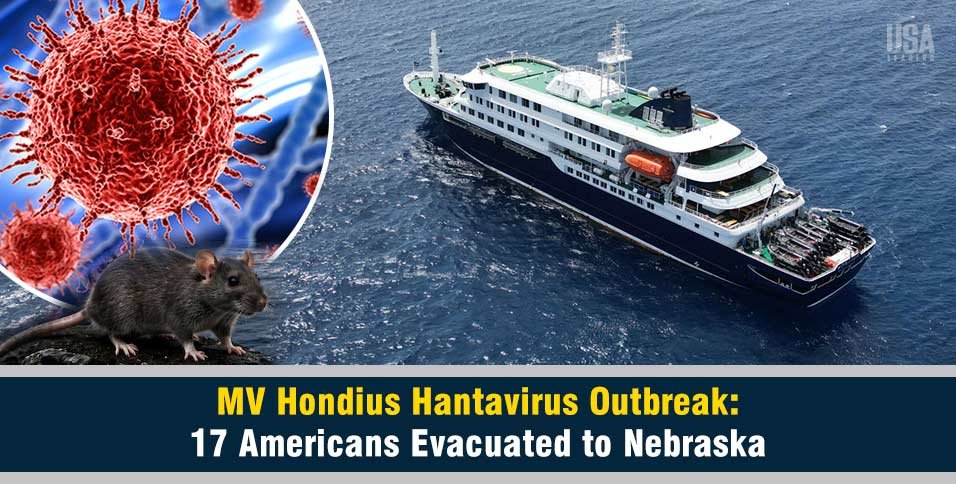
The MV Hondius left Ushuaia, Argentina, on April 1, 2026. Around 150 passengers and crew from 23 countries were on board. Tickets cost between €14,000 and €22,000 per person. The plan was to visit Antarctica and the remote South Atlantic islands.
By April 6, the first passenger was already sick. By April 11, he was dead.
What started as one case quickly became a multinational crisis with patients in eight countries, and 17 Americans are now under medical watch in Nebraska.
How Did the Hantavirus Outbreak Start? — Origin of the Andes Virus
The outbreak did not begin on the ship. It began in South America.
The first patient, a 70-year-old Dutch man, had spent four months traveling through Chile, Uruguay, and Argentina before boarding. He returned to Argentina just four days before the cruise departed. Argentina’s health ministry later confirmed he was likely exposed to the Andes hantavirus through contact with infected rodents during his trip.
Once on board, the virus spread from person to person, something most hantavirus strains cannot do.
Three Deaths Across Three Countries — The Full Hantavirus Timeline
The outbreak moved fast and crossed borders quickly.
April 11 — The Dutchman died on board. His body stayed on the ship until it stopped at Saint Helena on April 24.
April 24 — His 69-year-old wife left the ship at Saint Helena with stomach pain. She flew toward Johannesburg but collapsed trying to board a second flight. She was too sick to travel.
April 26 — She died at a hospital in Johannesburg. Lab tests later confirmed she had the Andes virus.
April 28 — A German woman on the ship developed a fever and felt very unwell.
May 2 — She died on board from pneumonia. Tests in the Netherlands confirmed the same virus strain.
May 2 — WHO received its first official report of the outbreak cluster.
May 8 — WHO confirmed 8 cases, 6 lab-confirmed as Andes hantavirus, with a 38% death rate among those who became seriously ill.
Andes Hantavirus Human Transmission — Why This Outbreak Is Different
Most hantavirus types only spread through rodent droppings, urine, or saliva. You can’t catch them from another person.
The Andes virus is the only exception.
Per the CDC’s official outbreak FAQ, the Andes virus spreads through close, extended contact with a sick person — things like sharing utensils, kissing, or being near their coughs and body fluids. It does not spread through the air like COVID-19 did.
On a cruise ship with shared dining rooms, narrow hallways, and small cabins, avoiding close contact is nearly impossible. That is how one sick passenger became nine cases across 23 nationalities.
Global Hantavirus Outbreak Response — Spain, WHO, and the World Reacts
Getting the ship to a safe port was not simple.
The MV Hondius stopped in Cape Verde for three days, but local hospitals could not handle the situation. The ship then headed to Tenerife in Spain’s Canary Islands.
Spain’s regional leader initially refused to let the ship dock, worried about spreading the virus to the island’s tourism-heavy population. Spain’s national health minister overruled that decision on humanitarian grounds.
WHO Director-General Dr. Tedros Adhanom Ghebreyesus flew to Tenerife personally. He told the press directly, “This is not another COVID. The risk to the public is low. People shouldn’t be scared.”
The ship anchored offshore. Passengers were moved by boat to a special area of the airport with no contact with the public. On May 10, at 5:30 a.m., disembarkation began.
17 Americans Quarantined in Nebraska — The US Hantavirus Response
The US government moved quickly once the ship reached Tenerife.
The CDC sent a team to meet the 17 American passengers before they flew home. The State Department arranged a special medical flight. The destination: the National Quarantine Unit at the University of Nebraska Medical Center (UNMC) in Omaha — the only federally funded quarantine facility in the United States.
Two Americans needed extra care. One tested positive for the Andes virus on a PCR test (mild result). Another had mild symptoms. Both traveled in sealed medical units on the plane, separated from other passengers.
The flight landed at Offutt Air Force Base near Omaha. Most passengers were taken to UNMC for assessment. The two sicker passengers went directly to specialized treatment centers.
Nebraska Quarantine Unit Details — Inside America’s Only Federal Facility
Most people have never heard of this facility. That is exactly how it should be; it quietly prepares so it is ready when needed.
The National Quarantine Unit opened in November 2019, just before COVID-19 arrived. It was built with a $20 million federal grant. It features 20 private rooms, each equipped with its own air filtration system that prevents the spread of viruses throughout the building.
The staff is all volunteers — trained nurses, doctors, and health workers who practice for situations like this every three months.
This team has handled major outbreaks before:
- 2014 — Treated American Ebola patients
- 2020 — Received 13 Americans from the COVID-19 Diamond Princess cruise ship
Dr. Ali Khan, a public health dean at UNMC, welcomed the returning passengers simply: “You are coming to the premier facility in the United States, if not the world, to take care of you.”
Hantavirus Monitoring Period — What the 42-Day Watch Means
The Americans in Nebraska are not technically under a legal quarantine order. They are being monitored and assessed voluntarily.
After an initial check-up at UNMC, most will go home, where their local health departments will check in with them daily.
Why 42 days? That is the longest time the Andes virus can take to show symptoms after exposure. A person can feel completely fine and still develop the illness weeks later.
Early warning signs include:
- Fever over 38°C (100.4°F)
- Muscle pain in the legs, hips, or back
- Chills, nausea, vomiting, or stomach pain
- Shortness of breath
If symptoms appear, the patient moves immediately to the Nebraska Biocontainment Unit for full isolation and treatment. There is no approved vaccine and no specific cure. Doctors manage symptoms and support breathing while the body fights the virus.
Seven other Americans who left the ship earlier are already being watched at home in Texas, California, Georgia, and Virginia.
Is Hantavirus a Pandemic Risk? — What Experts Say
The short answer: no. But experts want the world to pay attention.
The Andes virus kills roughly 38% of patients who develop serious lung symptoms. That is a very high death rate. But it is also hard to catch, you need prolonged, close contact with someone who is already visibly sick.
Dr. Angela Hewlett, who leads the Nebraska Biocontainment Unit, said clearly: “I do not see this progressing to a worldwide pandemic, although there’s still a lot of unknowns.”
Public health experts, however, are pointing to a bigger concern. The US has just one federal quarantine facility with 20 rooms. The global response worked this time because the Andes virus has natural limits. A more contagious virus with the same death rate would look very different.
As one health law expert put it: if this had been a highly contagious virus, the world would have been in serious trouble.
The Bottom Line — Hantavirus Cruise Ship Update 2026
Three people died. Seventeen Americans are being watched in Nebraska. Patients connected to one cruise ship are now in hospitals or under monitoring across eight countries.
And yet experts call this a near-miss.
The Andes virus is deadly but hard to spread. The global response, while stretched, held together. America’s single federal quarantine facility received its most high-profile guests since the early days of COVID-19 and is doing the job it was built to do.
The 42-day clock is ticking. For the 17 Americans in Omaha, that clock is everything.
For the rest of the world, the MV Hondius is a reminder that in the age of global travel, a virus picked up on a remote road trip in Patagonia can cross the Atlantic and land in Nebraska in six weeks.
The question is not whether this can happen again. It is whether the world will be better prepared when it does.
Hantavirus Outbreak FAQs — Simple Answers to Common Questions
Can hantavirus spread on a plane?
A flight attendant who had contact with an infected passenger tested negative. No confirmed in-flight transmission has been found.
Should I cancel my cruise?
No. WHO and the CDC say the risk to the public is low. This is a contained cluster, not a community outbreak.
Is there a vaccine?
No. There is no approved vaccine and no specific antiviral treatment for hantavirus.
How long have the Americans been being watched?
Up to 42 days from their last known exposure to the virus.
Could this become the next COVID?
WHO says no. The Andes virus cannot spread through the air and requires sustained close contact. It does not have pandemic potential under current evidence.
Also Read – Ebola Outbreak 2026: WHO Declares Emergency: What Americans Need to Know