The USA Leaders | May 20, 2026
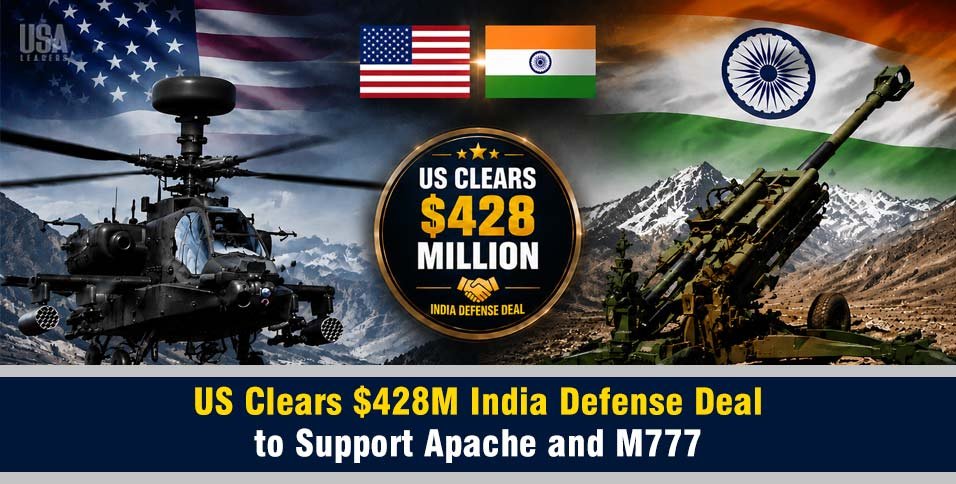
Washington has approved two military aid packages for India totaling $428.2 million. One package supports India’s attack helicopters, and the other funds its mountain artillery. Here’s the story in plain terms.
Quick Facts: The US-India $428M Defense Deal
| Detail | Info |
| Total Deal Value | $428.2 million (combined) |
| Deal 1 | $198.2M — Apache AH-64E helicopter sustainment |
| Deal 2 | $230M — M777A2 ultra-light howitzer sustainment |
| Approved By | US State Department (DSCA notification) |
| Prime Contractors | Boeing, Lockheed Martin (Apache); BAE Systems (M777A2) |
| Beneficiary | Indian Air Force & Indian Army |
| Strategic Purpose | Indo-Pacific security, India border defense |
| Regional Impact | Assessed as not altering regional military balance |
Last week, the US State Department approved more than routine paperwork. It cleared two defense support deals with India worth $428.2 million. This isn’t just about spare parts or manuals “sustainment” ensures India’s top frontline systems stay fully operational. Washington’s commitment sends a message that goes far beyond the price tag.
The US-India defence deal in plain numbers — who approved it and what it covers
On May 19, 2026, the US State Department approved two military support packages for India, totaling $428.2 million. Each package supports a different weapon system crucial to India’s national security. These are not new purchases but long-term agreements that help maintain existing equipment at peak performance, highlighting the strategic importance of the deal.
$198.2 million for AH-64E Apache helicopter maintenance — what India actually gets
The $198.2 million package provides follow-on support for India’s AH-64E Apache helicopters, including engineering and technical help, logistics, training, and technical manuals.
Boeing and Lockheed Martin, two of America’s largest defense contractors, are securing long-term revenue from one of the fastest-growing defense markets, a solid win for their shareholders.
$230 million for M777A2 howitzer spare parts — keeping India’s high-altitude artillery battle-ready
The second package, worth $230 million, provides long-term support for India’s M777A2 ultra-light howitzers, including spare parts, repairs, training, technical help, and logistics.
BAE Systems will be the main contractor. The company has long-standing ties to India’s howitzer program, including a key assembly partnership with Mahindra Defence, which we’ll discuss soon.
India’s Apache attack helicopter fleet — a decade of buying American and why it continue
India’s connection with the Apache helicopter didn’t begin this week. It has developed over more than a decade through two separate purchases and increasing use of one of the world’s most advanced attack aircraft.
The AH-64E is the most advanced Apache helicopter, designed for modern networked warfare. With its Longbow radar, it can attack targets anytime, in any weather. India’s choice to adopt it was a deliberate strategic move.
28 Apaches and counting — how the India Air Force helicopter deal grew from 2015 to today
India now has 28 AH-64E Apache helicopters. The Indian Air Force bought 22 in a 2015 US military deal, and the Indian Army received six under a 2017 contract.
Timeline: The Road to the $428.2M US-India Defense Deal
| Year | Milestone & Platform Focus | Strategic Significance |
| 2015 | Air Force Apache Acquisition | The Indian Air Force secures 22 advanced AH-64E Apache attack helicopters in a major U.S. foreign military sale. |
| 2016 | M777 Artillery Contract | India signs a $750 million agreement for 145 M777A2 ultra-light howitzers, laying the groundwork for today’s support package. |
| 2017 | Army Apache Expansion | The Indian Army followed up with its own dedicated contract to add 6 additional Apaches to its fleet. |
| 2021 | Local Production Operational | Final M777A2 deliveries are completed as the local BAE Systems–Mahindra Defence assembly and maintenance line becomes fully operational. |
| 2026 | The $428.2M Support Chapter | The US State Department officially clears the combined sustainment deal to keep these exact frontline air and land assets mission-ready. |
What Boeing and Lockheed Martin will actually do under the new military aviation support contract
Under the Apache support program, Boeing provides airframe engineering and system integration, while Lockheed Martin manages the avionics, sensors, and targeting systems that make the AH-64E highly effective in challenging terrain.
Foreign military sustainment contracts are usually more stable than first-time purchase deals. Once a military bases its operations on a platform, changing it becomes very costly and complicated. India isn’t changing course, it’s investing even more.
The M777 howitzer India story — why a lightweight gun is India’s most important border weapon
The M777A2 isn’t just any artillery. For India, it’s a crucial weapon, especially because of one key region: Ladakh.
Traditional heavy artillery can’t work in India’s high-altitude, rugged northern borders. Roads are scarce, and supply lines are weak. Weighing around 4,200 kg, the M777A2 is light enough to be carried by a Chinook helicopter and placed precisely where needed, even above 4,000 meters.
“The M777A2 can go where other guns can’t. That isn’t just a tactical advantage in Ladakh, it’s the only option.”
145 guns, one Ladakh border deployment: how India uses the M777A2 ultra-light howitzer in the mountains
India has 145 M777A2 howitzers, bought from the US in a $750 million deal in 2016 and fully delivered by 2021. They are mainly deployed in high-altitude areas, especially along the Line of Actual Control with China in Ladakh.
The 2020 Galwan Valley standoff highlighted the need for stronger mountain artillery in India. The M777A2, with its long range, precision, and lightweight design, was quickly deployed to forward positions where heavier guns couldn’t reach.
BAE Systems and Mahindra Defence — the Make in India defence partnership that assembled 120 of these guns locally
The first 25 M777A2 howitzers were fully imported from the US, ready for use. The remaining 120 were assembled, integrated, and tested in India through a collaboration between BAE Systems and Mahindra Defence.
This is more than just a purchase, it’s a tech transfer, an industrial partnership, and a jobs initiative all in one. It also shows India’s ‘Make in India’ defence policy: import some, manufacture the rest locally.
Why the US-India military partnership keeps growing and what the Indo-Pacific security strategy has to do with it
Washington didn’t approve $428 million for Indian defense support just for paperwork. Every US arms deal serves a strategic goal, and here, the purpose is clearly stated by the State Department.
According to the agency, the potential sale would “support the foreign policy and national security objectives of the United States” by strengthening ties with New Delhi. The department explicitly stated that the proposed sale will “improve India’s capability to meet current and future threats, strengthen its homeland defence, and deter regional threats.”
“Deter regional threats” is diplomatic language with a fairly unambiguous geographical address.
What the US State Department foreign military sale approval really means for India’s relationship with America
The US-India defence relationship didn’t happen overnight. It has been two decades in the making from the landmark 2005 Defence Framework Agreement to the BECA geospatial data-sharing pact in 2020 and the current wave of platform-level cooperation.
India is the world’s largest arms importer. It’s also a democracy of 1.4 billion people sharing a 3,488-kilometre land border with China. Washington doesn’t need a map to understand that arithmetic. These two $428M deals are the latest chapter in what is arguably the most consequential bilateral defence relationship of the 21st century.
The US also confirmed: The approved sales will not alter the regional military balance, nor will they affect American defence readiness. That’s the standard DSCA assurance but its inclusion signals that Washington ran the geopolitical risk calculus carefully before signing off.
What the India defence modernisation pipeline means for US arms exports in 2026
For investors and industry analysts following the US defence sector, this week’s announcement is not an isolated data point. It’s a confirmation of a long-term trend that shows no sign of slowing down.
India’s defence budget has grown consistently over the past decade, crossing $75 billion in recent years. Its stated goal is to reduce import dependence over time but the paradox is that it needs to buy more foreign equipment now in order to eventually produce less of it later.
Why defence sustainment contracts are more valuable than new weapons deals and India proves it
New procurement deals get the headlines. Sustainment contracts quietly generate revenue. For Boeing, Lockheed Martin, and BAE Systems, this week’s approvals represent recurring, long-term income that is far less subject to budget cycles and political risk than fresh sales would be.
Once a military bases its operations on a system like India has with the Apache and M777A2 switching becomes very costly. India won’t replace its Apache helicopters with Chinese ones. Support and maintenance are tied to these platforms for their entire lifespan, which could last 20–30 more years.
That’s the kind of revenue visibility that institutional investors and defence sector analysts find very attractive even if “spare parts contract approved” rarely makes a front page.
What comes next in the India US defence cooperation story drones, jet engines, and a much bigger pipeline
The $428.2 million approved this week is, in the grand scheme of the US-India defence relationship, essentially a maintenance invoice. The bigger headline deals are still being negotiated.
India has been in active discussions or early negotiations for MQ-9B SeaGuardian surveillance drones, additional P-8I Poseidon maritime patrol aircraft, and most consequentially potential GE F414 jet engine technology transfer for India’s indigenously built Tejas Mk2 fighter jet.
If the engine deal closes, it would represent a level of technology sharing between the US and India that was simply unthinkable twenty years ago. The $428M approved this week is a foundation stone, not a capstone.
The bottom line:
Washington didn’t just approve spare parts. It reaffirmed a long-term strategic bet on India as the cornerstone of its Indo-Pacific architecture. For Boeing, Lockheed Martin, and BAE Systems it’s recurring revenue. For India’s armed forces it’s operational continuity. For anyone watching the balance of power in Asia, it’s one more data point in a trend that only runs in one direction.
Also Read – The 10 Largest Economies in the World (2026): Is the U.S. Still #1?