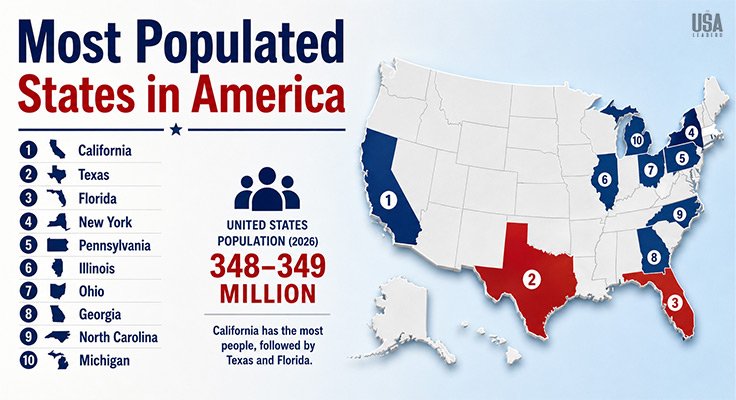
California is the most populated state in the United States, with over 39.3 million people. Texas and Florida follow next. Together, the ten most populated states are home to more than half of the country’s nearly 348 million residents, according to the latest Census data and 2026 population estimates.
How Many People Live in the US?
In 2026, the United States had about 348–349 million people, making it the third most populated country after India and China. The U.S. population was around 347 million in 2025, and growth has slowed to about 0.5% per year, the slowest rate since the COVID-19 pandemic.
The U.S. population is not evenly spread across all states. Just nine states are home to more than half of the country’s people, while the 25 least populated states together account for less than one-sixth of the total population. Our guide to how many states are in the USA covers the full civics picture.
This concentration is more than just a fact. Businesses use state population data to choose store locations and plan advertising. Policymakers rely on it to understand elections, and marketers use it to see where most spending power in the US is located.
Some people call this ranking the “most popular states in America,” but popularity and population are different. Most of the time, people mean the state with the most residents and by that measure, California ranks first.
The 10 Most Populated States in America (2026)
Below is a list of U.S. states ranked by population, from largest to smallest, along with each state’s share of the total U.S. population. This ranking clearly shows that a large portion of the country’s population lives in just a few big states.
| Rank | State | 2026 Population | Share of US Population |
| 1 | California | 39,345,844 | 11.3% |
| 2 | Texas | 32,101,064 | 9.2% |
| 3 | Florida | 23,659,198 | 6.8% |
| 4 | New York | 20,003,435 | 5.7% |
| 5 | Pennsylvania | 13,073,016 | 3.8% |
| 6 | Illinois | 12,735,249 | 3.7% |
| 7 | Ohio | 11,940,399 | 3.4% |
| 8 | Georgia | 11,401,288 | 3.3% |
| 9 | North Carolina | 11,343,875 | 3.3% |
| 10 | Michigan | 10,155,806 | 2.9% |
- California is the most populated state in the U.S., with about 39.3 million people, making up nearly 11% of the country’s population. It is home to major cities like Los Angeles and leading tech hubs in the Bay Area, and it has one of the world’s largest economies.
- Texas is the second most populated state in the U.S., with about 32.1 million people, and it is growing fast due to strong job opportunities, no state income tax, and people moving in from other states.
- Florida is the third most populated state in the U.S., with about 23.6 million people. Its warm weather, strong tourism, and no state income tax attract retirees, remote workers, and businesses.
- New York has about 20 million people, and nearly half live in New York City, making it the most populated state in the Northeast.
- Pennsylvania has a population of about 13 million and is an important state in the mid-Atlantic region. It is known for its industrial history, with Philadelphia and Pittsburgh as its largest cities.
- Illinois is the sixth most populated state in the U.S., with about 12.7 million people. Most of its population lives in the Chicago metropolitan area.
- Ohio has a population of 11,940,399, spread across several mid-sized metro areas, including Columbus, Cleveland, and Cincinnati, rather than one dominant city.
- Georgia’s population has reached 11,401,288 residents, driven largely by Atlanta’s continued growth as a business and logistics hub.
- North Carolina has grown to 11,343,875 residents, making it one of the fastest-growing larger states, driven by the Research Triangle and strong in-migration.
- Michigan ranks 10th in population, with about 10.15 million people, led by Detroit and its strong automotive industry.
Why Are These States So Populated?
Only a few key reasons explain why most people live in just a few states. When you look at U.S. states by population, the same patterns appear again and again.
- Economic opportunity:States such as Texas, California, Florida, and Georgia have large job markets, many big employers, and in some cases, no state income tax.
- Climate and lifestyle: Warm states like Florida, Texas, and Arizona are popular choices for retirees and people who work remotely.
- Historic settlement and major cities: New York, Pennsylvania, Illinois, and Ohio grew large because of manufacturing and trade, which still support their economies today.
- Coastlines and borders: States on the West Coast, East Coast, and along the southern border usually have more people, while states in the Great Plains and Midwest have fewer residents.
California’s economy is so large on its own that it would rank among the richest countries in the world if it were an independent nation, which helps explain why it keeps attracting new residents despite its high cost of living.
The Largest Cities in America (And Which States They’re In)
State population numbers don’t tell the full story. In many large states, growth comes mainly from one or two big cities. New York City alone makes up nearly 40% of New York State’s population, while metro Atlanta accounts for most of Georgia’s growth.
| Rank | City | State | Population |
| 1 | New York City | New York | 8,335,000+ |
| 2 | Los Angeles | California | 3,878,704 |
| 3 | Chicago | Illinois | 2,721,308 |
| 4 | Houston | Texas | 2,390,125 |
| 5 | Phoenix | Arizona | 1,673,164 |
| 6 | Philadelphia | Pennsylvania | 1,550,000+ |
| 7 | San Antonio | Texas | 1,526,656 |
| 8 | San Diego | California | 1,404,452 |
| 9 | Dallas | Texas | 1,326,087 |
| 10 | Austin | Texas | 1,000,000+ |
New York City is the largest city in the United States, with over 8.3 million people. It has more residents than Los Angeles and Chicago combined. Los Angeles has about 3.9 million people, while Chicago has around 2.7 million.
Southern and western cities make up most of the top 10. Texas has four cities on the list Houston, San Antonio, Dallas, and Austin, matching California for the highest number. Phoenix and San Diego also appear, showing strong growth across the Sun Belt.
Which State Has the Most Large Cities?
California has the highest number of cities with more than 100,000 people about 78. Texas follows with around 47 cities, and Florida has about 32. These many large and mid-sized cities together help keep these states among the most populated in the U.S., rather than relying on just one big metro area.
Texas is unique because it has four cities, Houston, San Antonio, Dallas, and Austin, in the national top 10. Instead of growth in one major city like New York, Texas spreads its population growth across multiple cities.
The Least Populous US State – A Sharp Contrast
Wyoming is the least populated state in the U.S., with about 590,000 people in 2026. That is fewer people than many mid-sized cities, making Wyoming the clearest example of the least populous state.
Some of the least populous states, including Wyoming and Mississippi, also appear on lists of the poorest states in America, though population size and income levels don’t always move together. Rhode Island, for example, is the smallest state by land area, yet it has a higher population than Alaska, North Dakota, South Dakota, and Wyoming combined.
State Population Trends Heading Into 2026
The population of U.S. states differs a lot. California has tens of millions of people, while Wyoming has only a few hundred thousand. Many Sun Belt states such as South Carolina, Idaho, North Carolina, Texas, and Utah are growing the fastest. In contrast, some states in the Northeast and Midwest, including Vermont, Hawaii, West Virginia, and New Mexico, are seeing little growth or small population declines.
Fastest-Growing vs. Slowest-Growing States
- Fastest-growing: South Carolina, Idaho, North Carolina, Texas, and Utah are growing the fastest each year, mainly because many people are moving there from other states, not just because of births.
- Slowest-growing or shrinking: Vermont, Hawaii, West Virginia, and New Mexico and, sometimes, New York and Illinois have seen little or no growth. This is mainly due to high living costs and people moving to other states.
Domestic migration is the main reason, not birth rates. More Americans are moving to states with cheaper housing, low or no state income tax, and warmer weather. Experts expect this trend to continue for the rest of the decade.
For a more local view of how these state totals break down by county, see our guide to how many counties are in the US. And if income, not just population, is what you’re comparing across states, our breakdown of the richest states in America pairs well with this ranking.
How We Sourced and Verified This Data
All numbers in this article come from trusted public and government sources, not guesses. State population data is taken from the U.S. Census Bureau’s 2025 estimates and verified using World Population Review and Wikipedia. City population figures are based on the same census data, along with rankings from Britannica.
- Primary source: U.S. Census Bureau Population Estimates Program (Vintage 2025), the official federal source for state and city population data.
- Cross-reference sources: World Population Review, Wikipedia’s List of U.S. states and territories by population, and Britannica were used to confirm rankings and catch any discrepancies between sources.
- Update cadence: This blog is reviewed whenever the Census Bureau releases new vintage estimates, typically once a year, so the rankings reflect the most current available data rather than outdated census-year figures.
When sources showed small differences due to rounding or update timing, we used the latest Census Bureau-based data and treated the number as an estimate, not an exact count.
Conclusion
Texas is likely to stay among the top five most populated states by 2030. It is expected to grow faster than New York and increase its lead over other states. By 2030, Texas may reach around 35.2 million people. Florida is also growing quickly but is unlikely to surpass Texas.
FAQs
- Which US state has the smallest population?
Wyoming is the least populous US state, with roughly 590,000 residents as of 2026.
- How many people live in the United States in 2026?
The US population is estimated at approximately 348 to 349 million people in 2026, according to Census Bureau projections.
- What is the most popular state in America?
By population, California is often called the most popular state in America, though the term actually refers to population size rather than preference or popularity.