California is the richest state in the U.S. by GDP, producing $4.1-$4.3 trillion a year, more than the entire economy of Japan. This blog post ranks the 10 richest states in America based on GDP, the most widely used measure of economic health, and breaks down what’s actually driving each one’s wealth, from trade and innovation to natural resources and education.
The median household income in the United States sits at roughly $83,000 a year. It is a very different number from the trillion-dollar GDP figures below, since GDP reflects the size of a state’s entire economy, not individual paychecks.
By the end of this blog, you will have a clear picture of the most wealthy states in the US in terms of nominal GDP per capita by state, what makes each one unique, and a few practical takeaways if you’re considering where to grow a business or a career.
List of Top 7 Richest States in America by GDP (2025 BEA Data)
| Rank | State | 2025 Nominal GDP | Nominal GDP Growth (YoY) | Primary Growth Drivers |
| 1 | California | $4.25 Trillion | 6.3-6.5% | Tech equities, Professional Services, Healthcare |
| 2 | Texas | $2.90 Trillion | 2.5% | Oil & Gas exploration, Manufacturing |
| 3 | New York | $2.47 Trillion | 5.7% | Financial Markets, Silicon Alley Tech, Real Estate |
| 4 | Florida | $1.84 Trillion | 6.5% | Population influx, Tourism, Real Estate development |
| 5 | Illinois | $1.20 Trillion | 4.7% | Financial Services, Advanced Logistics |
| 6 | Pennsylvania | $1.06 Trillion | 4.9% | Industrial Manufacturing, Healthcare systems |
| 7 | Ohio | $0.97 Trillion | 4.8% | Industrial Production, Export Trade |
Note: The growth rates above are based on the U.S. Bureau of Economic Analysis (BEA) and reflect nominal GDP growth, meaning they include inflation. Real, inflation-adjusted growth for most of these states runs closer to 2 to 3% a year, in line with the national average.
1. California

- Nominal GDP: ~$4.3 Trillion
- GDP Per Capita: ~$107,800
- Population: 39.4 million
California ranks first on the list of the richest states in America. If California were its own country, its economy would rank among the five largest in the world. The key economic sectors influencing California’s GDP are financial services, real estate, information technology, and manufacturing.
Financial Services and Real Estate: The finance, insurance, real estate, rental, and leasing industries contribute more to California’s GDP than any other sector.
California has a thriving and diverse financial industry, with numerous banks, insurance companies, venture capital firms, and asset managers doing business there. High demand for housing, particularly in coastal cities, also keeps real estate values climbing.
Information Technology: Silicon Valley, the global hub of innovation and technology, is located in California and is home to many of the world’s most valuable technology businesses, including Apple, Alphabet, and Nvidia. California is also well represented in biotechnology, aerospace, and entertainment.
Manufacturing: California’s manufacturing industry is diversified and advanced, producing a wide range of goods such as computers, electronics, machinery, chemicals, food, beverages, and transportation equipment. The state also leads the country in renewable energy production, including solar, wind, and hydroelectric power.
These are some of the main factors that contribute to California’s GDP. Other sectors, including health care, education, tourism, and agriculture, also play a meaningful role in the state’s economy.
2. Texas

- Nominal GDP: $2.90 Trillion
- GDP Per Capita: ~$92,650
- Population: 31.3 million
Texas has the second-largest economy in the United States, with the second-highest GDP in the country. A few sectors drive most of that output.
Oil and Gas: Oil and gas account for roughly 9% of Texas’s GDP, making it the state’s largest sector. Texas remains the leading producer of crude oil and natural gas in the U.S., and that industry supports many others, including transportation, construction, and finance.
Trade: Texas exports tens of billions of dollars in goods annually, with the state’s economy ranking among the largest in the world on its own. Texas maintains strong trade relationships with Mexico, Canada, and China, helped by its strategic location, large ports, and free trade agreements.
Manufacturing: Texas has a diverse and advanced manufacturing industry, producing chemicals, machinery, food, beverages, and transportation equipment. The state is also a leader in renewable energy production, particularly wind and solar power.
Information Technology: Texas has a vibrant and growing technology industry, with companies and startups operating across software, hardware, telecommunications, biotechnology, and aerospace.
3. New York

- Nominal GDP: $2.47 trillion
- GDP Per Capita: $123,369
- Population: 19.8 million
New York is one of the richest U.S. states, with its economy driven mainly by financial services, real estate, and information technology. Finance, insurance, and real estate together account for nearly half of the state’s total economic output, making them major contributors to New York’s GDP.
Financial Services: New York boasts a large and diverse financial industry, with many banks, insurance companies, venture capital firms, and asset managers operating in the state. High demand for housing, especially in New York City, keeps real estate values elevated.
Information Technology: New York is home to Silicon Alley, the East Coast hub of innovation and technology, where companies like IBM, Verizon, and Spotify are based. The state also has a strong presence in biotechnology, aerospace, and entertainment.
New York ranks among the top states for GDP per capita nationwide, meaning its economy produces more value relative to its population than almost anywhere else in the country.
4. Florida
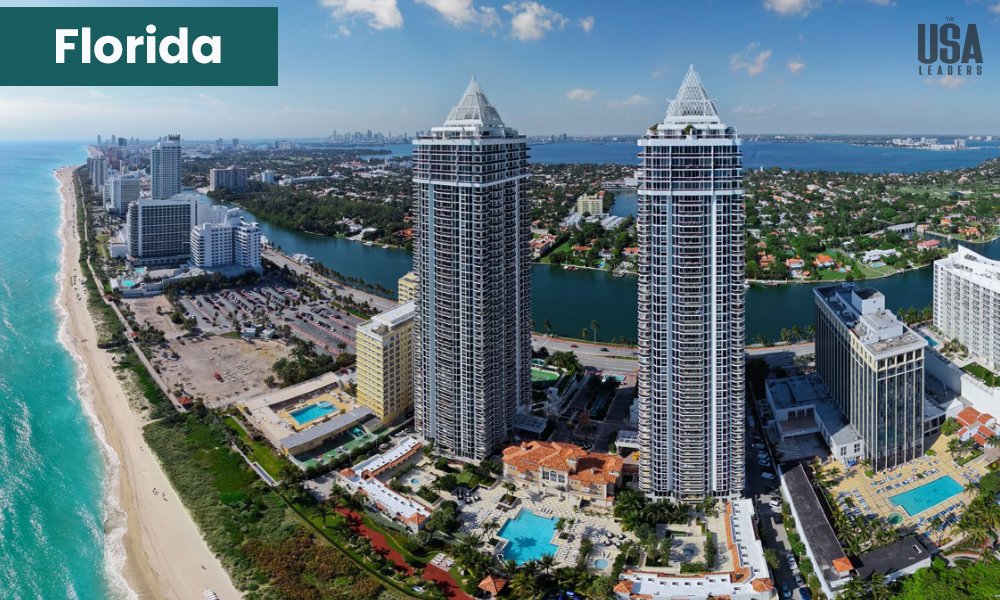
- Nominal GDP: $1.84 trillion
- GDP Per Capita: ~$78,600
- Population: 23.4 million
Florida has the fourth-largest economy in the U.S., and it has been one of the fastest-growing large state economies in the country in recent years. The main economic sectors influencing Florida’s GDP are trade, tourism, real estate, and agriculture.
Trade: Florida has a strong trade relationship with Latin America, Europe, and Asia, helped by its strategic location, large ports, and free trade agreements.
Tourism: Florida is the most visited state in the U.S., drawing well over 130 million visitors a year. Beaches, theme parks, wildlife attractions, and cultural events appeal to both domestic and international tourists alike.
Real Estate: Florida faces high demand for housing, especially in coastal cities, which keeps pushing up property values. The state also has a large and diverse rental market, home to many retirees, seasonal residents, and immigrants.
Agriculture: Florida is the leading U.S. producer of citrus fruits, sugarcane, tomatoes, and other crops, alongside a sizable livestock, dairy, and aquaculture industry.
5. Illinois

- Nominal GDP: $1.20 trillion
- GDP Per Capita: $94,503
- Population: 12.7 million
Illinois ranks fifth on the list of the wealthiest states in the US. The main economic sectors influencing the state’s GDP are manufacturing, real estate, financial services, and professional and technical services.
Financial Services and Real Estate: Illinois has a large and diverse financial industry, with many banks, insurance companies, venture capital firms, and asset managers operating in the state.
Information Technology: Illinois is home to Silicon Prairie, the Midwest hub of innovation and technology, where companies like Motorola, Groupon, and Grubhub are based.
Manufacturing: Illinois has a diverse and advanced manufacturing industry, producing chemicals, machinery, food, beverages, and transportation equipment. The state is also a leading producer of renewable energy, including solar, wind, and geothermal power.
6. Pennsylvania

- Nominal GDP: $1.06 trillion
- GDP Per Capita: $80,895
- Population: 13.0 million
Manufacturing, real estate, and healthcare together make up more than a third of Pennsylvania’s GDP.
Manufacturing: Pennsylvania has a long history of industrial production, especially in steel, coal, and chemicals, alongside machinery, food, beverages, and transportation equipment.
Financial Services: Pennsylvania has a large and diverse financial industry, with many banks, insurance companies, venture capital firms, and asset managers operating in the state.
Education: Pennsylvania has a high-quality and diverse education system, with many public and private schools, colleges, and universities that help attract and support a wide range of industries.
7. Ohio

- Nominal GDP: $0.97 trillion
- GDP Per Capita: ~$82,780
- Population: 11.8 million
The main economic sectors influencing Ohio’s GDP are merchandise exports (manufacturing, trade, health care, and education).
Manufacturing: Ohio remains one of the largest manufacturing sectors among U.S. states and has a long history of industrial production, especially in steel, coal, and chemicals.
Trade: Ohio exports tens of billions of dollars in goods annually and ranks among the top ten exporting states in the country. The state has strong trade relationships with Canada, Mexico, and China.
Healthcare and Education: Ohio has a strong healthcare industry, with many hospitals, clinics, research centers, and pharmaceutical companies, supported further by a high-quality education system across its public and private colleges and universities.
Conclusion
A few patterns stand out once you look at all 7 of these economies side by side.
The richest states in the U.S. are no longer leaning on a single industry to carry them. California blends tech, finance, and entertainment. Texas pairs energy with a fast-growing tech corridor of its own.
That diversification is exactly why these states keep strengthening their economic lead. A downturn in one sector rarely sinks the whole state economy anymore, and that resilience is part of what makes them attractive for business expansion in the first place.
If you’re weighing where to grow a business, build a career, or relocate, total GDP matters less than what’s actually driving it. Looking at GDP per capita by state can also give you a clearer picture of how much economic value is generated relative to population.
A trillion-dollar economy fueled by one aging industry is a very different bet from one built on five or six complementary sectors. Match your own industry to where the growth is concentrated, not just to the size of the headline number.
Neelmani Yadav
FAQs
What is the richest state in America by GDP?
California is the richest state in America, with a nominal GDP of $4.25 trillion, accounting for roughly 13.8% of the entire United States economy.
Is Texas richer than New York?
Yes, when measured by total economic output, Texas is larger than New York, with a GDP of $2.90 trillion compared to New York’s $2.47 trillion, although New York still has a higher GDP per capita, at $123,369 versus Texas’s ~$92,650.
What are the top 5 largest state economies in the US?
The five largest state economies in the United States are California, Texas, New York, Florida, and Illinois.
Which U.S. state has the highest GDP per capita?
Among the 50 states, New York holds the highest GDP per capita (~$123,369). However, including federal districts, Washington, D.C. far surpasses every state at over $277,000 per resident due to high federal economic concentration.