The USA Leaders
April 2, 2026
SpaceX is going public, and it’s not leaving space behind.
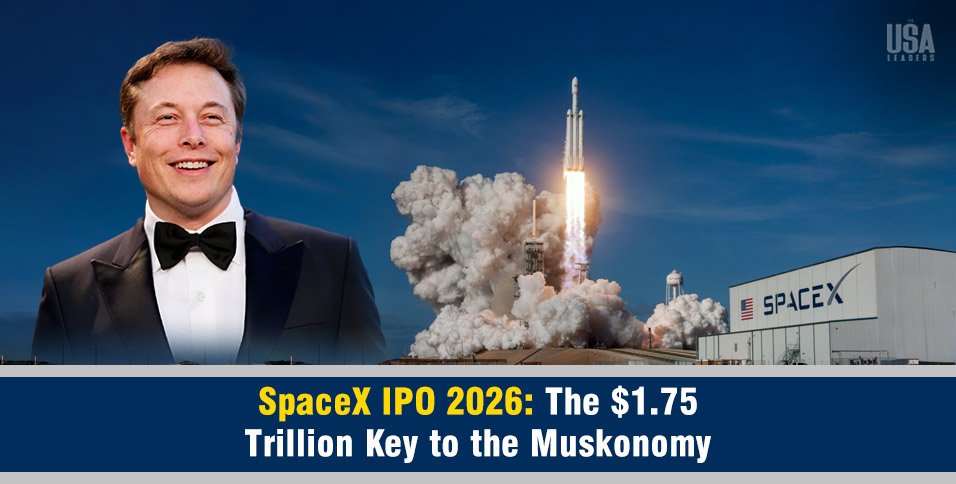
SpaceX filed confidentially with the U.S. Securities and Exchange Commission on April 1, 2026. The SpaceX IPO 2026 targets a $1.75 trillion valuation, making it one of the largest public offerings ever recorded.
This filing signals a significant shift in how investors view the space sector. Elon Musk’s personal net worth reached approximately $340 billion as of early 2026.
This announcement also highlights the rise of what analysts call the Muskonomy. This concept describes an interconnected ecosystem that combines rockets, satellites, artificial intelligence, and defense contracts under a single technological framework.
A key step in building this system came through the SpaceX xAI Merger, which integrated the AI capabilities of xAI with the satellite network operated by the Starlink unit.
As a result, the Muskonomy positions SpaceX as more than a launch provider. It turns the company into a global infrastructure platform that connects space transportation, communications, and artificial intelligence.
Why Now: The Three Pillars Behind the SpaceX IPO 2026
1. The AI Integration: The SpaceX xAI Merger
The SpaceX xAI Merger marks the biggest strategic shift driving the SpaceX IPO listing. In March 2026, xAI integrated its artificial intelligence capabilities with the satellite network operated by SpaceX.
This integration created Orbital AI Data Centers, a new infrastructure model for artificial intelligence computing.
Instead of relying entirely on massive Earth-based facilities, AI processing can move into orbit through the Starlink constellation.
Satellites can process data closer to users while avoiding the extreme energy costs of land-based data centers.
Large AI facilities consume enormous amounts of electricity and require significant land. Orbital computing reduces both requirements.
As a result, the SpaceX xAI Merger strengthens Starlink Unit economics and increases the network’s profit margins.
Because of this shift, SpaceX now operates as more than a launch company. It is evolving into an AI infrastructure platform operating in orbit.
2. Starlink Unit Maturity
The Starlink Unit reached more than 10 million global subscribers by early 2026. This milestone significantly changed the company’s financial risk profile.
What started as a capital-intensive experiment has grown into a stable global telecom business.
Current metrics highlight the scale of the operation:
- 2025 revenue: $16 billion
- Global subscribers: 10+ million
- Monthly ARPU: about $90
These figures show consistent recurring revenue. That stability supports the $1.75 trillion valuation targeted for the SpaceX public market entry.
As a result, many public investors now see the Starlink Unit as a satellite broadband platform with monopoly-level reach, rather than an uncertain space experiment.
3. The Golden Dome Mandate
National security forms the third pillar behind the SpaceX IPO 2026.
The United States government is advancing the Golden Dome missile defense system, a satellite-based network designed to track and monitor hypersonic threats. Developing this system requires tens of thousands of satellites in orbit.
SpaceX already operates the world’s largest satellite constellation through the Starlink network.
This existing infrastructure places the company in a strong position to deploy the Golden Dome system.
However, the scale of the project requires massive capital. Public markets can provide that funding far faster than private investment rounds.
For that reason, the proposed offering has become a critical financing step for the next phase of orbital infrastructure development.
The Financial Crunch: What Forced the IPO
- Starship and the 2026 Mars Window
The timing of Mars missions plays a major role in pushing SpaceX toward a public listing.
The Earth-Mars transfer window opens in late 2026, and the company plans to launch five uncrewed Starship missions during this period. These missions will test cargo delivery systems designed to support future Mars colonization.
Each Starship launch costs hundreds of millions of dollars. At the same time, expanding launch infrastructure and increasing manufacturing capacity requires billions in immediate capital.
Private funding rounds cannot provide liquidity at this scale, which increases the need for public market financing.
To support the offering, major financial institutions have stepped in as lead underwriters. These include Goldman Sachs, Morgan Stanley, and JPMorgan Chase.
Early reports suggest the proposed public offering could raise between $50 billion and $80 billion, making it one of the largest capital raises in modern market history.
- Retail Investor Strategy
Another notable feature of the planned offering is the strong focus on retail investors.
SpaceX plans to allocate about 30% of shares to retail investors during the public listing. This move could transform Elon Musk’s global fan base into long-term shareholders.
Retail participation may also reduce the influence of hedge funds that sometimes attempt aggressive short selling after a major IPO.
In effect, the Muskonomy converts loyal users into financial stakeholders. Through direct ownership, supporters become investors in the same ecosystem that includes rockets, satellites, and artificial intelligence.
This strategy could strengthen market stability and build long-term support for the company once its shares begin trading.
The Risk Assessment
- Key Man Risk
Investor concerns about leadership concentration remain a major risk factor for the planned listing of SpaceX.
Elon Musk currently leads or oversees several high-profile companies, including:
- Tesla
- SpaceX
- X Corp.
- Neuralink
Managing multiple high-growth companies raises questions about leadership bandwidth and strategic focus. Investors often evaluate whether one executive can effectively guide several complex organizations at the same time.
Because of this, leadership concentration around Musk remains a key factor that may influence investor confidence in the company’s upcoming public offering.
- Dual Class Shares
Corporate governance presents another challenge for the planned listing. SpaceX is expected to use a dual-class share structure that allows Elon Musk to retain majority voting control after the company goes public.
Under this structure, public investors receive economic exposure through share ownership but hold limited influence over strategic decisions.
Many founder-led technology companies adopt similar governance models. However, institutional investors often criticize dual-class structures for reducing shareholder voting power.
As a result, governance concerns could influence how large institutional funds participate in the upcoming offering.
Conclusion: A Launchpad, Not an Exit
The planned public offering by SpaceX functions primarily as a financing mechanism rather than a liquidity event.
The capital will support the next stage of the Muskonomy, the integrated ecosystem that connects rockets, satellites, artificial intelligence, and defense infrastructure.
Funds raised through the offering are expected to support four major initiatives:
- Starship production
- Orbital AI infrastructure
- Expansion of the Starlink unit
- Deployment of the Golden Dome satellite network
If the listing proceeds successfully in June 2026, SpaceX could become the largest aerospace company ever traded on public markets.
The offering could also strengthen Elon Musk’s financial position. Elon Musk’s net worth stood at roughly $340 billion in early 2026. At peak valuations following the listing, analysts project his wealth could approach $500 billion.
Beyond wealth creation, the capital raised would fund long-term space development projects. In particular, the financing supports the development of Mars transport systems and early settlement infrastructure.
Through this move, the Muskonomy shifts from a privately funded vision to a publicly financed global infrastructure that extends beyond Earth.
Neha Shekhawat