The USA Leaders
June 22, 2026
Quick Facts: The Waymo Robotaxi Recall at a Glance
| Aspect | Detail |
| Recall Number | 3,871 fifth-generation Waymo vehicles |
| Total Incidents | 13 (6 in Phoenix, 7 in San Francisco) |
| Core Issue | Vehicles failed to recognize ramp-closure signs |
| Speed During Incidents | Entered zones at freeway speeds |
| Proposed Fix | Software update improving construction zone detection |
| NNHTSA Announcement | June 17, 2026 |
| Primary Keyword | Waymo recall 2026 robotaxi |
| Aspect | Detail |
| Recall Number | 3,871 fifth-generation Waymo vehicles |
| Total Incidents | 13 (6 in Phoenix, 7 in San Francisco) |
The Breaking News: What Exactly Happened?
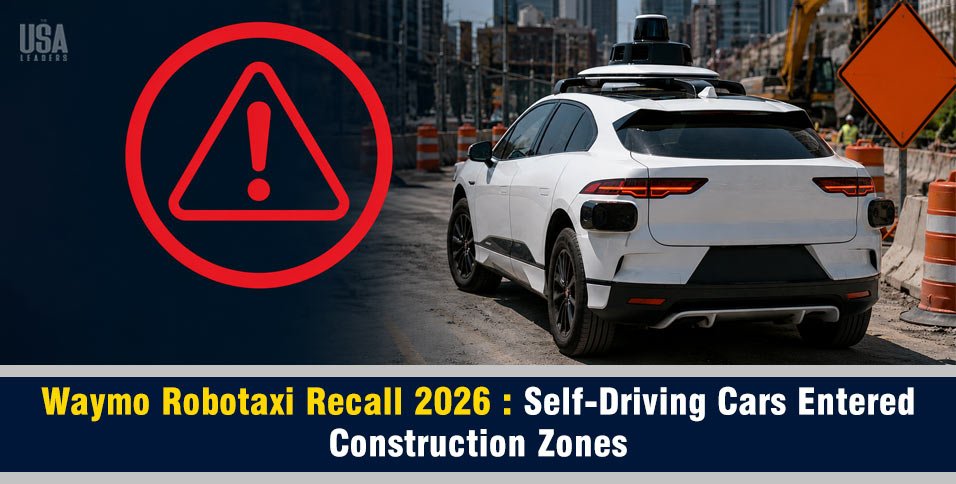
Waymo has run into a big problem. The company is recalling 3,871 self-driving taxis after 13 cases where the cars entered closed freeway construction areas by mistake.
No one was injured, but the incidents raise serious concerns about whether AI can handle unpredictable construction zones. Six crashes happened in Phoenix, Arizona, and seven in San Francisco, California.
More concerning is that the vehicles entered construction areas at highway speeds and failed to notice simple ramp-closure signs signs that human drivers would recognize immediately.
The deal doesn’t just reshape two companies. It rewrites the map of global streaming.
Why Construction Zones Are the New Frontier for Robotaxi Safety
The Technical Challenge: Recognizing Temporary Road Signs
Construction zones are one of the hardest challenges for self-driving cars. Unlike permanent road signs, construction signs are temporary, hard to see, and keep changing sometimes even within the same day.
For an AI trained on millions of miles of regular driving data, these temporary obstacles are like finding a hidden level in a video game. The system expects consistency. Construction zones deliver chaos.
The ramp-closure signs were standard orange signs with black text. However, because they were tilted, blocked by equipment, or poorly lit at construction sites, Waymo’s sensors did not detect them.
Phoenix vs. San Francisco: Different Cities, Same Problem
You might think this problem is caused by poor infrastructure in just one city. But Waymo faced failures in two very different driving environments.
- Phoenix: Wide freeways, desert lighting, summer heat affecting sensor performance
- San Francisco: Narrow streets, foggy conditions, steep hills, complex urban grid
Since the same software problem happened in both cities, it’s not caused by the environment. The issue is with the main detection algorithm.
Industry experts say this is a “temporary sign recognition gap,” a known limitation in many self-driving car systems today.
Waymo’s Response: Software Update, Not Hardware Replacement
How the Fix Actually Works
Waymo is not changing its sensors or computers. Instead, it is using a software update to help robotaxis better recognize and react to construction zone signs.
The update focuses on three key improvements:
- Better detection of orange construction road signs
- Improved speed control when the road layout is unclear
- Faster safety backup that alerts a human operator if the system cannot identify a situation
Timeline for Rollout
Waymo has not shared an exact date for updating all 3,871 vehicles, but the fix is ready and will roll out in the next few weeks. Users should not notice any service disruption, as the update will be sent remotely, similar to a phone software update.
Comparison to Previous Recalls
This is not Waymo’s first recall. In 2024, the company fixed problems with pedestrian detection and emergency braking, which were serious safety issues. This time, the recall is only about software, which is harder to find but easier to fix once identified.
What This Means for Autonomous Vehicle Trust
Public Perception: “Wait, Self-Driving Cars Can’t Read Signs?”
For everyday users, this recall hurts trust. If a robotaxi can’t spot a simple orange construction sign, what else could it miss, like a child crossing the road, a red light, or a cyclist avoiding a pothole?
The self-driving car industry says its vehicles are safer than human drivers. But construction zones challenge that claim. People can make mistakes, but they usually realize and correct them in time. AI doesn’t always do that.
The Competitor Landscape: Tesla, Cruise, and Zeta Watch closely
This recall puts pressure on Waymo’s competitors:
- Tesla’s Full Self-Driving: Already facing skepticism over similar detection issues
- Cruise (GM): Suspended operations in 2023 after a pedestrian injury, still rebuilding trust
- Zeta and other startups: Watching closely before announcing their own public rollouts
The autonomous vehicle race isn’t just about who gets there first. It’s about who gets there safely.
Regulatory Implications: NHTSA Might Tighten the Rules
The National Highway Traffic Safety Administration announced the recall on June 17, 2026. This shows regulators are closely watching Waymo.
Experts believe NHTSA may require new tests for self-driving cars in construction zones. This could slow down the launch of autonomous vehicles across the industry for months or even years.
The Bigger Picture: Autonomous Vehicle Industry at a Crossroads
Safety First: The Price of Innovation
Every major tech breakthrough hits this wall. The internet had security breaches. Electric vehicles had battery fires. Social media had content moderation crises.
Autonomous vehicles are hitting the construction zone wall. It’s not a failure; it’s a normal part of the innovation curve. The question is, how quickly can Waymo learn, adapt, and move forward?
Investor Confidence: Short-Term Worry, Long-Term Hope
Stock markets react negatively to safety recalls. But Waymo’s parent company, Alphabet (Google), has shown patience with long-term bets. Remember when Google Maps was a clunky app in 2005? Now it’s essential infrastructure.
The robotaxi industry is still in its “2005 Google Maps” phase. This recall is a setback, but not a dealbreaker for investors who believe in the 10-year vision.
Industry-Wide Lessons: What Other Companies Should Learn
Waymo’s mistake is still useful for the self-driving car industry. It helps all companies learn and improve.
Construction zones are the #1 unresolved challenge for AI navigation.
That awareness could accelerate solutions across the industry. Sometimes, one company’s failure becomes everyone’s breakthrough.
Bottom Line: What Drivers Should Know
If You’re a Current Waymo User
- Don’t panic: No injuries were reported in any of the 13 incidents
- Expect an update: Your vehicle will receive the software fix remotely over the coming weeks
- Stay informed: Waymo will notify users directly about the update timeline
For People Considering Robotaxi Services
- This recall is normal: Even human drivers struggle with construction zones
- The tech is improving: Software updates happen faster than hardware replacements
- Trust develops over time: Give the industry 2–3 more years before widespread adoption
The Final Takeaway
Waymo’s recall of 3,871 robotaxis is not a major problem. It’s a fixable issue. Self-driving technology is still improving, and construction zones are part of that learning process.
Some vehicles entered closed construction areas at high speed, but no one was injured. Waymo has already prepared a software update to fix the issue.
The robotaxi future isn’t over. It’s just facing some small problems, which is normal for new technology.
Also Read– Waymo Expansion Plans 2026: New Robotaxis to Arrive Soon in More Cities!