
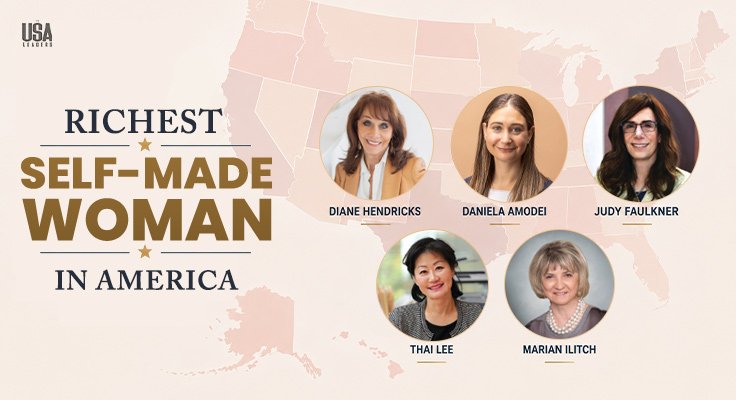
When you look at the richest self made women in America in 2026, the biggest takeaway is not just their bank balances. According to Forbes’ 11th annual ranking, released in June 2026, there are now 43 self-made female billionaires. They hold a combined self-made fortune of $166.3 billion, up from 38 women the previous year.
For the first time since the ranking launched in 2015, every single woman on the list holds a ten-figure net worth.
Unlike broader global wealth lists that include heiresses, Forbes defines “self-made” in a strict way. It means women who built their own companies or earned wealth as executives. They did not inherit their wealth. Forbes assigns each founder a self-made score ranging from 6 to 10.
From AI labs in San Francisco to roofing warehouses in Wisconsin, these women leaders prove that steady work beats hype.
Who Are the Top 10 Richest Females in America Who Built Their Own Wealth?
The top 10 richest self made women in America in 2026 are Diane Hendricks ($21.7B),Daniela Amodei ($15.5B), Judy Faulkner ($9.6B),Thai Lee ($8B), Marian Ilitch ($7.6B),Elizabeth Uihlein ($6.9B), Jayshree Ullal ($6.8B),Johnelle Hunt ($6.7B), Eren Ozmen ($6.7B),and Peggy Cherng ($6.5B).
1. Diane Hendricks: Scaling ABC Supply Through Contractor Loyalty
Diane Hendricks co-founded ABC Supply in Beloit, Wisconsin, in 1982 with her late husband, Kenneth, turning a single roofing distributor into North America’s largest wholesale supplier of roofing, siding, and windows. Rather than taking the company public, Hendricks kept ABC Supply privately held, allowing leadership to reinvest profits into strategic acquisitions and local branch autonomy without quarterly Wall Street pressure.
A teen mother at 17 who once worked as a Playboy Bunny to support her child, Hendricks later expanded into real estate, manufacturing, and logistics through Hendricks Holding Company. She has ranked No. 1 on this list for nine straight years, with an estimated net worth of $21.7 billion according to Forbes (June 2026).
2. Daniela Amodei: Turning AI Safety Into Enterprise Value at Anthropic
Daniela Amodei co-founded artificial intelligence company Anthropic in 2021 with her brother, Dario, serving as president while scaling operations, policy, and enterprise partnerships. After studying English literature at UC Santa Cruz and working in politics, she joined fintech giant Stripe as an early recruiter before serving as vice president of safety and policy at OpenAI.
As Anthropic’s private valuation soared to $965 billion in May 2026, Amodei jumped from No. 28 to No. 2 in a single year. Forbes estimates her net worth at $15.5 billion as of June 2026, making her the fastest-rising among all women entrepreneurs in the country.
3. Judy Faulkner: Bootstrapping Epic Systems Without Venture Capital
Judy Faulkner founded Epic Systems in a Wisconsin basement in 1979 with $70,000 from friends and family, building electronic health-record software that now holds medical records for more than 325 million people. Her defining business decision was refusing venture capital, private equity, and outside acquisitions, keeping Epic completely private and debt-free.
She has pledged to give away 99% of her wealth through the Giving Pledge. Forbes pegs her estimated net worth at $9.6 billion as of June 2026.
4. Thai Lee: Acquiring and Scaling SHI International
Thai Lee turned a struggling five-person software reseller into SHI International, one of America’s largest privately held IT solutions providers with roughly $15 billion in annual revenue. Born in Bangkok and raised largely in South Korea before earning an MBA from Harvard Business School, Lee and her former husband bought the predecessor company for under $1 million in 1989.
Instead of chasing flashy consumer tech, Lee focused on high-retention corporate procurement for clients like Boeing and AT&T, maintaining majority ownership for more than three decades. Forbes estimates her net worth at $8 billion (June 2026).
5. Marian Ilitch: Building an Integrated Empire Around Little Caesars
Marian Ilitch co-founded Little Caesars Pizza in Garden City, Michigan, in 1959 with her late husband, Mike, growing a single storefront into a global chain generating over $5 billion in annual systemwide sales.
Crucially, she reinvested pizza cash flows into sports and entertainment real estate, acquiring the NHL’s Detroit Red Wings and MotorCity Casino Hotel while an Ilitch family trust owns the Detroit Tigers. Forbes places her and her family’s self-made fortune at $7.6 billion as of June 2026.
6. Elizabeth Uihlein: Organic Growth Over Mergers at Uline
Elizabeth Uihlein and her husband, Richard, launched shipping and packaging distributor Uline from their basement in 1980 after noticing a gap in reliable box and supply delivery for businesses. Today, the Wisconsin-based company employs roughly 9,000 people and sells more than 43,000 products nationwide.
Unlike competitors that grew through debt-heavy roll-ups, Uline expanded almost entirely through organic catalog growth, relentless inventory availability, and fast shipping. Forbes estimates Uihlein’s net worth at $6.9 billion (June 2026).
7. Jayshree Ullal: Leading Arista Networks Through Public-Market Scale
Jayshree Ullal proves that non-founder women CEOs can build massive equity wealth by taking a high-growth tech company public and executing relentlessly. Born in London and raised in India, Ullal became president and CEO of cloud networking firm Arista Networks in 2008, guiding the company through its 2014 IPO and expanding annual revenue past $9 billion.
She is one of the highest-ranking Indian American women business leaders in the United States, with a Forbes estimated net worth of $6.8 billion as of June 2026.
8. Johnelle Hunt (Tie): Long-Term Equity Discipline at J.B. Hunt
Johnelle Hunt co-founded J.B. Hunt Transport Services in Arkansas in 1969 with her late husband, Johnnie Bryan Hunt, starting with five trucks and seven trailers before transforming American freight logistics. In the early decades, Hunt managed company finances and helped navigate trucking deregulation, taking the carrier public in 1983 and pioneering intermodal rail-truck partnerships.
Even at age 94, Hunt remains the largest individual shareholder in the publicly traded logistics giant. Forbes estimates her net worth at $6.7 billion (June 2026).
9. Eren Ozmen (Tie): Turning Around Sierra Nevada Corporation
Eren Ozmen and her husband, Fatih, acquired aerospace and defense contractor Sierra Nevada Corporation in 1994 when the Nevada-based firm had just 20 employees. A Turkish immigrant who earned her MBA at the University of Nevada, Reno, Ozmen shifted the company from a small defense subcontractor into a major prime contractor.
Under her leadership as chair and president, the firm expanded into commercial orbital spaceflight through its Sierra Space division, developer of the Dream Chaser spaceplane. Forbes ties her with Johnelle Hunt at an estimated net worth of $6.7 billion as of June 2026.
10. Peggy Cherng: Applying Engineering Systems to Panda Express
Peggy Cherng brought a Ph.D. in electrical engineering and a background as a software developer to fast-casual dining when she co-founded Panda Express with her husband, Andrew, in 1983. Born in Myanmar and raised in Hong Kong, Cherng recognized early that restaurant chains fail when back-end logistics cannot keep up with store openings.
She built proprietary computerized systems for point-of-sale tracking, inventory management, and supply chain forecasting long before restaurant tech became standard, allowing Panda Restaurant Group to scale to thousands of locations without franchising. Forbes estimates her net worth at $6.5 billion as of June 2026.
2026 Top 10 Ranking Summary Table
| Rank | Name | Company / Industry | Key Business Move | Estimated Net Worth (Forbes, June 2026) |
| 1 | Diane Hendricks | ABC Supply (Building supplies) | Kept company private; scaled via acquisitions | $21.7 Billion |
| 2 | Daniela Amodei | Anthropic (Artificial intelligence) | Scaled enterprise AI safety; $965B valuation | $15.5 Billion |
| 3 | Judy Faulkner | Epic Systems (Healthcare software) | Bootstrapped with $70K; zero VC or debt | $9.6 Billion |
| 4 | Thai Lee | SHI International (IT services) | Bought small reseller for <$1M in 1989 | $8.0 Billion |
| 5 | Marian Ilitch | Little Caesars (Food & sports) | Reinvested pizza profits into sports/venues | $7.6 Billion |
| 6 | Elizabeth Uihlein | Uline (Shipping & packaging) | Organic catalog growth to 43,000+ SKUs | $6.9 Billion |
| 7 | Jayshree Ullal | Arista Networks (Cloud networking) | Led 2014 IPO and AI data-center expansion | $6.8 Billion |
| 8 | Johnelle Hunt | J.B. Hunt Transport (Logistics) | Pioneered intermodal freight; retained shares | $6.7 Billion |
| 9 | Eren Ozmen | Sierra Nevada Corp. (Aerospace) | Scaled 20-person firm into space prime contractor | $6.7 Billion |
| 10 | Peggy Cherng | Panda Express (Fast-casual dining) | Built custom POS and supply-chain software | $6.5 Billion |
Note: All net worth figures reflect Forbes’ June 2026 America’s Richest Self-Made Women snapshot estimates, calculated using June 1, 2026 public stock prices and private-company valuations.
How Many Self-Made Women Are Billionaires in the U.S. Right Now?
According to Forbes, there are 43 self-made women billionaires in the United States in 2026, marking the first time the publication’s annual list required a $1 billion minimum to qualify. When Forbes launched the ranking in 2015, only 18 self-made women on the list were billionaires, and just 38 reached that threshold in 2025.
Because only 43 women in the country currently meet the self-made billionaire threshold, searches for the top 20 or top 100 female billionaires in America either pull from the lower half of this 43-woman cohort or combine self-made founders with women who inherited family fortunes.
Which Industries Create the Most Self-Made Women Billionaires?
Technology is the single largest wealth engine, producing roughly 20 of the 43 women on the 2026 list across AI, enterprise software, semiconductors, and cybersecurity. However, successful businesswomen also built multibillion-dollar companies in physical sectors that venture capitalists often overlook:
Technology and AI: Led by Daniela Amodei, Judy Faulkner, Thai Lee, and Jayshree Ullal, alongside newcomers like Nvidia CFO Colette Kress ($1.2 billion).
Food, Beverage, and Hospitality: Anchored by Marian Ilitch, Peggy Cherng, and Lynda Resnick.
Manufacturing, Logistics, and Industrial Supply: Driven by Diane Hendricks, Elizabeth Uihlein, Johnelle Hunt, and Eren Ozmen.
Aerospace and Biometrics: Highlighted by SpaceX president Gwynne Shotwell (1.3billion)and Clear Secure CEO CarynSeidman Becker(1.1 billion), who bought Clear out of bankruptcy and took it public.
Media, Fashion, and Retail: Represented by Oprah Winfrey, Spanx founder Sara Blakely ($1.4 billion), Kim Kardashian, Taylor Swift, Beyoncé, and Rihanna.
Geographically, California remains the top hub with roughly 16 of the 43 billionaires residing in the state, though Wisconsin boasts two of the top three (Hendricks and Faulkner).
Is There an Under-30 Self-Made Female Billionaire in 2026?
No woman founder under 30 currently appears on the 2026 list of self-made women billionaires. Although Kalshi co-founder Luana Lopes Lara briefly held the under-30 title at age 29 in December 2025 before turning 30 in May 2026.
Following venture funding that valued Kalshi at $11 billion, Lara’s net worth reached $2.6 billion, ranking her No. 20 on Forbes’ June 2026 list as the youngest self-made woman billionaire in the world. She overtook Scale AI co-founder Lucy Guo, 31, who ranked No. 27 in 2026 with an estimated $1.5 billion net worth.
4 Business Lessons for U.S. Founders From These Women Leaders
1. Equity ownership matters more than fundraising headlines: Judy Faulkner, Diane Hendricks, and Elizabeth Uihlein avoided diluting their stakes with outside venture capital, allowing them to retain majority control as their companies compounded over decades.
2. Boring B2B niches produce resilient cash flow: Roofing supplies, shipping boxes, and freight trucking lack the glamour of consumer apps, yet they generated three of the top eight fortunes on the list.
3. You do not need to be a founder to build a billion-dollar stake: Executives like Jayshree Ullal, Gwynne Shotwell, Sheryl Sandberg ($2.4 billion), and Colette Kress proved that joining high-growth companies early and negotiating meaningful equity packages can rival founder wealth.
4. Immigrant entrepreneurs power U.S. innovation: Four of the top 10 women (Thai Lee, Jayshree Ullal, Eren Ozmen, Peggy Cherng, and No. 20 Luana Lopes Lara) were born outside the United States and built industry-defining companies in American markets.
Conclusion:
The 2026 ranking of the richest self made women in America shows that there is no single formula for building an enduring U.S. business. Whether scaling an AI safety leader like Anthropic in five years or compounding a private building-supply distributor over four decades, all 43 women on Forbes’ list turned operational discipline into lasting ownership.
For aspiring founders and corporate leaders alike, their careers offer practical proof that solving real customer problems and protecting equity remain the surest paths to long-term value.
FAQs
1. Why did well-known names like Dolly Parton, Kylie Jenner, and Selena Gomez drop off the 2026 Forbes list?
They dropped off because Forbes raised its minimum qualification threshold to a $1 billion net worth for the first time in 2026. That new ten-figure cutoff narrowed the ranking to 43 self-made female billionaires and automatically excluded past list-makers whose fortunes sit below $1 billion, including Dolly Parton, Kylie Jenner, and Selena Gomez.
2. Who is the youngest self-made woman billionaire in the world right now?
Luana Lopes Lara, co-founder and COO of prediction-market platform Kalshi, is the world’s youngest self-made woman billionaire in 2026 at age 30, with a Forbes-estimated net worth of $2.6 billion. She originally claimed the title at age 29 in December 2025, surpassing Scale AI co-founder Lucy Guo.
3. How does Forbes define a “self-made” woman billionaire?
Forbes classifies a woman as self-made if she built her own company or earned her fortune through her own career rather than inheriting it. Every woman on the America’s Richest Self-Made Women list scores between 6 and 10 on Forbes’ 10-point self-made scale, distinguishing them from heiresses who inherited family stakes.