There is a particular kind of work that never makes the front page, that earns little applause at galas and generates few headlines, and yet, without which none of the visible, celebrated work of community change would be possible. It is the work of people who build the backend, structure systems, draft compliance frameworks, steward finances, and construct the operational scaffolding that allows a mission to survive contact with reality.
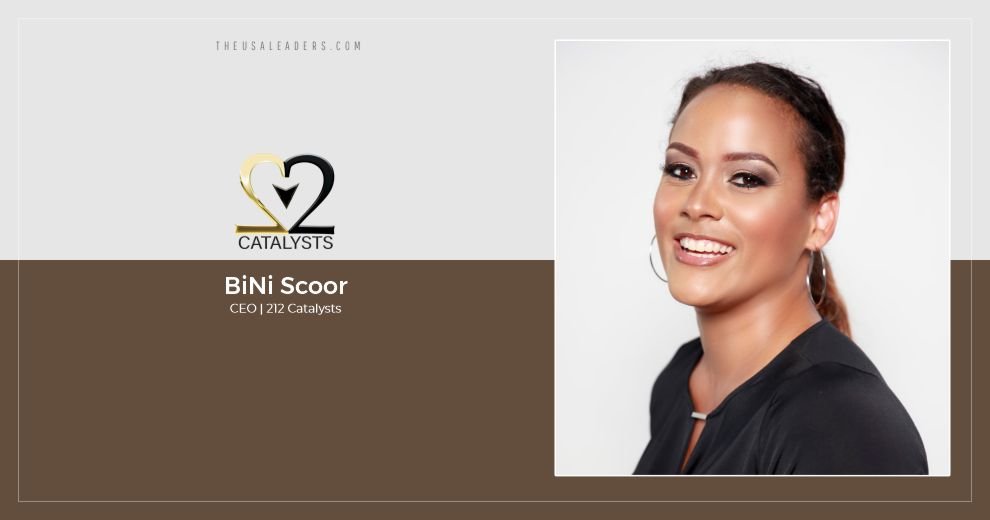
BiNi Scoor has been doing this work for over 25 years. As Chief Executive Officer of 212 Catalysts, a consulting and fiscal intermediary firm she founded in Austin, Texas, in 2019, BiNi has made a career of solving the problems others overlook and building the systems others do not think to build.
The results are significant by any measure. Since its founding, 212 Catalysts has helped clients secure over $28 million in funding, generating approximately $31 in community interventions for every single dollar received from clients. Over 100,000 families have been reached with vital services and resources. Across the full arc of her career, she has facilitated cross-sector coalitions that helped establish systems and policies for over $600 million in grant and sponsored projects and over $70 million in in-kind partnerships.
But numbers alone do not explain the whole story. The rest of it starts in the American South, in a family shaped by history, faith, and the deep, inherited refusal to look away.
From the South to the Resistance: A Legacy of Fighting Back
BiNi grew up in a mixed-race family, African American and German, in the American South, at a time when that combination was not merely unusual but actively unwelcome. “Growing up in a mixed-race blended family at a time when this was still frowned upon in the South, I experienced a lot of racism,” she recalls. Her response was not retreat but inquiry. She read books and watched documentaries, working to understand Black history and the forces shaping the world around her.
Her faith and the steady example of her mother, who “always gave generously to help others,” provided a moral compass that still orients her work today.
Later in life, she discovered something about her grandfather that reframed her understanding of herself entirely. Her grandfather had led the Scoor resistance movement against the Nazi regime during World War II and was detained in the Nordmark Labor Camp. The family history, across two continents, was a story of principled defiance handed down through generations.
“Activism and fighting for others who cannot fight for themselves are just ingrained in my DNA and life experience,” she says. What distinguishes her path is what she built on that inheritance: a rigorous professional formation, including a Bachelor’s degree in Public Relations and a Master’s in Business Administration, directed toward the spaces where that formation could do the most practical good.
The Gap Nobody Wanted to Fill
As her career moved through front-line program work and programmatic leadership into funding and systems-level administration, a pattern became impossible to ignore. Across nonprofits, school systems, churches, and community organizations of every size and structure, the same gap kept appearing.
“I discovered a huge need in the community impact ecosystem that has gone unnoticed and unattended for decades: support for the business backend that forms the foundation for programmatic and organizational operation.”
The people leading these organizations were almost universally gifted at their missions. They understood their communities, they had vision, and they could execute programs with real dedication. What they consistently lacked was the financial architecture to sustain and grow that work: the expertise to secure funding, to manage it responsibly, to build the compliance infrastructure that would give funders the confidence to invest again and again.
BiNi recognized this not as a frustration but as an opportunity. In 2019, she built 212 Catalysts around exactly that purpose. Her specialties, in her own words, are “turning big, nebulous ideas into concrete action to achieve positive, measurable results” and, in two words that function almost as a professional signature: “getting things unstuck.”
People, Process, and the Magic of Execution
Ask BiNi about her methodology, and the answer comes immediately: “People and process.” Every initiative, every new program, every revival of something that has stalled, begins the same way. Engage the right people at the right time, guide them through an iterative input process, and move from concept to execution through a facilitated strategic planning framework that clearly defines roles, responsibilities, and timelines.
“It works beautifully every time,” she says, with the steady confidence of someone who has watched the same approach deliver results across vastly different contexts for decades.
But she is equally clear about where most organizations lose their way. She has watched far too many produce sound plans and then achieve nothing at all. The word “execution” carries particular weight in how she talks about this work, and she uses it deliberately.
“The magic isn’t in the plan… the magic happens when a plan is executed well, and that takes being properly funded.”
Her process begins with one essential question: “What are we trying to accomplish?” That, she explains, should be the North Star, with deliberate thought given to how success will be measured. From there, you work backward: identifying the inputs, outputs, activities, partnerships, and people required. You quantify the costs, resource the plan properly, and then, as she would put it, you do the work.
When a High School Almost Went Dark
In 2004, BiNi was selected to manage a campus improvement grant, a 21st Century Community Learning Centers grant, at what was then called Reagan High School in Austin, Texas. The program had already collapsed to near-zero attendance within its first month of operation.
Working with the local community, she transformed a program on the verge of failure into a nationally recognized initiative that achieved positive, measurable outcomes at a previously low-performing high school, helping save Reagan from closure alongside two additional schools within the same vertical team. She was subsequently given responsibility for ten secondary campuses and their local and state/federal grants.
The work drew recognition from the U.S. Department of Education, Colin and Alma Powell’s America’s Promise Alliance, the Texas Education Agency, the Texas Department of Transportation, Southwestern Educational Development Laboratory (SEDL), and a Stanford University alumni research group, among others.
From that foundation, the list of initiatives she helped launch or rescue from stagnation continued to grow: the Central Texas Afterschool Network, the Austin/Travis County Ready By 21 Coalition, the Black Men’s Health Clinic, the Austin/Travis County Mentoring Collaborative, the African American Youth Harvest Foundation, the African American Leadership Institute, the St. Johns Community-School Alliance, and the Data Connection Pilot between Austin Independent School District and the Michael and Susan Dell Foundation.
In 2023, she moderated a summer program sustainability podcast with the Wallace Foundation and The Learning Agenda national team, grounded in her work with the Texas Education Agency ADSY Summer Learning initiative.
What Most People Get Wrong About Grants
One of the more valuable services BiNi provides is a corrective one. The mythology around grant funding, she has observed, is pervasive, well-marketed, and actively damaging to the organizations that fall for it.
“Many people have been sold by predatory marketing that makes it sound like grant funding is out there everywhere and just needs to be claimed.”
The reality is far more demanding. Every grant requires specific deliverables that must be met, and funds must be spent in strict alignment with the funder’s priorities. New nonprofits generally do not receive funding at the outset, and launching any organization requires genuine sweat equity, personal financial sacrifice, and the development of a demonstrated track record of good stewardship over time.
And then there is the observation that surprises most people:
“Grants are the worst way to build any kind of healthy business, as they are unpredictable, time-limited, and can be difficult to administer.”
For an organization to genuinely thrive over the long term, she argues, earned revenue and consistent fundraising must be established and sustained alongside any grant activity. The core operations of any mission-driven organization should live within reliable funding streams, not around the volatility of grants.
The EquiMediary Shift: More Funding to More Missions
Among the most significant innovations in BiNi’s current work is the EquiMediary model, an approach that expands access to funding for smaller and underserved nonprofits by pairing fiscal sponsorship with capacity-building support.
The model works by relieving organizations of the backend complexities associated with fund management. Because 212 Catalysts operates as a trusted, compliant intermediary on the finance, backend, and compliance side, funders become more willing to support mission-driven organizations they believe in, knowing the administrative and audit trail will be clean and properly maintained.
“It will alleviate compliance burden and allow mission-focused leaders to flow more in their zones of genius,” she explains, “translating to the measurable impact we all want to see.”
212 Catalysts is currently part of a national Equitable Intermediaries Cohort, working alongside partners across the country to encourage both philanthropic and government funders to adopt this model. The stakes, as she sees them, are considerable.
“This would be a game changer for the philanthropic community and government funding models,” she says, “to get more money to smaller/newer agencies and thereby maximize community impact.”
Current initiatives connected to this work include the African American Leadership Institute in Central Texas, which BiNi co-founded in 2021 and which has since generated multiple media features, as well as support connected to the development of Texas’s first Trauma Recovery Center.
A Record of Recognition, A Life of Service
The arc of recognition in BiNi’s career runs long and consistent. The Legacy Leadership Award from the Central Texas Afterschool Network came in 2017. The Distinguished Changemaker Award from the African American Youth Harvest Foundation followed in 2018. In 2019, she was nominated for Achievements in Black Austin by the Black Austin Network.
The years that followed brought a steady stream of acknowledgment. In 2021 alone, she received the Outstanding Leadership Award from the Austin NAACP, inclusion on the Top Ten Central Texas Diversity Champions list from the Austin Black Business Journal and Community News, a feature in VoyageAustin’s “Hidden Gems: Local Businesses and Creatives You Should Know,” and a nomination for the Best CEO Award by the Austin Business Journal.
In 2022, she was named among the Best in the Citi: Top 10 Innovators to Watch by Soulciti/AALI, featured in the “In the Black” Black History Month Spotlight by Six Square Austin’s Black Cultural District, nominated for DEI and Nonprofit Leaders of the Year by DivInc, and was selected for inclusion in the Black Women in Business commemorative book.
By 2024, the honors included the Association of Fundraising Professionals Special Recognition as Individual Philanthropist, a place on the Austin Woman Changemaker List, and the Austin NAACP DeWitty Overton honor.
Her board service spans over 20 agencies since 1997, presently including Austin Achieve Public Schools, where she serves as Chair, the Concordia University Access and Equity Advisory Board, the Friends of Balcones Canyonlands National Wildlife Refuge, where she served as Treasurer, and the African American Leadership Institute. Over the last 18 years, she has presented at dozens of regional, statewide, and national conferences and summits, including the Harvard Graduate School of Education and the U.S. Department of Education 21st CCLC conferences. She has served as a guest speaker, mentor, and host to students from the RGK Center for Philanthropy and Community Service at The University of Texas at Austin, UT McCombs School of Business, UT Project SERVE, UT CONNECT, Texas State University, and Concordia University, among other programs.
What Comes Next
When BiNi looks forward, she speaks in structural terms. She envisions a philanthropic ecosystem where fiscal intermediary models are standard rather than exceptional, where capacity-building support is built into the funding process rather than left as an afterthought, and where organizations doing effective, demonstrated work in underserved communities are no longer shut out of larger funding awards simply because they lack the administrative infrastructure to manage them.
Her call to the leaders, funders, and advocates working in this space is clear and unhurried:
“Follow 212 Catalysts and work within your spheres of influence to shift resources toward the people and agencies that have demonstrated positive community impact but simply need more funding and resources to expand and amplify their impact.”
The thread connecting her grandfather’s resistance against the Nazi regime, her mother’s quiet generosity, a nearly shuttered Austin high school, and the national coalition work now underway through 212 Catalysts is not hard to find. It is a thread made of the conviction that standing between the powerful and the powerless is not heroic, not optional, and not theoretical. It is simply necessary.
BiNi has been doing it for over 25 years. By every measure available, the work is only growing.
Quotes
“The magic isn’t in the plan… the magic happens when a plan is executed well.”
“Many people have been sold by predatory marketing that makes grant funding sound easy to claim.”