The USA Leaders
April 24, 2026
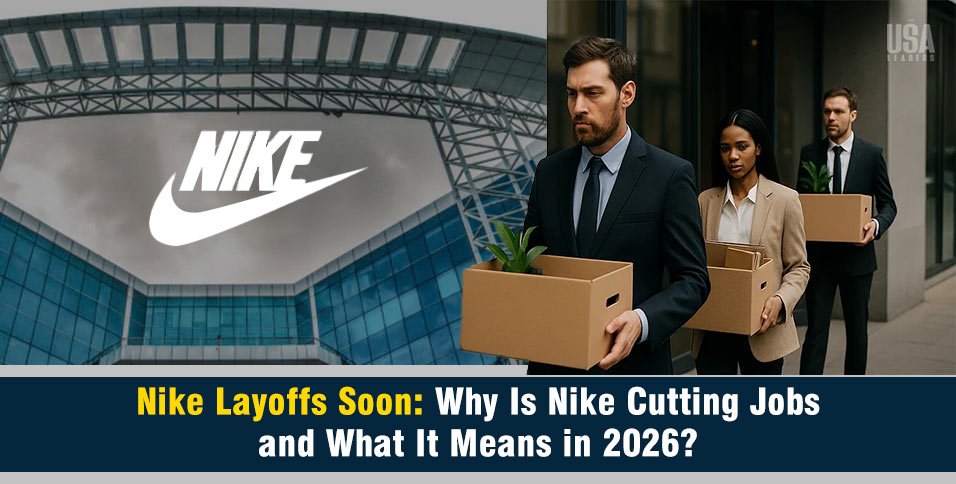
Nike has officially confirmed a new round of job cuts, with approximately 1,400 employees set to be laid off globally as part of its ongoing restructuring strategy. The layoffs, which primarily target technology and global operations teams, are part of Nike’s broader effort to streamline operations and regain growth momentum in a highly competitive market.
So, is Nike struggling financially, or is this a strategic shift toward a leaner, more efficient future?
Why is Nike laying off employees if the company is not in crisis?
The answer lies deeper than simple cost-cutting. These layoffs are part of a major transformation strategy that could redefine how Nike operates in the coming years.
Why Is Nike Laying Off Employees?
The Nike layoffs 2026 are not just about reducing staff; they are about reshaping the company for the future.
Nike is moving toward a leaner, faster, and more technology-driven business model. Instead of maintaining large, complex teams, the company is focusing on:
- Automation
- Centralized decision-making
- Faster product development
This shift reflects a broader trend across global companies where efficiency is replacing expansion.
Nike leadership has emphasized that these decisions are meant to:
Improve speed
Reduce operational complexity
Increase long-term profitability
In simple terms, Nike is trying to do more with fewer people.
What’s Really Behind Nike Layoffs 2026? Key Reasons Explained
1. Shift Toward Automation and AI
Nike is investing heavily in automation and advanced technology, especially in supply chain and operations
As machines and software take over repetitive tasks, fewer human roles are needed.
2. Rising Competition in the Sportswear Market
Nike is facing strong competition from brands like:
- Hoka
- On Running
- Adidas
These brands are gaining popularity, especially in performance footwear, forcing Nike to rethink its strategy.
3. Slower Growth in Key Markets
One of the biggest concerns is declining demand in major regions like China, which has impacted overall growth expectations.
4. Cost Pressure and Profit Margins
Global challenges like:
- Rising production costs
- Supply chain disruptions
- Tariffs
have forced Nike to focus on cost efficiency.
5. “Win Now” Strategy Execution
Nike’s internal turnaround plan, known as “Win Now,” aims to:
- Simplify operations
- Focus on core products
- Improve performance
The layoffs are a direct step toward executing this plan.
How Many Employees Are Affected by Nike Layoffs?
Nike has confirmed the following details:
| Category | Impact / Change | Reason for Change |
| Total Job Cuts | 1,400 Roles (Global) | Final phase of the “Win Now” efficiency plan. |
| Key Tech Hubs | Oregon, USA & India | Consolidating talent to speed up decision-making. |
| Warehouse Cuts | 775 roles (TN & MS) | Accelerating the shift toward robotic automation. |
| C-Suite Changes | CTO & CCO roles eliminated | Flattening the organization; duties moved to the COO. |
| Converse Brand | Manufacturing moved to Asia | Closer to factory partners for faster production cycles. |
| Running Strategy | Launch of “Nike Mind” | To compete with technical rivals like Hoka and On. |
| Women’s Market | NikeSkims Partnership | Reclaiming growth in the lifestyle-performance market. |
| Financial Goal | Save $2 Billion over 3 years | Offsetting $1.5B in tariffs and lower digital sales. |
Summary of Major Locations Affected
- Beaverton, Oregon: Heavily impacted by corporate and technology reductions.
- Memphis, Tennessee: Significant cuts in manual labor at distribution centers.
- Global Offices: Reductions in Europe and Asia as regional IT support is centralized.
By taking a $300 million restructuring charge in 2026, Nike is betting that a leaner, more technical organization will be able to regain its dominance in the athletic world by 2027.
Which Department Is Most at Risk?
The layoffs are highly surgical, focusing on areas where human roles are being replaced by AI or consolidated into central hubs.
| Department | Risk Level | Specific Roles Impacted |
| Technology | High | Regional IT support, decentralized software devs, and redundant data analysts. Roles are moving to hubs in Oregon and India. |
| Global Operations | High | Manual warehouse labor, fulfillment coordinators, and logistics planners in TN and MS. |
| Converse Team | Medium | Engineering and manufacturing resources are being moved closer to Asian factory partners. |
| Corporate/Admin | Medium | Middle management, specifically Director and VP levels, and administrative support in North America. |
| Product Innovation | Low | Engineering roles related to “mental equipment” (Nike Mind) and performance running are actually seeing investment. |
Is Nike in Financial Trouble?
Nike is not in immediate trouble, but the company is going through what can best be described as a “necessary but challenging correction phase.”
Why Is This Happening?
Nike reported $46.3 billion in revenue for fiscal 2025, reflecting a 10% decline. However, this drop wasn’t accidental. The company deliberately reduced its focus on mass-market lifestyle sneakers like Air Force 1 to make space for more advanced, performance-driven products that offer higher value.
Impact of Tariffs
Another major pressure point is rising costs. The 2025 “Liberation Day Tariffs” have added nearly $1.5 billion in annual expenses. To manage this, Nike is cutting jobs while gradually shifting production to regions like Latin America and Africa to reduce long-term cost pressures.
A Strategic Move, Not a Crisis
Unlike companies facing financial distress, Nike still has strong cash reserves. These changes are part of a forward-looking strategy aimed at preventing future challenges. By investing in automation and streamlining operations, Nike is working to reduce production costs and build a more efficient business model for the years ahead.
What This Means for US Employees and the Global Workforce
For employees, the layoffs bring uncertainty, especially in tech and operations roles.
For the US market:
- Job competition may increase
- Demand for tech and AI skills will rise
For the global market:
- More companies may follow similar strategies
- Workforce structures will continue to evolve
The Bigger Trend: Layoffs Are Becoming the New Normal
Nike’s decision reflects a global shift in how companies operate.
Across industries:
- Companies are reducing workforce size
- Automation is replacing manual roles
- Efficiency is becoming the top priority
This means:
Layoffs are no longer just about crisis; they are about transformation
End Note
The Nike layoffs in 2026 are more than just another wave of job reductions; they reflect a deeper shift in how work is evolving.
The company is moving away from its traditional global structure toward a more streamlined, technology-focused model designed for speed, efficiency, and innovation.
While this transformation could strengthen Nike over time, it also brings up a bigger question:
Is this the future of all major companies?
As automation, artificial intelligence, and rising competition continue to reshape industries, Nike’s move may be an early sign of a broader global transition already underway.