The USA Leaders | May 25, 2026
What is the 2026 Ebola outbreak?
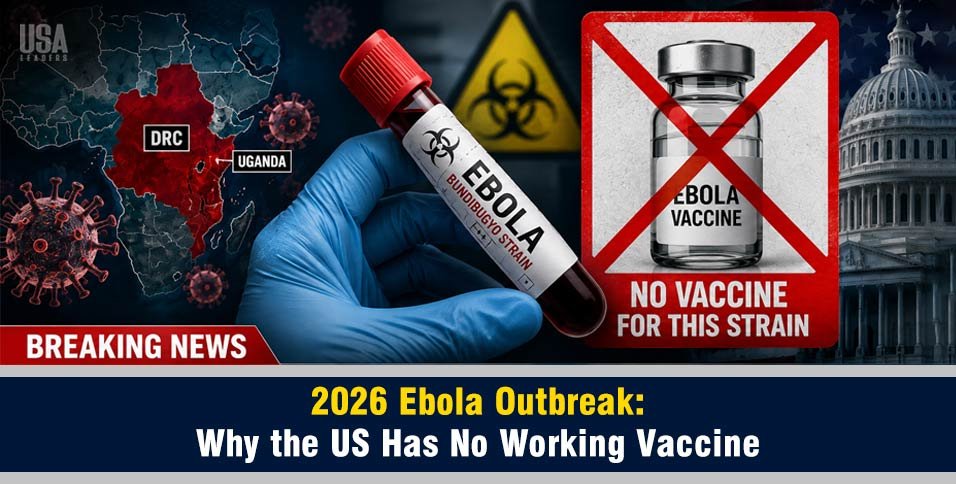
In May 2026, a deadly Ebola strain called Bundibugyo spread across the Democratic Republic of Congo and Uganda. On May 17, 2026, the World Health Organization declared it a global health emergency. By late May, there were nearly 750 suspected cases and 177 deaths.
The U.S. has confirmed one infected American: Dr. Peter Stafford, a 39-year-old missionary surgeon now being treated at Charité University Hospital in Berlin. The major issue is that the U.S. Ebola vaccine stockpile was made for a different strain and provides no protection against this outbreak.
Quick Facts: Ebola Outbreak 2026 at a Glance
| Factor | Status |
| Virus Strain | Bundibugyo, a rare type of Ebola |
| WHO Alert Level | Highest possible (declared May 17, 2026) |
| Suspected Cases / Deaths | ~750 cases; 177 deaths (as of May 23, 2026) |
| Fatality Rate | Kills 30 to 50 out of every 100 infected |
| Approved Vaccine? | None for this strain |
| Approved Treatment? | None for this strain |
| U.S. Stockpile Vaccine | Ervebo works on Zaire strain only |
| Does It Work Here? | No |
| When Could a Vaccine Be Ready? | 6 to 9 months away, at the earliest |
| U.S. Cases | 1 American infected (Dr. Peter Stafford, treated in Germany) |
| Detection Delay | 21 days — tests missed the strain entirely |
| U.S. Travel Advisory | Level 4: Do Not Travel (DRC, Uganda, South Sudan) |
Inside the 2026 Stockpile Paradox
For years, U.S. officials told the public that Ebola was no longer a serious threat at home. The government spent millions on the Ervebo vaccine and said the nation’s healthcare system was well prepared to handle any risk.
That confidence cracked in May 2026. As the WHO declared its highest level of global health emergency, U.S. officials faced a difficult truth.
The virus spreading in the DRC and Uganda is not the Ebola strain officials prepared for. The U.S. vaccine stockpile targets a different strain. The preparation existed—but it didn’t fit the actual threat.
The U.S. Has a Vaccine – Just Not for This Virus
Think of it like having a spare tire in your car. It’s a great backup plan. But if that spare fits a small sedan, it’s no use when your pickup truck gets a flat on the highway.
That’s exactly where the U.S. medical stockpile stands today.
The government holds a large supply of Ervebo, an Ebola vaccine approved by the FDA in 2019. It works well but only against one type of Ebola called the Zaire strain. The virus spreading right now is the Bundibugyo strain. These two are related, like cousins in the same family. But they are different enough that the immune system can’t fight one using protection built for the other.
As a result, the U.S. vaccine supply is sitting on the shelf full, well-preserved, and powerless for this emergency.
Why the Two Vaccines Are Not the Same Thing
Ebola is not just one disease. It includes several related viruses, and each one has a different outer protein like a different “face.” Your immune system learns to recognize one face at a time. So, if it knows the Zaire type, it may not recognize the Bundibugyo type.
The same gap applies to treatments. The two approved Ebola medicines, developed through clinical trials in the DRC between 2018 and 2020, were also built for the Zaire strain only. As Doctors Without Borders (MSF) confirmed, those medicines improved survival rates for Zaire patients but offered no benefit for Bundibugyo.
Today, doctors can only offer basic care to Bundibugyo patients—IV fluids, fever control, and oxygen support. For a disease that kills 30% to 50% of those infected, treatment options remain very limited.
An experimental vaccine is in development, but the WHO says it would take six to nine months just to produce enough doses for early testing. The outbreak, however, is moving much faster.
Three Weeks in the Dark: The Diagnostic Failure
This is the hardest part of the story to explain, but the most important to understand.
The first known patient became sick on April 24, 2026. She was a nurse and died three days later. Her family did not know what caused her death, so they prepared her body without any protection. The virus spread quietly from there.
By May 5, at least 50 people had already died. The first warning did not come from hospitals or health officials; it came from social media.
The delay happened because clinics in the DRC used an Ebola test that only detected the Zaire strain. It showed negative results, so no alert was raised. Meanwhile, the virus kept spreading through a busy gold-mining area where workers travel between towns and across borders every day.
On May 14, the correct test was finally used, confirming the Bundibugyo strain—21 days after the first case.
For three weeks, a deadly virus spread unnoticed because testing tools had not been updated for a strain identified back in 2007. This was not bad luck. It was the result of years of cuts to health monitoring systems.
You can read the full outbreak timeline and U.S. risk assessment in our earlier report: Ebola Outbreak 2026: WHO Declares Emergency — What Americans Need to Know.
The Market Failure Behind Vaccine Research
This gap is not a coincidence. It is a result of how drug development works and who it serves.
Drug companies focus on medicines that can sell at scale. Bundibugyo has caused only three known outbreaks, all in remote and low-income regions of central Africa. Because there is no large paying market, companies have little incentive to develop a vaccine.
This pattern is well known in disease research. Scientists at the U.S. National Institutes of Health once created an Ebola vaccine that worked in animals, but human trials were never funded because the disease mainly affected people in poorer regions. If Ebola had mostly impacted wealthy countries, vaccines would likely already exist.
Funding for neglected diseases has also declined over the past decade, rising only during major crises. After 2014, most funding focused on the Zaire strain, while Bundibugyo received almost no investment.
As a result, nearly two decades after its discovery, Bundibugyo re-emerged in 2026 without a vaccine, treatment, or quick solution.
What the U.S. Is Doing Instead: Old Tools, New Crisis
Because the United States lacks a modern medical shield to deploy, the federal response has been forced to pivot backward. Public health agencies are substituting advanced biotechnology with blunt-force legal containment.
- Emergency Border Restrictions (Title 42): Initiated on May 18, 2026, the CDC and Department of Homeland Security issued strict mandates blocking entry to foreign nationals who have traveled through the DRC, Uganda, or South Sudan within the last 21 days.
- Single-Airport Funneling: All U.S. citizens and permanent residents returning from the affected African zones are required to land at designated screening hubs, starting with Washington Dulles International Airport, with Atlanta Hartsfield-Jackson and Houston Intercontinental added to manage the volume.
- Mandatory 21-Day Monitoring: Returning travelers must undergo enhanced visual screening and temperature checks and log their health status daily for three weeks. If symptoms manifest, they are instructed to isolate immediately and contact local health boards before presenting at emergency rooms.
The seriousness of the situation became clear when an Air France flight from Paris to Detroit was diverted to Canada after authorities identified a high-risk passenger from the DRC region. The containment system is working, but it is under constant pressure.
Public health experts often note that travel restrictions cannot fully stop a disease. When people are desperate to move, they find ways around borders. And when medical supplies are limited, physical containment becomes the only option left.
The Human Cost
Dr. Peter Stafford, a 39-year-old board-certified surgeon and Christian missionary, was the only surgeon at a remote hospital near Bunia in the DRC. He contracted Ebola while treating patients before the outbreak was officially announced.
He was later flown to Charité University Hospital in Berlin, home to one of Europe’s top infectious-disease isolation units. His wife, Dr. Rebekah Stafford, and their four children were also evacuated and are being monitored nearby.
From his hospital bed, Stafford said he feared he might not survive before the evacuation but is now cautiously hopeful. Doctors say he is very weak but not in critical condition and is under close care.
Another missionary doctor, Dr. Patrick LaRochelle, 46, has no symptoms and remains in isolation at a hospital in Prague after possible exposure.
The Takeaway
The United States was well prepared for the last major Ebola threat. The Ervebo vaccine is effective, distribution systems are ready, and response teams are highly trained. Still, the 2026 outbreak shows that viruses don’t follow business or planning timelines.
The Bundibugyo strain was not new; it was identified back in 2007. Gaps in testing and the lack of a vaccine were already known. These problems weren’t fixed early because they didn’t offer clear financial returns.
Now, the cost of that delay is being felt through community losses in East Africa and the emergency evacuation of American surgeon Dr. Peter Stafford to Berlin’s Charité Hospital.
Strong travel controls may protect U.S. borders, but the bigger issue remains. Will global health systems invest in vaccines that cover multiple strains, or will they keep reacting only after the next ignored variant sparks another crisis?
Also Read – MV Hondius Hantavirus Outbreak: 17 Americans Evacuated to Nebraska