The USA Leaders | May 22, 2026
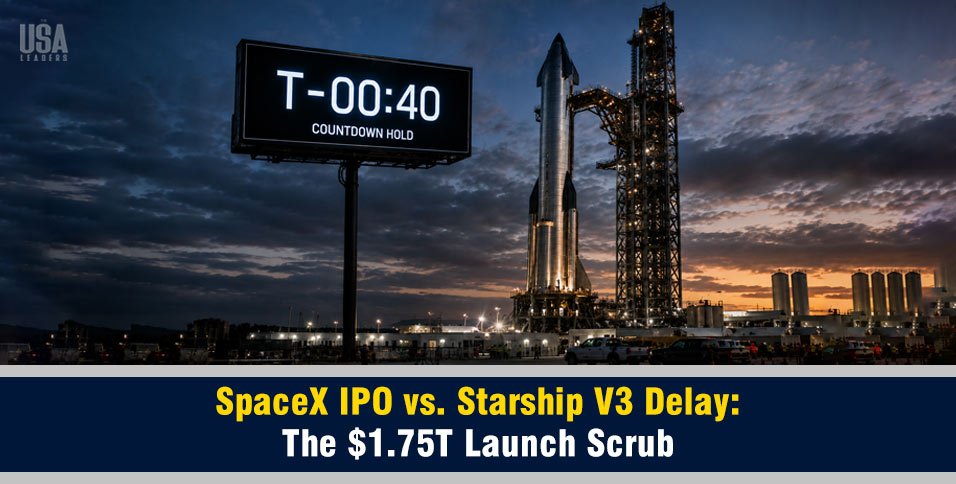
Elon Musk’s bold plan to take SpaceX public hit an early challenge. Just one day after announcing the highly anticipated IPO, a last-minute mechanical issue at Starbase, Texas, forced engineers to delay the first launch of the upgraded Starship V3 rocket.
Quick Facts: SpaceX Market Debut & Flight 12 Status
| Financial & Operational Metric | Live SEC Prospectus & Launch Data (May 2026) |
| Primary Mission Objective | Starship Flight 12 (First deployment test of taller, upgraded V3 stack) |
| Target IPO Valuation | ~$1.75 Trillion to $2 Trillion (Ticker: SPCX on the Nasdaq) |
| Anticipated Public Debut | As early as June 12, 2026 |
| 2025 Consolidated Revenue | $18.67 Billion (Driven primarily by Starlink’s 50% YoY growth) |
| Unprofitable Growth Drivers | Net losses in AI infrastructure segment ($6.36B loss on $3.2B revenue) |
The SpaceX IPO 2026 Stock Valuation: Corporate Pressure Cooking
In today’s fast-paced tech industry, traditional ideas of corporate “synergy” have been replaced by intense, deliberate pressure. Elon Musk demonstrated this once again with a high-profile operational move that stunned both Wall Street and aerospace experts.
On Wednesday, May 20, SpaceX broke its long-standing financial silence by publicly filing its S-1 prospectus with the U.S. Securities and Exchange Commission (SEC). The filing reveals plans to raise up to $80 billion, which would make it the largest IPO in stock market history. To fully understand how these massive milestones alter the financial landscape, read our deep dive into the SpaceX IPO 2026 structure.
Instead of allowing investors to quietly digest the massive numbers, leadership immediately scheduled the debut of the heavily redesigned, 407-foot Starship Version 3 megarocket for the very next evening.
Industry analysts say linking a high-risk, uncrewed test flight with an ongoing IPO follows a familiar Musk playbook. By timing both events together, leadership raised the stakes and drew worldwide attention to the Texas launch site. This massive valuation plan is also a driving factor behind shifts in Elon Musk’s net worth, which positions him to potentially become the world’s first trillionaire.
Starship Flight 12 Live Stream Updates: Why Mechazilla Blinked
For millions watching live, the last-minute delay was frustrating, but it was not caused by a problem with the rocket. Flight 12 was progressing smoothly at Launch Pad 2 until a local equipment issue triggered an automatic hold in the final minutes.
The rocket and its new Raptor 3 engines were not at fault. Instead, the problem came from ground support equipment on the “Mechazilla” launch tower. A hydraulic pin on the tower’s large “chopstick” arms failed to retract during the final launch sequence, forcing the countdown to stop.
The Countdown Interruption Protocol:
- The Root Issue: Tower engineering crews identified a Mechazilla tower arm mechanical malfunction.
- The System Reaction: An automated computer sequence triggered an immediate hold at T-minus 40 seconds.
- The Operational Fix: Propellant loading lines were safely disconnected and drained.
- The Mission Recovery: The flight path timeline was completely recycled for a Friday turnaround opportunity.
Musk quickly addressed the issue on X to calm market concerns. He said that if the hydraulic arm problem is fixed overnight, SpaceX could move to a fast turnaround and attempt a launch today, Friday, May 22, 2026, at 5:30 PM CT.
He also minimized financial concerns, telling investors that even a full hardware loss would have limited impact. With many V3 ships and boosters already being built at Starbase, such a setback would likely delay operations by only about one month.
Technical breakdown: what actually caused the scrub
The Culprit Was a Hydraulic Pin, Not an Explosion
Let’s be precise, because the market will be. This wasn’t a fireball. It wasn’t a second-stage break-up. It was a hydraulic pin on the launch tower’s massive “chopstick” mechanical arms that refused to retract during the final countdown. That single component froze the mission.
The countdown cycled through multiple holds, triggered by fuel temperature and pressure readings, before ultimately being stood down at approximately T-minus 40 seconds, about 6:40 PM CDT. Controllers exhausted the troubleshooting window and called it.
“The hydraulic pin holding the tower arm in place did not retract. If that can be fixed tonight, there will be another launch attempt tomorrow at 5:30 CT.”
— Elon Musk, post on X, May 21, 2026
Elon Musk Business Strategy: Navigating Massive AI Infrastructure Losses
Building reusable rockets is extremely complex, but so is understanding the financial details in the new public filing. For the first time, global investors can clearly see how the so-called “Muskonomy” actually works.
In the filing, the company says its growth plans rely heavily on Starship. SpaceX needs Starship to start delivering payloads to orbit in the second half of this year to support its goal of a $1.75 trillion valuation.
The S-1 also shows how deeply connected the company’s businesses are. Investors are not just buying into rockets; they are investing in a large AI ecosystem. The filing reveals that SpaceX has merged with xAI, officially adding the Grok chatbot business as part of the company.
SpaceX’s connectivity business, led by Starlink, remains very profitable. In 2025, it earned $11.39 billion in revenue and $4.42 billion in operating profit. However, the newly added AI infrastructure unit reported a $6.36 billion loss last year due to heavy spending. This includes a massive $12.7 billion investment in ground-based and planned space data centers.
Wall Street’s support for the $1.75 trillion public offering now depends on whether SpaceX can increase its launch pace to meet these high costs. Attention is once again on the Texas launch site, where Starship V3 must prove it can succeed.
Why This Matters for Investors
The launch delay came just hours after SpaceX filed its long-anticipated S-1 prospectus with the U.S. Securities and Exchange Commission. That filing revealed plans to raise up to $80 billion, potentially making it the largest IPO in financial history.
By pairing a high-risk test flight with a historic public filing, SpaceX placed operational performance directly in front of future shareholders. The moment underscored a central reality: SpaceX’s valuation is inseparable from Starship’s ability to fly reliably and frequently.
What You Need to Know
What is the current status of Starship V3?
The first Starship V3 test flight (Flight 12) was scrubbed on May 21, 2026, due to a hydraulic pin failure on the launch tower.
When is the next launch attempt?
SpaceX is targeting Friday, May 22, 2026, at 5:30 PM CT (6:30 PM ET), pending repairs.
Does the delay impact the IPO?
According to company leadership, the delay does not materially affect the IPO timeline and may push operational goals back by roughly one month at most.
Conclusion: The Billion-Dollar Lesson in Tech Governance
Thursday night’s launch delay shows how closely innovation and risk are tied. By pairing a highly experimental space test with the biggest public financial filing ever, Elon Musk highlighted a leadership style built on bold, calculated risks. For future investors, the message is clear: investing in SpaceX means accepting both massive growth potential and unexpected technical delays. Even a small mechanical issue can pause major momentum, but SpaceX’s ability to quickly reset and relaunch shows its strength. If Friday’s retry succeeds, the Starship V3 launch could further confirm the company’s power in both finance and spaceflight.
Also Read – Ebola Outbreak 2026: WHO Declares Emergency: What Americans Need to Know