The USA Leaders
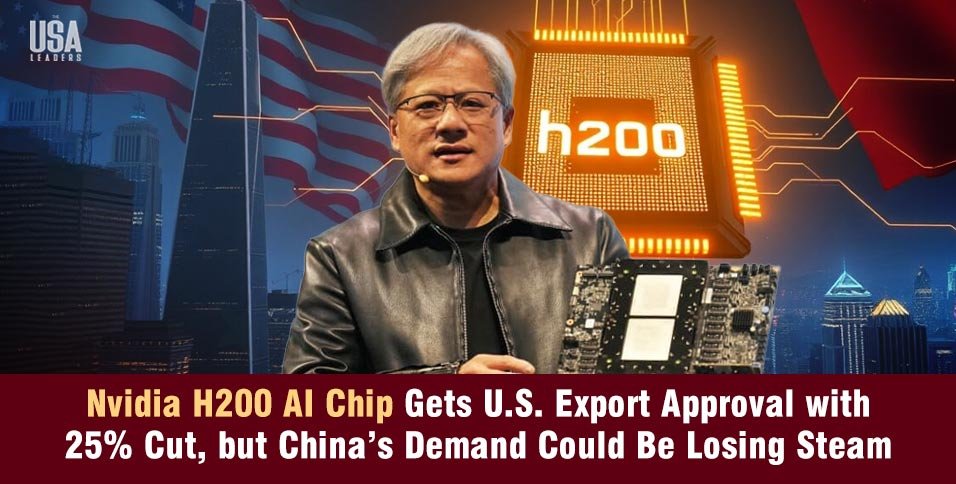
December 09, 2025 – The U.S. has shown a green light for exports of the Nvidia H200 AI chip to China, but only under strict conditions. That includes a requirement that the U.S. gets 25% of sales revenue under a revenue-sharing arrangement.
The H200 AI chip from Nvidia is a high-performance chip with a next-generation AI accelerator. But despite the approval, growing economic, political, and technological headwinds suggest China’s appetite for the chip may be cooler than expected.
Approval of Nvidia H200 AI Chip Sales To China
According to President Donald Trump’s post, the U.S. government has approved shipments of the Nvidia H200 AI chip to China. Along with a 25% portion of sales revenue, the deal also includes stricter end-user vetting and compliance checks before any export is allowed.
For Nvidia, this loosens a previous ban and reopens a potentially major market. For policymakers, it’s a calibrated compromise between economic interests and security concerns.
Nvidia has positioned the H200 as a next-generation AI accelerator, a chip designed to train large machine-learning models and power advanced cloud-based computing.
“We applaud President Trump’s decision to allow America’s chip industry to compete to support high-paying jobs and manufacturing in America,” a spokesman from Nvidia told CNBC in a statement.
Prior to the export approval, many analysts had assumed that China, with its vast tech sector and appetite for AI infrastructure, would immediately become a major customer.
China’s Hesitation Despite U.S. Approval
Even with the new permission, China may choose not to rush into big purchases. There are several reasons for this reluctance:
- Political and regulatory caution:
Chinese officials and state-affiliated media have increasingly emphasised the risk of depending on foreign technologies. Under current leadership, there’s a strong push for “self-reliance” in high tech. That narrative makes buying expensive foreign chips like the Nvidia H200 AI chip politically sensitive.
- Distrust and uncertainty:
Chinese firms may fear future U.S. sanctions or unpredictable changes in export rules. Though now approved, the revenue-sharing model itself could be viewed as a temporary concession rather than a long-term guarantee.
- Tech sovereignty ambitions:
China appears to be doubling down on homegrown alternatives, a move that could undercut demand for foreign chips.
Given these pressures, even a high-performance chip may not guarantee strong demand, especially when national strategy and geopolitics are factored in.
China’s Domestic Competition: Alternatives Gaining Ground
One of the strongest reasons China may hold back on buying the Nvidia H200 AI chip is the growth of domestic AI-chip development. Several Chinese firms, state-backed or private, are now producing AI chips designed for deep learning, cloud computing, and other advanced tasks.
These homegrown chips, while often less powerful on paper than the H200, carry benefits such as lower cost, no export restrictions, and alignment with national policy.
For many Chinese tech firms, investing in local chips is increasingly attractive. Cutting-edge chips may offer performance, but using domestically built hardware helps guarantee long-term stability without the risk of future export bans or political backlash.
As a result, demand may tilt toward local options, making the H200 more of a “prestige purchase” than a need.
Technical and Economic Realities Could Limit Adoption
Beyond politics and competition, practical issues may further dampen demand for the Nvidia H200 AI chip in China:
- High cost and deployment complexity:
Setting up AI infrastructure around H200 depends on more than just hardware. AI infrastructures require compatible software, stable supply chains, and ongoing maintenance. Given current global economic uncertainties and tighter corporate budgets, many Chinese firms may find the total cost prohibitive.
- Risks of future restrictions:
Even though exports are currently approved, companies may still fear that new geopolitical tensions could lead to another round of restrictions. That risk and uncertainty around licensing, compliance, and long-term viability makes the investment in H200-based infrastructure a risky bet for strategic AI projects.
- Compatibility issues:
The H200 was designed primarily for certain cloud environments. Integrating it with Chinese data centres and legacy systems could entail additional overhead in terms of software adaptation and support.
When weighed against cheaper, homegrown alternatives, even if less powerful, it’s easy to see why many Chinese firms might hold off on H200 purchases.
Impact of Limited Demand for Nvidia and U.S. Tech Policy
If China refrains from major H200 chip purchases, the new export approval will not translate into the revenue windfall many in the market expected. For Nvidia, that could mean slower growth in its China-related AI enterprise business than anticipated.
From a policy perspective, the decision to approve exports with a 25% cut and strict controls reflects a balancing act by the Trump Administration and broader U.S. leadership.
On one hand, there’s pressure to support American tech firms and drive global competitiveness. On the other hand, there’s concern over national security and technology transfer to strategic rivals like China.
If demand remains tepid, it raises questions about whether this framework of export plus revenue-share is scalable or sustainable. Future export policies may get tighter again, or instead may pivot toward encouraging domestic innovation rather than relying on such compromises.
The Bigger Picture: China’s Long-Term Strategy
According to President Donald Trump’s statement, “Xi responded positively”. This Xi Jinping’s backing, even if non-formal, offers a signal of goodwill that could smooth over resistance from Chinese regulators.
It suggests that, at least on paper, there may be political space for Chinese firms to consider buying the Nvidia H200 AI chip under the new terms. Chinese firms might treat the H200 as a testing experiment, not a foundational investment. This may offer short-term capabilities. But for China, a long-term strategy seems to favour self-sufficiency.
The limited expected demand suggests that even when geopolitics temporarily loosens, structural shifts in China’s tech strategy could outlast any single policy change.
Conclusion
The U.S. export approval for the Nvidia H200 AI chip, with a 25% revenue-sharing cutoff, represents a significant moment in global tech diplomacy. But approval alone doesn’t guarantee demand.
Between political caution, economic constraints, and long-term strategic goals, China appears unlikely to rush into large-scale purchases.
The H200 might remain a powerful symbol of U.S. AI-chip leadership, but not necessarily a best-seller in China’s evolving market.
For Nvidia and the global tech community, the next few months will reveal whether this is a breakthrough or just another chapter in a slow-moving transition toward tech sovereignty.
Also Read : China’s US Exports Drop By 29%: Are Emerging Economies Replacing the U.S. in the Trade Map?