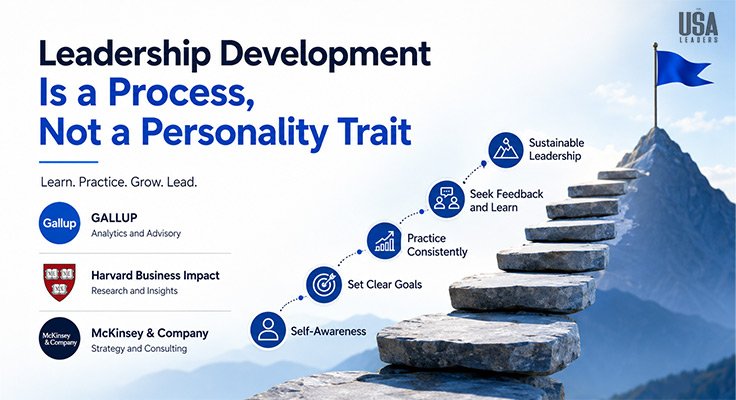
Leadership skills can be learned; they are not something you are born with. People develop these skills step by step through self-reflection, guidance from mentors, small leadership roles, and regular feedback. Most people see meaningful progress with consistent practice over several months, while lasting improvement often takes 9–18 months. Studies show that training and practice, not natural talent, are what create strong leaders.
If you’ve ever wondered, “How can I get better at leading people?” you’re on the right track. Leadership is a skill you can learn, not something you’re just born with. This guide explains what leadership development really involves, how it’s different from management training, the common ways people learn it, the steps most leaders go through, and what research shows about what actually works and how long it takes. Think of it as a simple, practical roadmap to building leadership skills based on real evidence, not guesses.
Why Leadership Development Is a Process, Not a Personality Trait
Many people think leaders are born, not made. In reality, leadership skills are developed over time. A 2025 global study by Harvard Business Impact, based on insights from over 1,100 HR and learning leaders across 14 countries, shows that companies now focus on continuous leadership development instead of one-time training because it leads to real behavior change.
McKinsey’s research on next-generation leadership reaches a similar conclusion from a different angle. Its analysis on scaling leadership development points to six traits that separate stronger leaders over time, including continuous learning, resilience, and a humble mindset, and notes that even leaders who seem naturally gifted still need to keep sharpening these traits deliberately. In other words, talent might set a starting point, but the process is what determines how far someone actually goes.
Seeing leadership as a process takes away a lot of pressure. You don’t need to be perfect to begin just focus on the next step, and the process helps guide you forward. If you want the fundamentals first, our guide on what leadership really means is a useful starting point before working through the process below.
Leadership Development vs. Management Training: What’s the Difference
These two terms are often used as if they mean the same thing, but they are different. Confusing them is a common reason why development efforts fail.
Management training focuses on day-to-day tasks like approving leave, running performance reviews, following project processes, and meeting HR rules. It is mainly about processes and is usually the same for people in similar roles.
Leadership development is different. It is about building good judgment, self-awareness, and the ability to influence others skills that cannot be learned from a checklist. According to McKinsey’s leadership research, many managers know how to do the job, but they often lack self-awareness, humility, and emotional intelligence, which are essential for leading well under pressure.
Management training teaches how things work. Leadership development teaches how to make the right decisions. Most people need both, starting with management.
Types of Leadership Development: Which Format Actually Works?
There is no single correct format for developing leadership skills, and most effective development paths combine several of the following:
- On-the-job stretch assignments. Taking on a project or temporary role that is a little beyond your current job is one of the fastest ways to learn, because the work has real responsibility.
- Coaching. Coaching is a planned, often paid relationship with a professional who helps you reach specific goals over a short period of time.
- Mentoring. Mentoring is a long-term, informal relationship with someone more experienced, who offers general guidance rather than focusing on one specific goal.
- Formal training programs. Structured courses, workshops, or certifications offered by employers or professional organizations help teams build shared understanding and basic knowledge.
- Peer learning groups. Small groups of people at the same level meet regularly to talk about challenges and keep each other accountable. This works well because peers understand daily work better than senior mentors.
- Self-directed learning. Learning through books and case studies is slower, but it supports and strengthens social learning.
Coaching and mentoring are often confused. Coaching is usually short-term, focused on specific goals, and often paid. Mentoring is long-term, more general, and usually informal. Both are useful, and people may need each at different times.
How to Develop Leadership Skills: A Step-by-Step Process
This is the order most people naturally follow. Using it on purpose, instead of waiting for it to happen, helps you move faster.
- First, understand where you are today. Know what you do well and what you need to improve. Ask a manager or coworker for honest feedback, because judging yourself alone is often not accurate.
- Set one clear goal. Instead of saying “be a better leader,” choose something specific like improving how you handle conflicts or delegate tasks. Clear goals are easier to work on and measure.
- Pick the right way to develop. Choose what fits your goal. Coaching can help with communication skills, while a mentor is better for bigger career decisions.
- Start with small leadership tasks. You don’t need a title to lead. Volunteer to run a meeting, manage a project, or help train a new team member. Small steps are the best way to practice leadership.
- Focus on basic skills. Practice clear communication and decision-making, even when you don’t have all the information. These skills solve many everyday leadership problems.
- Ask for feedback regularly. One-time feedback is not enough. Set monthly or quarterly check-ins to learn what is working and what needs improvement.
- Study real leadership decisions, not just theory. Case studies show how ideas work in real situations, not just in theory. Our features on what makes a good leader and high-performing leaders walk through real examples are worth studying.
- Read to widen your perspective. Books let you learn from other people’s experiences, helping you understand life situations before you face them yourself. Start with our list of leadership books, and for a broader reading list beyond business, the best books of all time is a good next stop.
- Reflect every week. Spend 10 minutes thinking about one leadership moment that went well and one that didn’t. This habit leads to steady improvement.
- Review your goal every quarter. Once a skill becomes a habit, choose a new goal. Leadership growth happens step by step and never stops.
None of these steps require a promotion. or a new job title. You just need to do them again and again, in this order.
How Long Does the Leadership Development Process Actually Take?
There’s no fixed timeline, but the research gives a useful benchmark. Gallup’s State of the Global Workplace 2025 report found that managers who completed structured training saw measurable performance gains, between 20% and 28% improvement in manager performance metrics, that were still visible nine to eighteen months later. Their teams saw up to an 18% increase in engagement during the same period.
Most people notice small improvements after a few months of regular practice. However, real and lasting change usually takes about a year of consistent effort, especially when under pressure. Gallup research also shows that many managers around the world never receive formal leadership training. This is why a self-directed approach is important; you don’t need to wait for your company to provide training.
What the Research Says About Leadership Development
As you plan your growth, keep a few key data points in mind they show this skill is important, not optional.
- Gallup’s 2025 research shows that structured manager training improved manager performance by 20%–28% and increased team engagement by up to 18%, with benefits lasting 9 to 18 months.
- Organizations are moving away from one-time leadership training and focusing more on ongoing, structured development, according to Harvard Business Impact’s 2025 study of over 1,100 learning and development professionals in 14 countries.
- McKinsey’s research shows that the best leaders keep learning and stay humble, seeing growth as a continuous process rather than something they ever finish.
Overall, this research shows that leadership development is a long-term investment with real results, not a one-time activity.
What Can Slow Down Your Leadership Growth
Some habits can stop progress before it even begins. Relying on just one way of making decisions can slow your growth, because different situations need different approaches. What works in an emergency may not work in calm situations. Another common mistake is skipping feedback. When you practice alone without outside input, you may think you’re improving, but hidden mistakes can last for years instead of being fixed quickly.
Some habits can hurt trust in a team instead of helping growth. Taking credit for others’ work, blaming others for mistakes, or reacting poorly to feedback are signs that personal growth has stopped. These issues usually cannot be fixed by reading a book or taking a course.
Our guide on toxic leadership covers how to recognize that shift. Relying too heavily on a single controlling style is a related risk; our breakdown of autocratic leadership covers when it helps and when it holds a team back. Recognizing these patterns early is more important than ignoring them, and it often helps to get support from a mentor, coach, or manager.
Conclusion
Leadership skills grow through consistent practice, honest feedback, and clear goals. Start with self-assessment, choose one specific goal, and build through small leadership opportunities and regular reflection. Real progress takes time, but steady effort creates lasting results.
Leadership is built step by step, not overnight. Start small, stay consistent, and review your growth regularly.
FAQs
- How do I start developing leadership skills with no formal title?
Start by handling a small task that no one else wants. Leadership is shown through action, and titles come later.
- What’s the fastest way to improve as a leader?
Regular feedback helps people improve faster because it gives clear and useful guidance.
- Do you need a mentor to develop leadership skills?
A mentor is not necessary, but having one helps you learn faster and avoid common mistakes.
- What’s the difference between coaching and mentoring?
Coaching is usually short-term, focused on specific goals, and often paid.Mentoring lasts longer, covers broader guidance, and is usually informal. Many people use both at different times in their lives.
- How is leadership development different from management training?
Management training teaches what to do. Leadership development teaches how to think and lead people.