The USA Leaders
August 17, 2026
Quick Facts: US Measles Resurgence at a Glance
| Who | The CDC, state health departments, the World Health Organization, and UNICEF are tracking the surge. Most cases involve unvaccinated people. |
| What | 2,566 confirmed measles cases in the U.S. so far in 2026, tied to 38 new outbreaks. |
| Where | 47 U.S. states and jurisdictions, plus outbreaks in over 100 countries worldwide. |
| When | The outbreak remains active through 2026. The CDC updates case counts every Thursday. |
| Why | Kindergarten MMR vaccination coverage has fallen below the 95% herd-immunity threshold. |
A Disease America Eliminated Is Back on the Map
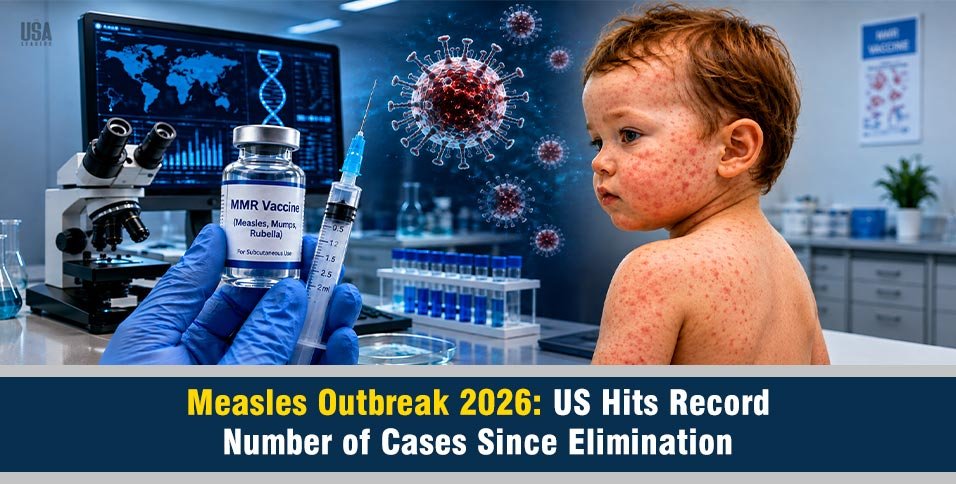
Measles is one of the most contagious viruses, and cases are rising across the U.S. in 2026.
As of August 13, the CDC has reported 2,566 measles cases across 47 U.S. jurisdictions. That is already close to the 2,289 cases reported for all of 2025, with several months still left in the year.
About 94% of the 2026 cases are linked to 38 active outbreaks, rather than isolated cases brought in by travelers.
In 2024, the U.S. reported only 285 cases. In just two years, measles cases have increased nearly nine times, showing a clear and ongoing rise.
Why Measles Outbreak Cases Keep Climbing in 2026
Measles was declared eliminated in the U.S. in 2000. Elimination does not mean the virus vanished; it means it stopped spreading on its own within the country. It still returns through unvaccinated travelers, and once it reaches a community with low immunization rates, it spreads quickly.
Measles is one of the most contagious diseases. In 2026, it is spreading across many U.S. states.
Lower vaccination rates are the main reason for the rise in cases. MMR vaccination among U.S. kindergartners fell from 95.2% in 2019–2020 to 92.5% in 2024–2025. This means about 286,000 children are not protected. When vaccination rates fall below 95%, communities face a much higher risk of measles outbreaks.
Measles is not a seasonal illness, but it spreads readily in crowded settings. Summer travel, camps, and family gatherings create exactly the conditions this virus needs to move between people.
Measles Outbreak Symptoms: What to Watch For
Symptoms usually develop 7 to 14 days after exposure, and they do not begin with the rash most people picture. The early warning signs are easy to mistake for a common cold.
- High fever, often above 103°F
- Cough, runny nose, and red, watery eyes
- Tiny white spots inside the mouth (Koplik spots), a telltale early sign
- A red, blotchy rash that starts on the face and spreads down the body 3 to 5 days later
An infected person becomes contagious four days before the rash even appears, a detail that catches many people off guard. They can spread measles to a room full of people before anyone realizes they are sick, and the virus can remain airborne for up to two hours after they have left the room.
Measles Outbreak: Vaccinated vs. Unvaccinated
The MMR vaccine remains the most effective defense against measles, and the data supports this clearly. Two doses provide approximately 97 percent effectiveness against infection. A single dose of the measles vaccine still provides roughly 93 percent protection.
Vaccinated individuals can still contract measles in rare instances, though such cases remain uncommon. CDC data shows breakthrough infections in vaccinated people account for around 10 percent of cases, consistent with prior years. When breakthrough infections occur, they typically happen in communities already experiencing heavy outbreak circulation, and symptoms tend to be milder.
The overwhelming majority of 2026’s serious cases and nearly all hospitalizations are concentrated among unvaccinated individuals or those with unknown vaccination status. Vaccination protects more than the individual who receives it; it also serves as the barrier that prevents outbreaks from escalating into epidemics.
Is Measles Deadly? What the Data Shows
The answer is yes, and not merely in a historical sense. Before the vaccine arrived in 1963, measles hospitalized an estimated 48,000 Americans and killed 400 to 500 people every year, mostly young children.
The global toll remains substantial. UNICEF estimates measles kills nearly 300 people every day worldwide, roughly 12 per hour, overwhelmingly young children under the age of five. The World Health Organization puts 2024’s global death toll at approximately 95,000 people, even after decades of vaccination progress prevented an estimated 59 million deaths between 2000 and 2024 alone.
Survivors do not always escape complications. Severe cases can lead to pneumonia, encephalitis (brain swelling), and blindness. The virus can also trigger a phenomenon researchers call immune amnesia, in which it erases existing immune memory and leaves survivors more vulnerable to other infections for up to two years afterward.
Measles Outbreak Worldwide: The Global Picture in 2026
The United States is not fighting this alone, and it is not even the hardest-hit region globally. UNICEF reports measles outbreaks have struck more than 100 countries over the past five years, home to roughly three-quarters of the world’s children.
Measles is one of the most contagious viruses. In 2026, it is spreading across many U.S. states. Global vaccination rates show why. In 2025, only 77% of children received both measles vaccine doses, while 84% received their first dose on time. Experts say at least 95% coverage is needed to prevent outbreaks.
This gap leaves about 29 million babies worldwide under-protected. Many are in Asia, Africa, and parts of Europe still dealing with the effects of the major 2024 measles surge.
UNICEF, the world’s largest vaccine buyer, delivers around 250 million doses of measles-containing vaccine every year across more than 90 countries. This represents an enormous logistical effort and is also the primary reason global measles deaths have declined as significantly as they have since the 1980 peak of 2.6 million annual deaths.
Measles is not the only outbreak drawing scrutiny from health officials in 2026. A recent cyclosporiasis outbreak in the US has also strained state surveillance systems, while international health agencies continue monitoring a separate Ebola virus outbreak overseas.
Why This Matters Beyond Public Health
For anyone tracking healthcare markets, this outbreak represents more than a headline. Rising case counts place pressure on hospital systems, including many of the top hospitals in the US, already stretched thin. The surge also increases the need for quick testing and MMR vaccines. It also puts pressure on state public-health budgets for next year.
In 2026, outbreak preparedness has become an important budget issue. Vaccine makers, urgent care centers, and schools are updating their plans for a virus the U.S. thought it had eliminated 25 years ago.
The Bottom Line
Measles requires no passport to spread, only an opening in immunity coverage. Declining vaccination rates are currently providing exactly that opening, both in the United States and globally. The data clearly indicates what closes that opening: restoring kindergarten MMR coverage above 95 percent.
Until that happens, this story is likely to continue making headlines throughout the remainder of 2026.
Related Reading: Medicaid Cuts 2026: Who Is Losing Coverage First and How to Protect Yourself
Author: Tejas Jadhav