
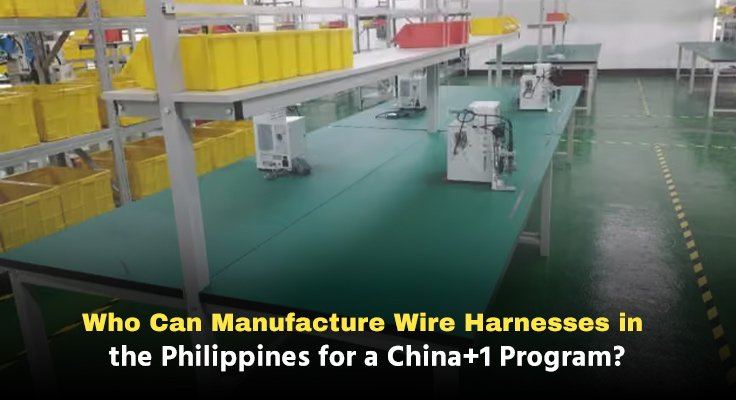
A Philippine factory gives a wire harness buyer another assembly location outside China. But two factories may still depend on the same connector supply. If that connector becomes unavailable, both may be waiting for it. Choosing a second location starts with understanding which part of the production route it changes.
A China+1 program adds production outside China rather than necessarily replacing the existing supplier. A buyer may want a second assembly location or, for US-bound goods, to assess different tariff treatment where the finished harness qualifies as Philippine-origin. Start with that objective, then trace the parts and design information the additional route needs.
Follow the parts, not just the factory address
The bill of materials, or BOM, lists the parts in the harness. Use it to examine where each route gets its wire, terminals, connector housings and any custom molded parts. The immediate seller and the underlying source may be different, so buying a connector through another distributor does not necessarily create a different component dependency.
Shared components are not automatically a reason to reject a route. Keeping the approved connector may be necessary for the equipment interface. The point is to know what remains shared and what the Philippine operation changes.
If the aim is to reduce reliance on one assembly site, shared component sourcing may fit the program. If the aim is to keep producing during a component shortage, another assembly site alone may not be enough. That program may also need an approved alternative or an agreed material plan.
This distinction makes a supplier discussion more useful. Instead of asking whether a factory provides China+1 production, ask which dependency the proposed arrangement would remove and which it would retain.
Make the design transferable
A receiving factory needs a buildable description of the released harness. The drawing should establish dimensions and branch positions. The wire list should show which contact connects to which. The BOM should identify the specified components, with the revisions that belong to the same release.
A finished sample can explain features that are difficult to show on paper, but should not become the only source of design information. If the factory must infer a wire specification or connector identity from the sample, the transfer is incomplete.
Process information also matters. Identify any fixtures, termination tooling or inspection instructions needed to reproduce the assembly. The Philippine factory does not necessarily need identical machines, but the team must resolve how its build method will meet the approved requirements.
If engineering knowledge or custom tooling remains with the existing route, describe how the receiving site will get support. Shared engineering can help the transfer while remaining a dependency of the new arrangement.
XUDONG Philippines combines wire harness and cable assembly in Cavite, Philippines, with parent-group harness expertise and mold-engineering support. That arrangement is relevant to a buyer adding assembly outside China while retaining access to group engineering resources for the harness design and tooling.
This offers a Philippine assembly route with shared engineering resources. It should not be confused with a supplier organization independent of the group.
Keep the routes on the same release
Once both routes are building, a drawing change needs to reach both of them. Otherwise, the same orderable part number could refer to different configurations depending on which site made it.
Define when a revision takes effect and what happens to parts already purchased or harnesses already assembled. The answer may differ between sites because their material and work-in-progress positions differ. Record that difference rather than assuming the same changeover date is practical everywhere.
Substitutions need similar treatment. If one route proposes another terminal or housing, engineering should decide whether it is acceptable and whether the approval applies to one route or both. Availability does not establish equivalence.
These decisions belong in the transfer arrangement before an urgent order exposes them. They give the receiving factory a way to keep building without quietly changing the approved design.
Demonstrate the route you intend to use
A sample made at the existing source may help settle an installation question, but it does not demonstrate production at the receiving site. Confirm the physical sample location and distinguish design approval from approval of the Philippine build process.
An initial build at the intended site should use the agreed design package and materials. Review the resulting assembly and the relevant build and test records against the application’s requirements. If the route will serve as a backup, also define how it will stay ready as revisions and component availability change.
For US imports, Section 301 duties on covered Chinese goods depend on country of origin, not the country of shipment. A harness that qualifies as Philippine-origin may therefore receive different tariff treatment from a China-origin harness. Other duties can still apply, so compare the applicable duty treatment using the actual product classification and origin determination. Philippine assembly alone does not settle origin or establish savings.
A China+1 harness program is ready to assess when the buyer can trace both the materials and the released design through the additional route. That shows what has changed, what remains shared and how the Philippine build will stay consistent with the equipment it serves.