
The USA Leaders
October 16, 2026
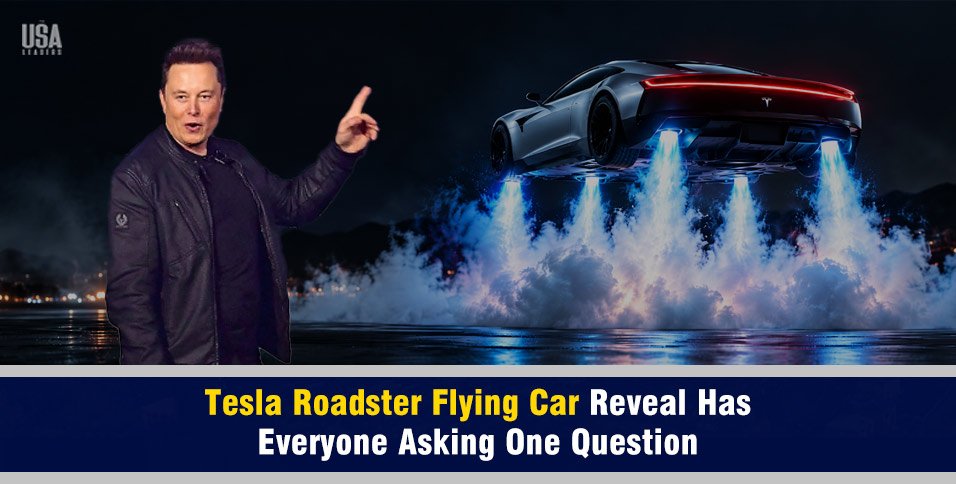
Austin, Texas – Tesla Roadster flying car plans are bringing attention to the future of electric vehicles and high-performance transportation. Tesla Roadster flying debut, associated with Elon Musk’s vision of a flying vehicle, has sparked interest in how the company could expand the possibilities of personal mobility.
The Tesla flying car builds on Tesla’s long-running plans for the Tesla Roadster 2, an electric sports car designed to deliver exceptional acceleration and performance. The latest Tesla flying car announcement puts the spotlight on what comes next for Tesla, including whether advanced vehicle technology could eventually move beyond conventional road travel.
What Is the Tesla Roadster Flying Car Announcement About?
The key question surrounding the Tesla Roadster flying car is whether it can genuinely fly or is primarily a high-performance electric sports car with experimental flight capabilities. While the latest reveal has showcased flight-related features, questions remain about its practical use, production readiness, and eventual availability to consumers.
Elon Musk, the CEO of Tesla, has previously described ambitious plans for the Roadster, and the latest Tesla flying car announcement has renewed discussion about the possibility of flight-related technology. However, a public reveal or demonstration does not necessarily mean it’s ready for mass commercial use.
For consumers, the distinction matters. A high-performance electric sports car and a road vehicle capable of controlled flight would involve different engineering requirements, operating conditions, and safety considerations.
How Tesla Roadster 2 Reached Was Able to Take Flight
The flight capability of the Tesla Roadster 2 reportedly stems from Elon Musk’s vision of combining electric vehicle engineering with experimental flight technology. While Tesla has focused on electric propulsion, battery technology, and performance engineering, the exact technology enabling the Roadster’s reported flight demonstration and its practical capabilities remain to be confirmed.
The Tesla Roadster 2 has been anticipated for years as the successor to Tesla’s original Roadster, which helped introduce the company as a manufacturer of electric sports cars.
Tesla’s broader development strategy has focused on combining electric propulsion with software, battery technology, and performance engineering. The next-generation Roadster represents an extension of that approach, with ambitious targets intended to distinguish it from traditional sports cars.
The next important steps will be translating announced capabilities into a production vehicle, confirming its specifications and establishing when customers can realistically expect deliveries.
How Could the Tesla Flying Car Affect the Auto Industry?
The Tesla flying car announcement could influence conversations across the automotive industry, particularly around electric performance, advanced engineering, and new transportation concepts.
Three areas are worth watching:
- Electric vehicle innovation: The Roadster keeps attention on how electric powertrains can deliver rapid acceleration and high performance.
- New vehicle technologies: Flight-related concepts could encourage manufacturers and technology companies to explore new approaches to personal transportation.
- Competition in premium vehicles: A production-ready Roadster with exceptional performance could create new benchmarks for electric sports cars and encourage competing brands to develop their own high-performance models.
For example, if Tesla delivers a road-legal sports car with the announced acceleration capabilities, other automakers may face greater pressure to improve performance while maintaining range, reliability and everyday usability.
Flight capability, however, would introduce a separate set of challenges involving vehicle design, operating rules, infrastructure, and public safety. Its commercial impact would depend on what Tesla ultimately delivers.
What Does the Tesla Roadster Flying Car Mean for Consumers?
For everyday drivers, the Tesla Roadster flying car concept is more a glimpse of experimental technology than an immediate change to daily transportation.
The Roadster is a premium sports car, so its initial audience is likely to differ from that of mainstream electric vehicles. Most consumers will continue to prioritize purchase price, driving range, charging access, reliability, and safety when choosing a car.
If elements of the Tesla flying car technology eventually become practical for wider use, they could influence future vehicle engineering. However, flying capabilities would require additional testing, appropriate infrastructure and regulatory approval before they could become part of ordinary road travel.
Tesla’s announced production target is 2028, meaning interested customers will need to wait for further details about the final vehicle, pricing, and availability.
What Comes Next for Tesla and the Automotive Industry?
The Tesla Roadster 2 provides an opportunity to demonstrate its engineering capabilities while exploring ideas that combine automotive and aerospace technology.
The Tesla flying car project also reflects a broader industry trend: automakers are competing not only on vehicle design and efficiency but also on software, performance, and new forms of mobility. Partnerships between automotive and aerospace engineering teams could provide opportunities to test technologies that may eventually find uses beyond specialized vehicles.
Still, the commercial significance of the Tesla Roadster 2 will depend on production readiness, customer demand, and the ability to deliver the promised features in a usable vehicle.
The Tesla Roadster flying car reveal is an important moment in the company’s pursuit of high-performance electric mobility. Whether its flight-related technology becomes commercially practical remains to be seen, but the development offers a look at how Tesla and the wider automotive industry may continue exploring the boundaries of personal transportation.
Neelmani Yadav