The USA Leaders
July 06, 2026
Quick Facts: Ebola Outbreak 2026 At a Glance
| Category | Details |
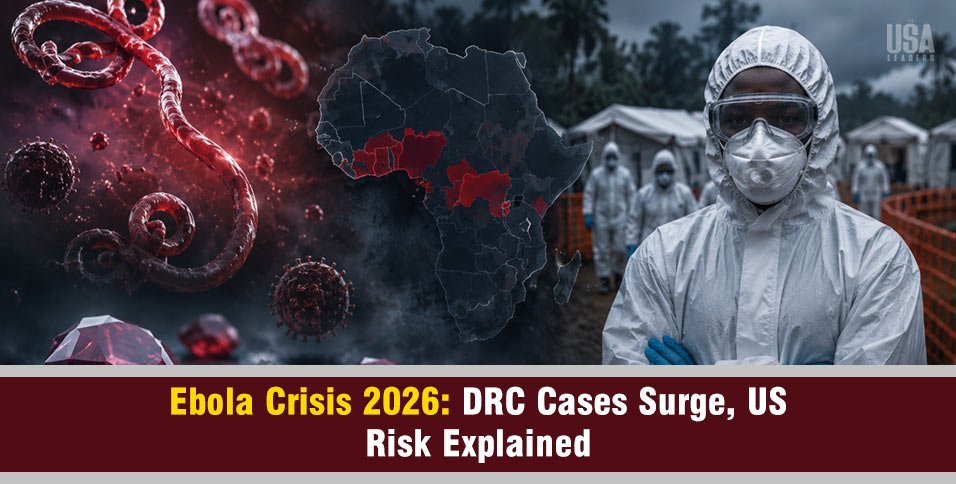
| Who | Democratic Republic of the Congo (DRC) & Uganda; 17th DRC Ebola outbreak on record |
| What | Ebola disease caused by the Bundibugyo virus strain |
| Where | Epicenter: Ituri Province, DRC; spread to North Kivu, South Kivu, and Kampala, Uganda |
| When Declared | May 15, 2026 |
| Confirmed Cases | 1,481 (as of July 3, 2026) |
| Confirmed Deaths | 454 |
| US Risk Level | Low, per CDC |
The Bundibugyo Strain: Not Your Standard Ebola
Here’s the twist that’s kept virologists up at night: this isn’t the Ebola strain most treatments were built for.The outbreak is caused by the Bundibugyo strain, which is harder to control because current Ebola treatments work mainly for the Zaire strain. There is also no specific vaccine available for this strain yet.
Researchers are not starting from scratch. A WHO-supported trial is testing the antiviral drug remdesivir along with antibody treatments. Three Ebola vaccine candidates are also being fast-tracked. Scientists are working quickly, but the virus already has an early lead.
Why This Outbreak Got Away From Everyone
This is what turns a regular health update into a story worth paying attention to.
An Ebola outbreak in central Africa has become worse after the US and other Western countries cut foreign aid, experts say. This happened about a year after the US reduced its international health support. These concerns are not political opinions; many independent news outlets report the same findings.
The reasons are clear but serious. Funding was cut in four major areas: less support for the World Health Organization, the shutdown of USAID, budget cuts at the CDC, and reduced health aid to the Democratic Republic of Congo and Uganda. Health expert Josh Michaud told CNN that when all these cuts happen at once, it strongly weakens disease monitoring and outbreak response systems.
Virologist Angela Rasmussen told CNBC that budget cuts have clearly made the outbreak worse. Less funding has weakened trust in health workers and made contact tracing and treatment more dangerous in Ituri Province. Essential supplies like PPE and body bags are also not reaching the hardest-hit areas. While “efficiency” may look good on paper, the real impact is seen when life-saving supplies are missing.
That said, the response has not stopped completely. The CDC says it has about 100 staff in Uganda and nearly 30 in the DRC, along with extra emergency support. The response is smaller than before, but it is still active.
Is the US at Risk? What Travelers Need to Know
The quick answer: very little has changed, but protections are active.
On May 15, 2026, the CDC issued a Level 1 travel alert for Uganda and a Level 3 alert for the DRC. Starting May 18, the US restricted entry for travelers who had been in the DRC, Uganda, or South Sudan within the last 21 days. So far, the CDC reports no Ebola cases linked to this outbreak in the United States.
The situation also affects the 2026 FIFA World Cup. DRC’s national team reduced its training camp in Kinshasa but still plans to travel through Europe and Texas before the tournament. A global health emergency can create challenges for major sports events.
The Global Response: Money, Vaccines, and a Ticking Clock
Aid is coming, but not mainly from the US. The UK promised up to £20 million, the US later announced $112 million for protective gear, testing, and screening, and the EU pledged €15 million. On the ground, Médecins Sans Frontières opened three treatment centers in Bunia, Goma, and Mongbwalu by mid-June.
Funding for vaccines is also moving forward. CEPI gave $50 million to Moderna, $8.6 million to Oxford, and $3.2 million to IAVI to speed up vaccine development. This is a global effort, but the US role is smaller than expected.
What Happens Next
The risk in the DRC is still very high because the virus is spreading and reaching new areas. Uganda’s risk is high due to confirmed cross-border cases. This means the outbreak is not over, and upcoming WHO reports will be important.
Source – European Centre for Disease Prevention and Control
For U.S. analysts and professionals, this issue is less about the virus and more about policy. Budget cuts may seem like numbers on paper, but during an outbreak, they can cost lives. That’s the link between federal layoffs and an epidemic spreading across regions—and it’s why future funding decisions matter.
Conclusion
The Ebola outbreak remains an active, high-risk emergency. As of July 2026, WHO has reported 1,481 cases and 454 deaths, with the DRC’s risk level assessed as very high. Most cases are in Ituri Province, where response efforts are focused. Cases in Uganda and one in France show why global monitoring is important, even though the overall risk is still low.
There is no approved vaccine for the Bundibugyo strain, so stopping the outbreak depends on fast action, proper funding, and strong coordination. However, cuts to U.S. aid and the closure of USAID have slowed response efforts, making it harder to act quickly when time is critical.
For the United States, the CDC says the risk remains low, with travel alerts and health checks in place. The bigger issue is global readiness. Ebola doesn’t need to reach the U.S. to be a threat; it shows how well the world can respond in a crisis. In 2026, the outbreak can still be contained, but only if action is taken without delay.
Also Read– Ebola Outbreak 2026: WHO Declares Emergency: What Americans Need to Know