The USA Leaders | June 15, 2026
Quick Facts: Paramount–Warner Bros. Discovery Merger
| Details | Information |
| Deal Name | Paramount Skydance Acquisition of Warner Bros. Discovery |
| Deal Value | $110.9 billion ($31 per share, all-cash) |
| Agreement Announced | February 27, 2026 |
| Shareholder Vote | Approved — April 23, 2026 |
| Expected Close | Q3 2026 (pending regulatory approvals) |
| Regulatory Status | Under review — US DOJ, EU, UK CMA, Canada, Australia |
| Losing Bidder | Netflix ($82.7B offer withdrawn February 26, 2026) |
| Combined Streaming Subs | ~207 million (projected) |
| Projected Annual Revenue | ~$70 billion (projected) |
| Key Assets | Warner Bros., HBO/Max, DC Studios, CNN, CBS, TNT Sports |
The Biggest Media Deal in Years Just Got Greenlit
Hollywood loves a comeback story, and this could be the biggest one the industry has seen in decades.
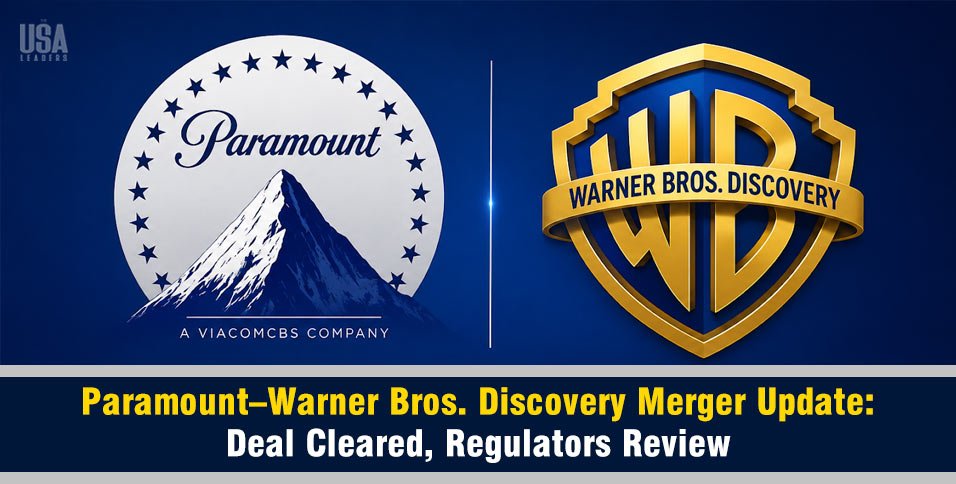
Paramount Skydance has signed a final deal to buy Warner Bros. Discovery for $110.9 billion in an all-cash transaction at $31 per share. Shareholders approved the deal on April 23, 2026, ending one of the biggest bidding battles in entertainment history. Paramount ultimately outbid Netflix in a dramatic acquisition battle for Warner Bros. Discovery, offering a superior all-cash proposal that Netflix declined to match. Paramount Skydance outbid Netflix in WBD acquisition
The deal doesn’t just reshape two companies. It rewrites the map of global streaming.
How Paramount Beat Netflix to the Prize
This was not an easy win for Paramount. The company had to compete aggressively. After receiving interest from several bidders, the Warner Bros. Discovery board decided to put the company up for auction on October 21, 2025. By December 2025, Netflix had become the leading contender, announcing an $82.7 billion deal to acquire WBD’s studio and streaming business.
Netflix’s bid seemed finalized until Paramount stepped in. On December 8, 2025, Paramount made an all-cash offer of $30 per share for WBD, valuing the company at about $108.4 billion. Although WBD’s board first rejected the offer, activist investors such as Ancora Holdings and Pentwater Capital strongly opposed the decision.
The Decisive Moment
After Netflix gave Paramount a seven-day waiver on February 17, 2026, Warner Bros. Discovery reopened talks. On February 26, 2026, WBD confirmed that Paramount’s higher offer of about $111 billion ($31 per share) beat Netflix’s bid. Netflix co-CEOs Ted Sarandos and Greg Peters chose not to match the offer and withdrew, saying the deal was no longer financially attractive.
Paramount emerged as the winner. David Zaslav called the result a “tremendous value for shareholders” and wished Netflix well, offering a polite closing after months of intense corporate rivalry.
What Shareholders Actually Voted On
The April 23 vote wasn’t simply a rubber stamp.
WBD shareholders approved the Paramount–Skydance acquisition on April 23, 2026. At the same meeting, they rejected the pay packages for CEO David Zaslav and other top executives.
This second vote is important. Shareholders supported the deal but opposed the $886 million executive payout, which advisory firm ISS had already called “extraordinary.”
Both companies’ boards have unanimously approved the deal, which is expected to close in Q3 2026, pending standard conditions such as global regulatory approvals. If the deal does not close by September 30, 2026, WBD shareholders will receive a quarterly fee of $0.25 per share until the transaction is completed.
What the $110.9B Media Merger Means for Streaming
If Paramount Acquires Warner Bros., What Changes? This is the question most consumers are asking. Here’s what the deal means in practice.
Streaming Consolidates
In March 2026, Paramount said it will merge Paramount+ and HBO Max into one streaming service after the deal is complete. Users will access content from both studios on a single platform.
Sports Broadcasting Gets Bigger
On April 2, 2026, Paramount and Skydance announced plans to combine CBS Sports and TNT Sports once regulators clear the acquisition. The resulting operation would rank among the most comprehensive sports broadcast networks in the United States.
The Combined Company by the Numbers
Paramount estimates that the combined company will generate about $70 billion in yearly revenue, $16 billion in EBITDA, and $10 billion in cash flow, serving nearly 207 million streaming subscribers worldwide.
Legacy Networks Reunite
The combined portfolio would reunite MTV, Nickelodeon, VH1, and Comedy Central with Warner’s brands after more than 40 years apart. For media analysts, it’s like bringing the old band back together and filling stadiums again.
Regulatory Timeline: US, EU, UK, Canada?
Q3 2026 is the target, but that timeline isn’t guaranteed.
The deal is expected to take 6 to 18 months to close. David Zaslav has noted that the process could take longer if more global regulators request further review. Below is the current status.
| Jurisdiction | Body | Under active review |
| United States | DOJ Antitrust Division / FTC | Under active review |
| European Union | European Commission | Phase 1 cleared — April 29, 2026 |
| United Kingdom | Competition and Markets Authority (CMA) | Under review |
| Canada | Competition Bureau | Under review since March 26, 2026 |
| Australia | ACCC | Under review since May 1, 2026 |
On April 29, 2026, WBD successfully passed the Phase 1 review by European antitrust regulators. The EU approved the deal without any conditions, indicating minimal competition concerns and helping speed up the merger timeline.
The US review carries the most weight. The DOJ reviewed Netflix’s competing bid with significant scrutiny. Paramount has consistently argued its own transaction raises no comparable competition concerns, and regulators haven’t publicly disagreed, at least not yet.
Who Pushed Back on the Merger and Why
A $110 billion deal doesn’t usually get praise from everyone, and this one faced strong backlash. In April 2026, over 4,000 actors, directors, writers, and other creative professionals signed an open letter against the acquisition. This wasn’t a small protest; it reflected serious concern from a large part of Hollywood’s creative community.
Cinema United warned that more consolidation could lead to fewer movies in theaters and give studios more power over exhibitors. In contrast, AMC Theatres CEO Adam Aron supported the deal in April 2026, showing that not all theater owners are concerned.
Why This Deal Matters Beyond Hollywood
It’s tempting to frame this as two studios merging. The real story is about who controls the future of storytelling at scale.
The merged company will own Warner Bros. and Paramount’s film, TV, and video game studios, HBO/HBO Max, DC Studios, multiple cable and broadcast networks, vast content libraries, and major sports rights.
That means Batman, Barbie, Mission: Impossible, Game of Thrones, Yellowstone, March Madness coverage, and NFL programming under one corporate roof. For advertisers, it creates a reach rival to Disney. For subscribers, it promises fewer apps to manage eventually.
Of the $110.9 billion deal, $24 billion was funded by sovereign wealth funds from Saudi Arabia, Qatar, and the UAE. Each holds less than a 25% stake, keeping the acquisition outside CFIUS national security review. Even so, foreign investment backing a major U.S. media company is likely to face continued attention in Washington.
The Bottom Line
The Paramount–Warner Bros. Discovery deal has cleared shareholders, progressed through early regulatory review, and targets a Q3 2026 close. It stands as the most consequential media transaction since Disney acquired 21st Century Fox, and its effects will reshape every corner of the entertainment industry.
“For investors, the $31-per-share all-cash deal offers certainty that Netflix never did. For consumers, one combined streaming platform sounds attractive if Paramount can deliver. For Hollywood creators, concerns about jobs, creative freedom, and content variety are still unresolved.”
In short: the deal is signed and approved, but the real story begins the day it closes.