The USA Leaders
March 26, 2026
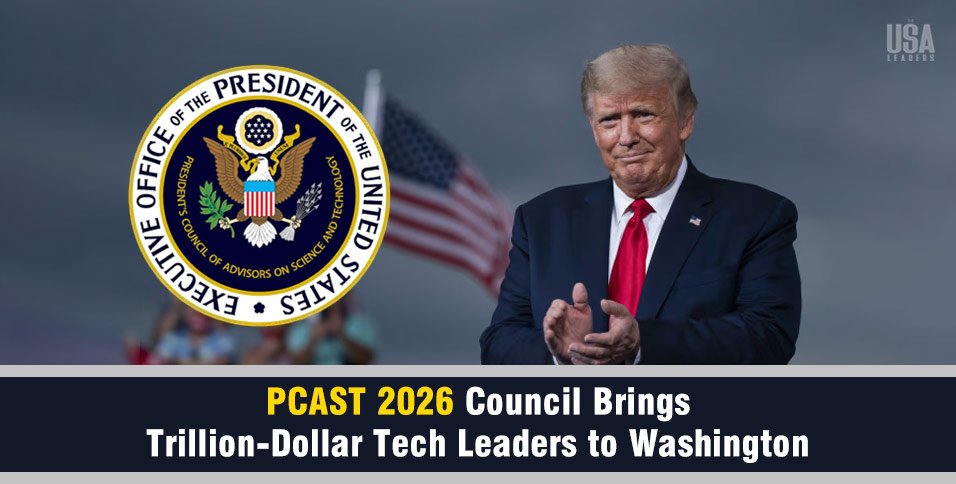
President Donald Trump has assembled one of the most powerful technology advisory groups in modern US history.
The President’s Council of Advisors on Science and Technology (PCAST 2026) includes leaders from companies that together represent more than $10 trillion in combined market value.
Venture capitalist David Sacks and former US Chief Technology Officer Michael Kratsios co-chair the council.
According to the White House, the goal is clear. The administration wants to remove bureaucratic barriers and accelerate innovation in artificial intelligence, crypto, and advanced computing.
For US businesses and investors, this council signals a new phase where government policy and Silicon Valley leadership work more closely together.
The Industry Leaders Powering the PCAST 2026
Unlike traditional advisory boards dominated by academics, the PCAST 2026 brings together active CEOs and technology founders.
These leaders run companies that shape global technology markets and US economic competitiveness.
The AI Titans
The council includes executives who control the infrastructure of the global AI economy.
- Jensen Huang, CEO of Nvidia, leads the company that produces the GPUs powering most advanced AI systems. NVIDIA’s market value exceeded $2 trillion in 2026.
- Dr. Lisa Su, CEO of AMD, joins the council as a pivotal leader in the semiconductor space, ensuring the U.S. has a competitive and resilient chip supply chain.
- Mark Zuckerberg, CEO of Meta, oversees a company valued at nearly $1.3 trillion and invests billions annually in artificial intelligence and virtual computing platforms.
- Sergey Brin, co-founder of Google, helped build one of the world’s most influential technology companies. Alphabet’s market capitalization remains above $1.8 trillion.
Together, these leaders shape the computing systems that drive modern AI development.
Infrastructure and Cloud Leaders
Another group focuses on enterprise software, cloud infrastructure, and global technology supply chains.
- Larry Ellison, co-founder of Oracle, built one of the largest enterprise software companies in the United States. Oracle’s market value stands above $400 billion.
- Safra Catz, Oracle’s CEO, leads the company’s push into cloud infrastructure and AI data platforms.
- Michael Dell, founder of Dell Technologies, built a computing giant with more than $88 billion in annual revenue.
These companies supply the servers, data centers, and security systems needed for large-scale AI deployment.
The Disruptors
Several members represent emerging technology sectors that could reshape the global economy.
- Marc Andreessen, co-founder of venture capital firm Andreessen Horowitz, manages billions in investments across artificial intelligence, fintech, and defense technology.
- Fred Ehrsam, co-founder of Coinbase, helped build one of the largest cryptocurrency exchanges in the United States.
- David Friedberg, CEO of The Production Board, bridges the gap between technology, venture investing, and agricultural innovation.
- Jacob DeWitte, CEO of Oklo, leads a company developing next-generation nuclear reactors designed to power energy-intensive AI infrastructure.
These innovators bring venture capital, crypto finance, and advanced energy into the policy conversation.
The Frontiers of Science: Energy & Quantum Computing
While the council is heavy on business leadership, it includes world-renowned scientists tasked with solving the physical constraints of the AI era, namely, power and processing limits.
- Bob Mumgaard, CEO of Commonwealth Fusion Systems, leads the race for clean, limitless fusion energy. His expertise is critical as AI data centers require record-breaking amounts of electricity to operate.
- John Martinis, Quantum Computing Expert, is a world-renowned physicist and former lead for Google’s Quantum AI team. He ensures the U.S. maintains its lead in the global race for quantum supremacy.
Top Priorities for the Council
The administration expects the council to advise on several national technology priorities.
First is AI dominance. The US government wants to maintain leadership in artificial intelligence development and infrastructure.
Second is energy innovation. Advanced computing requires a massive electricity supply. Nuclear and fusion technologies may provide long-term solutions.
Third is quantum computing. Researchers such as John Martinis will help guide the United States toward breakthroughs that could redefine computing power.
Finally, the council will address the American workforce. Automation will reshape industries, and policymakers want to balance productivity gains with job creation.
Why This Matters for the US Economy
The structure of this council signals a shift in how Washington approaches innovation policy.
Instead of relying mainly on academic advisors, the government now consults executives who lead trillion-dollar companies.
This creates a direct bridge between federal policy and private sector innovation.
For American businesses, the strategy aims to accelerate technology leadership while strengthening economic growth.
For global competitors, it sends a message that the United States intends to remain the center of the AI economy.
A Science Council With Deep Roots
The President’s Council of Advisors on Science and Technology traces its origins to 1933, when President Franklin D. Roosevelt created early science advisory groups during the New Deal.
The modern council structure evolved across several administrations, as explained in the history of the council published by the Obama White House archives.
However, the PCAST 2026 council looks very different.
Previous councils relied heavily on university researchers. The current group includes founders, CEOs, and investors who actively build the technologies shaping the global economy.
That shift reflects a simple reality. In the AI era, the most important innovation decisions increasingly happen inside private technology companies.
Conclusion
The 2026 PCAST represents one of the most business-focused science advisory groups in US history.
By bringing together founders, CEOs, investors, and researchers, the administration has created a leadership network capable of influencing the direction of artificial intelligence, digital finance, and advanced energy.
For the United States, the outcome could shape the next decade of technological leadership. The decisions made by this council may determine whether America remains the center of the global innovation economy.