
A food and beverage plant makes what it sells, and it makes something else too: a steady stream of organic material that has to go somewhere. Every operation must decide what happens next. For nearly two decades, one company has built its answer on a simple premise. The leftovers are not an ending. They are a beginning.
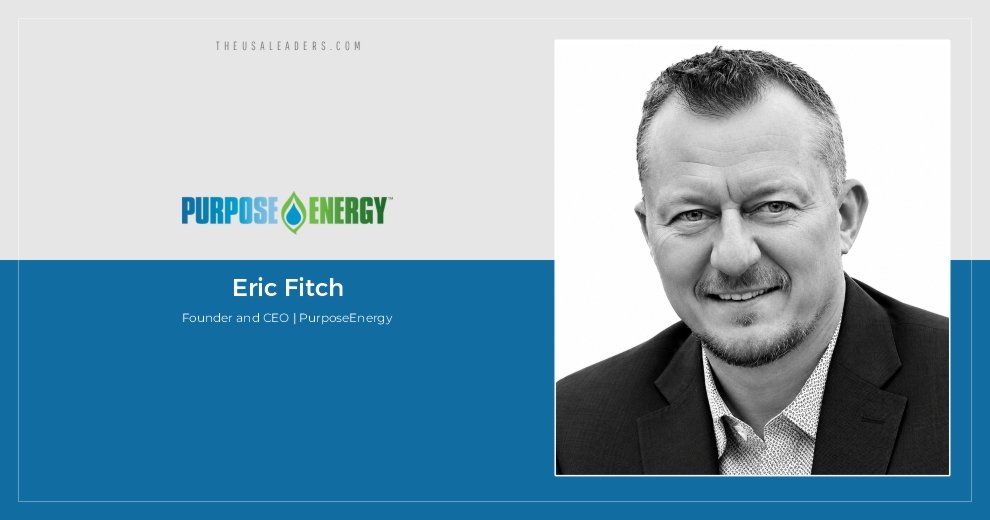
Eric Fitch is the Founder and CEO of PurposeEnergy, a role he has held since 2007. The company develops industrial wastewater treatment and water reclamation facilities for the food and beverage industry. Using patented technology and a network of blue-chip partners, it converts organic byproducts into three useful things: renewable energy, clean water, and nutrient-rich soil amendments.
A Generalist by Design
Eric brings more than 20 years of early-stage, venture-backed technology experience to that work. Early-stage companies reward people who can do many jobs well, and his career shows how. His path has crossed biotech, healthcare, consumer electronics, photonics, and smart materials.
The range is deliberate. His responsibilities have run from product development and business development to outside sales and team management. Along the way, he built technical and business relationships with senior executives in several industries.
He works as a start-up generalist, with strengths in inbound marketing, product development and product management, and operations, thriving in entrepreneurial, high-energy environments. What draws him is the meeting point of market and product, where a company’s vision either lands with customers or does not.
The Engineering Years
The record begins in piezoelectrics. From June 1996 to October 1999, Eric was a Product Development Engineer at ACX, Inc., an MIT startup that worked with encapsulated piezoelectric materials and developed related intellectual property. The technology reached aerospace, process control servo valves, sporting goods, rigid disk drives, PDAs, and mobile phones. ACX was acquired by Cymer, Inc.
Next came SynQor, Inc., another MIT start-up, where he served as Senior Mechanical Engineer from October 1999 to June 2000. SynQor develops and manufactures DC–DC power converters that use synchronous rectification.
From June 2000 to November 2002, he was at Axsun Technologies, Inc. The company developed a photonics-packaging platform that used nanometer-scale plastic deformation to align discrete optical components.
As Exterior Packaging Team Leader, Eric led teams responsible for manufacturing processes that modularize the packaging of the optical bench platform. He also led the Product Development Team for the Optical Channel Monitor, one of Axsun’s key commercial products. Axsun was acquired by Volcano Corporation and later became part of Excelitas Technologies.
From the Lab to the Market
At BioScale, Inc., from November 2002 to November 2005, Eric joined the founding technical team of a start-up developing a MEMS-based sensor platform for chemical and biological detection and fluid property analysis.
He was instrumental in the early engineering design. He was also responsible for business development, including the first commercial sale of a BioScale instrument and consumable cartridge. He developed the food pathogen detection business model that proved influential in raising equity capital. He also developed the platform’s fluid property analysis functionality. During his tenure, four SBIR grants he authored were awarded, representing a cumulative $2 million in funding.
Then came Carefx Corporation, which developed software designed to deliver rapid and relevant patient information to clinicians. As Senior Sales Executive from October 2005 to November 2006, Eric managed relationships with all hospitals in the northeastern United States, from Maine through New York. For three of four quarters, he led all sales executives in bookings. Carefx was later acquired by Harris Corporation.
A Short, Intense Assignment
From February to July 2007, Eric worked as a Muni WiFi Contract Negotiator at EarthLink. Cole Reinwand hired him on a contract basis to manage negotiations with multiple municipalities and close municipal Wi-Fi contracts.
EarthLink had won contracts to build municipal Wi-Fi networks in several U.S. cities. In November 2007, its management concluded that the municipal wireless business no longer aligned with the company’s strategic direction and began pursuing an exit.
Two Decades at PurposeEnergy
Read in sequence, the earlier chapters look like preparation: materials science, precision manufacturing, sensors, grant writing, hospital sales, municipal negotiation.
PurposeEnergy brings those threads into one operating model. Its original focus on brewery waste has broadened into industrial projects serving food and beverage manufacturers, including dairy producers.
In October 2026, the company commissioned its facility in Minster, Ohio, designed to process up to 250,000 gallons of organic residuals per day from Danone USA’s largest U.S. yogurt manufacturing facility and other regional producers. The facility converts these residuals into biogas for on-site process heat, treated water, and nutrient-rich soil amendments.
PurposeEnergy became part of infrastructure investor Quinbrook’s portfolio in 2023, while Fitch continued as its founder and CEO.
It is a long tenure for a founder in a field defined by early-stage companies. Eric’s earlier career is a catalog of start-ups, from ACX and SynQor to Axsun and BioScale. At PurposeEnergy, he has applied that range of technical and commercial experience to a business that depends on reliable industrial operations as much as on invention.
A Commitment Beyond the Company
Since August 2001, Eric has served as Director of the Board of the 484 Phi Alpha Foundation. It is a 501(c)(3) charitable foundation formed by alumni of the Sigma Alpha Epsilon fraternity at the Massachusetts Institute of Technology.
The foundation’s philanthropic commitments to MIT and related initiatives have exceeded $1 million. Its purpose is to support educational efforts and improve quality of life for students and residents in the Cambridge–Boston community, including through MIT outreach and student activities.
He has been a director and a member of the gift committee since the foundation’s inception, and he has joined various other temporary committees along the way. That is 25 years of continuous service.
The Circular Case
Eric’s story makes the circular case in practical terms: waste recovery must work as an industrial service, not simply as an environmental promise. A single founder has taken lessons from photonics, sensors, sales, and negotiation and applied them to a very practical question: what should an industrial plant do with its organic byproducts?
His answer, built over nearly two decades, is to treat them as inputs.
His career, from engineering to business development and sales, has prepared him to consider both the technical and commercial demands of resource recovery. At PurposeEnergy, he continues to focus on making that model practical at industrial scale.
Also Read – Leaders Advancing Circular Energy Through Waste-to-Resource Innovation in 2026