The USA Leaders
February 05, 2026
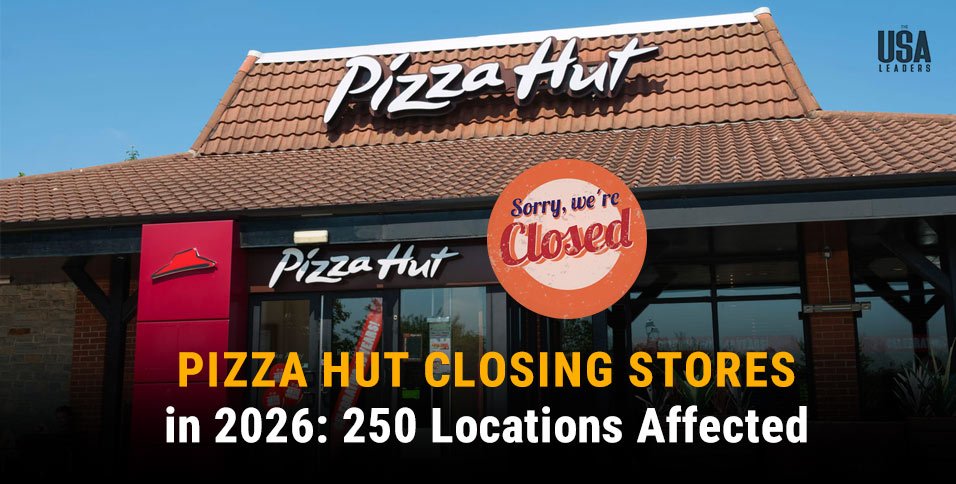
Yum! Brands announced this week that approximately 250 underperforming Pizza Hut locations will close by mid-2026, representing about 3% of the chain’s U.S. footprint. Pizza Hut closing stores becomes the latest sign of sustained pressure on the legacy pizza brand.
The decision, revealed during Yum! Brands’ February 4 earnings call, signals the culmination of years of decline for the once-dominant pizza brand, one now trailing Domino’s in market share and facing a 5% sales drop.
While closures typically spark alarm, this move reveals deeper structural challenges: shifting consumer preferences, franchisee struggles, and a brand that’s been outmaneuvered by faster, more agile competitors.
When Pizza Hut’s Dine-In Empire Became Its Downfall
Where once pizza restaurants competed on dine-in experience, today’s market favors delivery-focused, digital-first formats. Consumers now expect seamless app ordering, accurate delivery tracking, and loyalty rewards; advantages Domino’s has mastered.
Pizza Hut’s large-format, dine-in stores, iconic in the 1980s and 1990s; have become expensive liabilities.
Many of the 250 closed locations are older leases with high overhead costs, making them especially vulnerable when sales slow. What was once Pizza Hut’s competitive advantage has become its burden.
Why Domino’s Strategy Left Pizza Hut Closing Stores
Domino’s has surged past Pizza Hut to become the world’s largest pizza chain.
- Domino’s has roughly 21,750 locations
- Compared to Pizza Hut stores, which approximately are 19,974 globally.
In the U.S.,
- Domino’s now controls roughly 30% of the fast-food pizza market, up from 26% just a few years ago.
- This dominance stems from relentless execution: seamless technology implimentation, reliable delivery, and aggressive value pricing; exactly what post-pandemic consumers prioritized over sit-down dining.
- Domino’s digital sales, streamlined franchise model, and consistent promotional strategy have created a compounding advantage.
- By contrast, Pizza Hut’s older, larger-format stores lack the operational efficiency and tech infrastructure to compete.
Pizza Hut closing stores represents the company essentially surrendering its weakest positions in an unequal battle.
Marketing Missteps: How Pizza Hut Lost Its Way
Pizza Hut’s attempt to compete on price has largely failed. The chain launched a $5 pizza promotion to drive traffic, but the strategy didn’t reverse its 5% sales decline in 2025.
The problem runs deeper than pricing: consumers have already shifted their loyalty to Domino’s, and a cheaper Pizza Hut pizza doesn’t change that perception.
Compare this to Taco Bell, Yum! Brands’ fastest-growing subsidiary, which grew same-store sales 7% by combining value offers with a best-in-class digital experience and 25.7% digital sales mix.
Pizza Hut, by contrast, has struggled to modernize its ordering platforms and loyalty programs. Simply cutting prices, without the digital infrastructure and brand momentum to back it up, appears to only erode margins without winning back customers.
This marketing failure helps explain which stores are being shut down, the older locations without the digital capabilities or customer loyalty to survive on thin promotional margins.
Inside Yum! Brands: A Tale of Two Strategies
While Pizza Hut struggles with contraction, its Yum! Brands siblings are thriving; a reality that exposes Pizza Hut’s decline as a brand problem, not a portfolio problem.
- Taco Bell: The Clear Winner
Taco Bell is on fire. Same-store sales surged 7% in the latest quarter, with digital orders accounting for 25.7% of sales; nearly triple Pizza Hut’s digital penetration.
The chain has succeeded by targeting younger, value-conscious consumers with bold menu innovations, aggressive social media engagement, and a streamlined delivery model that prioritizes speed over the sit-down experience.
- KFC: Steady Growth
KFC has posted 3% global same-store sales growth and 1% U.S. growth, while also achieving record-breaking unit expansion. The fried chicken chain’s success internationally, combined with strategic menu evolution, shows that Yum! Brands’ portfolio can grow when brands stay relevant and operationally efficient.
- The Strategic Divide
These contrasting results make one thing unmistakably clear: Yum! Brands’ growth strategy prioritizes digital-first, fast-casual formats with strong unit economics, exactly what Pizza Hut’s aging, dine-in-heavy footprint cannot deliver.
The 250 Pizza Hut location closures aren’t just about underperformance; they’re about Portfolio restructuring. Yum! Brands seems to be betting on Taco Bell and modernized KFC units, not on saving a brand still tethered to a 1990s business model.
Wider Restaurant Industry Trends
Pizza Hut’s closures are part of a larger pattern unfolding across the fast-food restaurant industry. In early 2026 alone,
- Salad and Go exited Texas and Oklahoma (32 locations),
- Noodles & Company closed 33 company-owned and nine franchise restaurants,
- Wendy’s plans to close about 300 locations nationwide.
- Jack in the Box will shut 80–120 restaurants by the end of 2026. (80-120 were targeted for end of 2025)
- Red Robin is closing roughly 70 locations. (15 closed in 2025)
These aren’t isolated incidents, they reflect systemic pressures: rising labor costs, shifts in consumer spending toward delivery and value, increased competition from agile digital-native concepts, and the growing necessity of seamless mobile ordering and loyalty platforms.
Industry analysts note that consumers today reward brands that integrate these elements seamlessly. Legacy restaurants without strong digital infrastructure, like many of Pizza Hut’s aging locations, are increasingly expendable.
What’s Next for Pizza Hut
Yum! Brands has responded with “Hut Forward”, a modernization initiative designed to shift Pizza Hut toward smaller, delivery-optimized units with improved digital ordering and a fresh marketing approach.
The company is also making a one-time financial contribution to support the turnaround. However, the fundamental challenge remains: Pizza Hut is playing catch-up in a race Domino’s essentially won years ago. With competitors continuing to innovate and consumer expectations accelerating, Pizza Hut faces a critical decision.
It can either commit fully to the digital-first, delivery-focused model that’s working for Taco Bell and KFC; potentially alienating franchisees invested in traditional formats, or accept that its best days are behind it.
Conclusion: An Industry at a Crossroads
Pizza Hut closing stores seems like a reckoning move for a brand that built its empire on dine-in experience and is now struggling to survive in a delivery-dominant world.
Yet the broader lesson may be even more significant: within Yum! Brands’ diverse portfolio, brands that embraced digital transformation early (Taco Bell, KFC) are thriving, while those that resisted (Pizza Hut) are contracting.
For Pizza Hut, the “Hut Forward”, initiative offers a lifeline, but only if the company is willing to fundamentally reimagine what Pizza Hut means to consumers. For the restaurant industry as a whole, the message is clear: adapt quickly to digital-first models, or risk irrelevance. Pizza Hut’s struggle is a cautionary tale for any legacy brand that assumes yesterday’s competitive advantage will carry it into tomorrow.
Neha Shekhawat