The USA Leaders
February 11, 2026
Minneapolis
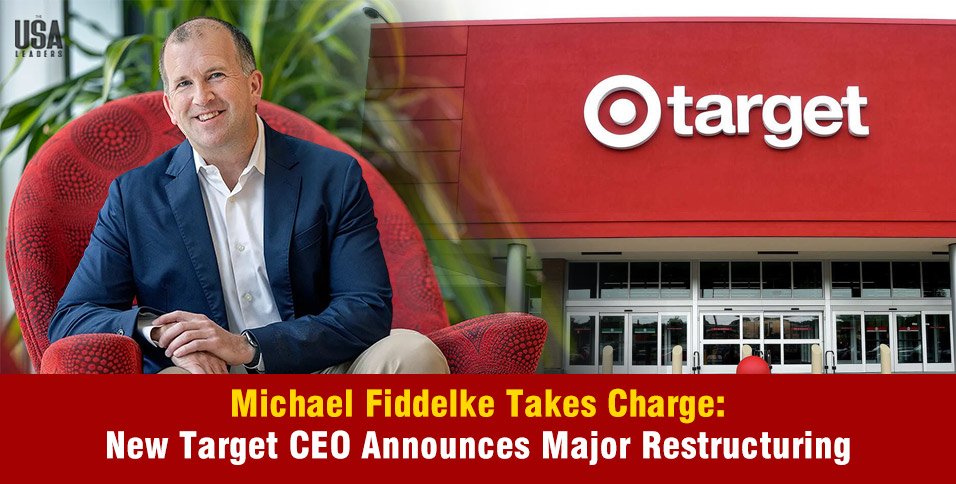
New Target CEO Michael Fiddelke has announced sweeping leadership changes as he moves quickly to reset the retailer’s direction. These changes mark his first major action since he took the top role on February 1, 2026.
Michael Fiddelke stepped into the CEO role after serving as Chief Operating Officer. He has worked at Target for more than 20 years, with leadership roles in finance, merchandising, operations, and human resources.
He told employees during a recent town hall that Target has lost trust with both shoppers and team members, a sign of the serious challenges ahead. Fiddelke aims to restore growth, rebuild confidence, and sharpen execution across the company.
Here’s what he said, according to the press release by Target: “It’s the start of a new chapter for Target, and we’re moving quickly to take action against our priorities that will drive growth within our business. These leadership changes align the right talent and expertise with key roles, and simplify our structure so we can advance our strategy with greater speed, clarity, and accountability.”
Executive Leadership Changes
Fiddelke announced several key changes:
- Brian Cornell, who led Target for nearly 11 years, has transitioned to Executive Chair of the Board of Directors.
- Rick Gomez, chief commercial officer who oversees merchandise inventory, will leave the company after 23 years.
- Jill Sando, who has led apparel and accessories, home, and Fun categories since 1997, will retire after 29 years.
- Lisa Roath will step into the chief operating officer role. She previously led merchandising for food, essentials, and beauty.
- Cara Sylvester will become chief merchandising officer. She previously served as chief guest experience officer.
Target has also launched an external search for a new chief guest experience and marketing officer. These changes place merchandising and operations at the center of Fiddelke’s strategy.
Strategic Plan and Investment
Fiddelke has outlined three clear priorities: Elevate the Guest Experience, Accelerate Technology, and Strengthen the Team.
He announced a $1 billion investment in store remodels, refreshed merchandise, and expanded technology tools. The company plans to upgrade store layouts, improve product presentation, and enhance digital systems that support both in-store and online shopping.
This $1 billion plan fits into a broader transformation effort. In May, Target created an Enterprise Acceleration Office under Fiddelke’s leadership. That office aims to deliver more than $2 billion in efficiencies across the company.
Leaders expect those savings to fund growth investments and improve execution. Fiddelke will present more details about the transformation strategy at Target’s 2026 Financial Community Meeting in March. The company will hold the meeting in Minneapolis instead of New York.
Workforce Changes
Target will eliminate about 500 roles across distribution centers and regional offices. Leaders say they will shift resources toward in-store staffing to improve service and store conditions. This represents about 0.8% of Target’s total workforce of approximately 415,000 employees.
The company wants more team members on sales floors to help guests and maintain standards. Internal metrics show that stores with higher staffing levels averaged 23% better customer satisfaction scores and 15% higher sales per square foot in 2025 pilot programs.
Business Challenges
Target faces pressure on several fronts. Sales growth has slowed. Some shoppers have complained about messy stores and weaker product focus.
The retailer has also faced backlash and boycotts tied to social and policy issues. At the same time, Walmart and other competitors have gained market share in key categories. During his town hall, Fiddelke said the company must rebuild trust. He stressed the need for stronger basics such as clean stores, full shelves, and clear value.
He also emphasized Target’s long-standing strength in design and style at affordable prices.
Industry observers note a key tension. Many analysts say Target needs fresh ideas to revive sales.
Yet the board chose an insider who built his career inside the company. Supporters argue that Fiddelke understands Target’s culture and systems better than any outsider. Critics question whether he can drive bold change after two decades within the same structure.
Analyst Reaction
Wall Street analysts have offered a mix of support and caution. Some view the leadership reset as a smart move that could speed up decision-making and tighten control over inventory and merchandising.
Inventory levels sit 12% above optimal ranges based on current sales velocity, creating drag on margins and cash flow. They believe a stronger alignment between operations and product strategy could improve execution. Others warn that results will depend on consistent follow-through.
Analysts say investors will look for clear progress in three key metrics over the next several quarters:
- Comparable-store sales growth (targeting return to positive 1-2% range by Q3 2026),
- Store cleanliness and inventory accuracy scores (targeting top quartile vs. peers by Q4 2026), and
- Gross margin expansion (targeting 60-80 basis points improvement by year-end 2026 through better inventory management).
What Comes Next
Fiddelke’s first weeks as the new Target CEO show an urgent tone. He has announced a change in the executive leadership, outlined a major investment plan, and acknowledged the company’s loss of trust.
In March, he will share detailed targets and timelines at the Financial Community Meeting. Target now stands at a turning point.
Fiddelke must prove that strong internal knowledge can translate into bold action. His early moves signal a push to restore discipline, rebuild confidence, and return the retailer to steady growth.
Neha Shekhawat
Also Read : From Engineer to CEO: The Unconventional Leadership Journey of Vape-Jet’s Tim Marsh