The USA Leaders
February 05, 2026
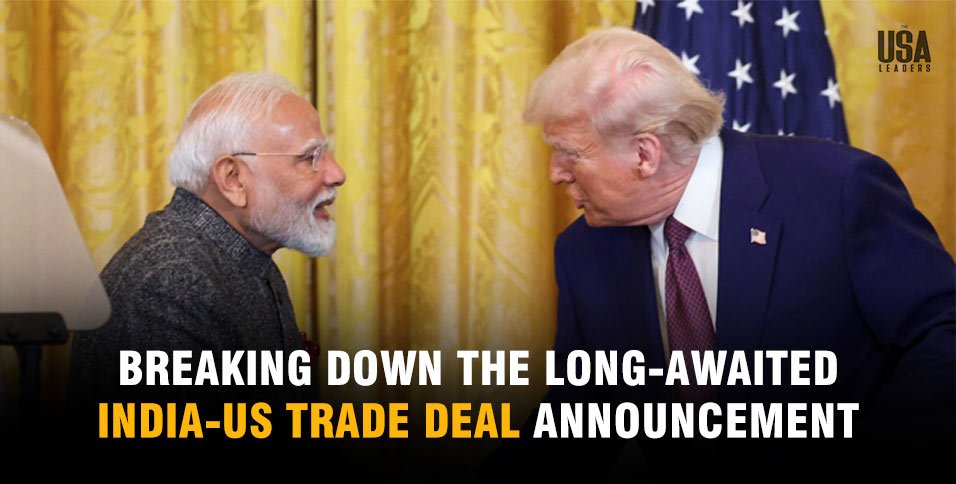
US President Donald Trump announced the latest development in the India-US trade deal through a social media post, stating that the US would reduce the reciprocal tariff on India from 25% to 18%. The announcement marked the most concrete signal yet of progress in the long-discussed trade agreement.
Significance of the India-US Trade Deal
To people unaware of why this is significant, here’s a recap of what happened last year:
Trump implemented a 50% tariff on India, as India refused to stop buying Russian oil and feeding into the “war machine” (Russia), as White House trade adviser Peter Navarro had called it. Of these, 25% was the reciprocal tariff and 25% was the “punishment” implemented by President Trump as of late August 2025.
Now, after long-stalled discussions and diplomatic talks between the nations, they are reaching a conclusion where PM Modi, as stated by President Trump on a Truth Social post, “agreed to stop buying Russian Oil, and to buy much more from the United States and, potentially, Venezuela. This will help END THE WAR in Ukraine, which is taking place right now, with thousands of people dying each and every week!”
The response from the Indian side has so far remained limited. Prime Minister Narendra Modi welcomed the development, expressing that he was “delighted” that Made in India products would now have reduced tariffs and referring to Trump as a “dear friend.”
Both Economies Release A Sigh Of Relief
The drop to an 18% tariff removes what many in India saw as a trade barrier. Exports to the US – especially textiles, apparel, seafood, jewellery, chemicals- had taken a hit. Lower tariffs mean:
- Indian goods become more competitive in the US
- Export orders can recover
- Pressure eases on jobs in labour-intensive sectors
That’s why the rupee, equity markets, and investor sentiment reacted positively. It’s less about celebration, more about relief.
India is one of the fastest-growing large economies. Lower Indian tariffs (if implemented) would benefit:
- US agriculture
- Energy exporters
- Aircraft, defence, and industrial goods
For the US, this means export growth, which supports jobs in specific sectors rather than across the whole economy.
Along with this, President Trump also states that India would buy “over $500 billion worth of U.S. energy, technology, agricultural products, coal, and other goods” as part of their economic cooperation in exchange for lower U.S. tariffs.
Again, the response from the Indian government remains vivid and unclear, which then raises the question:
What’s True And What’s False?
Truthfully? Nothing’s true, and nothing’s false. Both leaders have confirmed that the talks have been successful and they have reached or are reaching a conclusion to their India-US trade deal negotiations.
So far, only so much has been confirmed, contradictory to all the rumours and predictions happening everywhere; the official documents are yet to be announced. Waiting for official documents is preferable to falling into the spiral of controversy.
Conclusion
What can be said with certainty about the India-US trade deal is that it marks a meaningful thaw in a tense relationship built cause of the heavy tariffs war and geopolitical disagreements. The announced reduction in US tariffs signals intent, not finality. It reflects political will on both sides to stabilise trade, protect economic interests, and keep strategic cooperation intact in a rapidly shifting global order.
However, intent is not implementation. Until official documents are released, details around timelines, sectoral coverage, overall commitments, and India’s stance on Russian oil remain unresolved. This deal, as it stands, is less a finished contract and more of a framework in motion, promising but incomplete.
For now, markets may breathe easier, and diplomacy may regain momentum, but the real impact of the India-US trade deal will only be measured once policy turns into practice. Until then, caution matters more than optimism, and facts matter more than headlines.
Neha Shekhawat