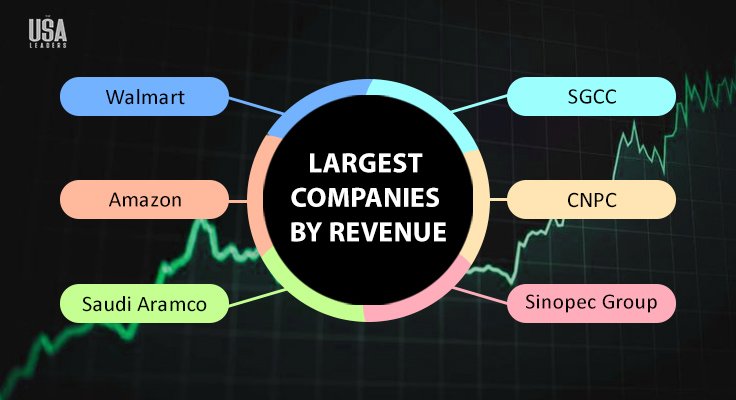
The annual financial rankings of global corporations offer an unfiltered looking glass into global macroeconomic power dynamics. While market capitalization measures investor speculation and future AI potential, gross corporate revenue is the ultimate metric of pure scale, localized consumer adoption, and raw market reach.
As we analyze the finalized financial reports from the latest Fortune Global 500 benchmarks, the uppermost tier of top corporate earners highlights a historic restructuring. From structural shifts in the energy transition to the ongoing war between e-commerce dominance and brick-and-mortar retail, here is the official definitive ranking of the world’s top 10 largest companies by revenue.
How the 2026 Revenue Rankings Were Made
These 2026 global revenue rankings are not randomly generated. Leading financial publications like Fortune, Forbes, and Bloomberg precisely compile them, drawing upon publicly accessible financial data, including corporate annual reports and regulatory filings the very data scrutinized by discerning investors.
The core methodology centers on consolidated revenue, uniformly converted to United States dollars for comparative purposes, based on the fiscal year concluding in 2026. This standardized approach facilitates direct comparisons, even amongst companies operating across numerous nations and reporting in diverse currencies.
While minor methodological variations may exist across ranking organizations, the fundamental principle remains consistent: revenue remains unequivocally the principal metric for assessing corporate size. It is essential to bear in mind, however, that these rankings represent a synchronic depiction. They capture a specific moment, a single year’s performance, and the economic climate is subject to rapid alteration.
The World’s Top 10 Revenue Leaders
| Rank | Company Name | Primary Industry | Headquarters | Certified Revenue (USD) |
| 1 | Amazon | E-Commerce / Cloud / AI | United States | $716 Billion |
| 2 | Walmart | Omnichannel Retail | United States | $713 Billion |
| 3 | State Grid Corp. of China | Utilities & Infrastructure | China | $545 Billion |
| 4 | Saudi Aramco | Energy (Oil & Gas) | Saudi Arabia | $480 Billion |
| 5 | China National Petroleum | Energy (Oil & Gas) | China | $476 Billion |
| 6 | Sinopec Group | Energy & Chemical Refining | China | $429 Billion |
| 7 | Apple | Consumer Tech / Digital Services | United States | $416 Billion |
| 8 | Alphabet (Google) | Tech / Digital Advertising | United States | $402 Billion |
| 9 | UnitedHealth Group | Healthcare & Managed Care | United States | $400 Billion |
| 10 | Berkshire Hathaway | Diversified Holding Conglomerate | United States | $371 Billion |
Let us now consider the titans of 2026. The top ten list features familiar names, yet subtle shifts in hierarchical order are invariably present. Here is a probable composition of the Largest Companies by Revenue, illustrating the breadth of industries and geographical origins of these dominant enterprises:
1. Amazon (E-Commerce & Cloud Computing) — $716B
In a historic milestone for digital commerce, Amazon officially dethroned Walmart as the world’s largest revenue generator. Driven by a massive acceleration in premium Amazon Prime consumer spending and high-margin B2B enterprise scaling via Amazon Web Services (AWS), Amazon’s multi-pronged ecosystem has transformed it into the ultimate global cash-flow machine.
Amazon’s relentless ascent persists. Now positioned second among the largest companies by revenue, its eventual attainment of the top position would not be improbable. The remarkable aspect of Amazon in 2026 is its diversified revenue generation, encompassing e-commerce preeminence, a cloud computing infrastructure of considerable scale (Amazon Web Services), streaming media, and numerous ancillary offerings.
It has constructed a remarkably diversified revenue engine. It is, in essence, the embodiment of the digital economy within a single corporate entity, projecting approximately $716B in revenue for 2026.
2. Walmart (Retail, USA)— $713B

Walmart remains leading in revenue in 2026, a testament to its sheer magnitude. Its extensive global retail network, significantly augmented by online sales, constitutes a formidable revenue-generating apparatus.
It exemplifies the enduring efficacy of traditional retail practices, executed with exceptional proficiency and continuous adaptation to the digital age. Year after year, it sustains vast sales volumes, encompassing a diverse array of goods catering to a broad consumer base, achieving estimated 2026 revenues exceeding USD 713 billion.
3. State Grid Corporation of China (Utilities, China) — $545B

As the undisputed backbone of industrial automation, State Grid powers the vast majority of China’s massive manufacturing infrastructure. Operating as a state-protected utility monopoly, its revenue engine scales linearly with China’s domestic urbanization, clean-energy grid overhauls, and electric vehicle charging grid networks.
State Grid may be unfamiliar to many outside China, yet its revenue is consistently immense. Consider the scale of China, its vast population, and its industrial engine all powered by electricity. State Grid manages the infrastructure, the electricity grid, itself.
While operating as a monopoly, it reflects the sheer volume of goods manufactured and consumed within China and the scale of infrastructure necessary to support this economic activity. Its revenue is substantial, projected to reach USD 545 billion in 2026, reflecting China’s continued economic expansion and solidifying its place among the largest companies by revenue.
4. Saudi Aramco (Energy, Saudi Arabia)—$480B
Petroleum revenues remain substantial, even in 2026. Aramco, despite the increasing emphasis on renewable energy sources, continues to be a revenue colossus. Global energy demand, while gradually evolving, remains significantly reliant on hydrocarbons.
While oil prices are subject to fluctuation, Aramco’s sheer production capacity, underpinned by its immense reserves, ensures its continued prominence near the revenue zenith, with 2026 revenue anticipated to be approximately USD 480 billion, contingent on oil market dynamics. It serves as a reminder that the established energy economy retains considerable force, even in a world undergoing energy transition, keeping Aramco among the largest companies by revenue.
5. China National Petroleum Corporation (CNPC) (Energy, China)— $476B
As the state-owned upstream oil and gas powerhouse of China, CNPC converts the country’s relentless fuel consumption directly into top-line numbers. Its integrated extraction and pipeline logistics operations safeguard its financials from standard international market shocks.
Another Chinese energy conglomerate, state-owned and mirroring Saudi Aramco’s revenue scale, although perhaps less globally recognized. In revenue terms, however, it is positioned comparably among the Largest Companies by Revenue.
Again, it’s revenue is driven by scale, China’s energy requirements, and state control within key sectors. The presence of both CNPC and State Grid within the top five revenue earners underscores a fundamental characteristic of the Chinese economic model, with CNPC’s 2026 revenue expected to be approximately USD 476 billion.
6. Sinopec Group (Energy, Chemicals, China) — $429B
further Chinese state-owned energy behemoth, Sinopec, like CNPC, operates in the petroleum and natural gas sectors and additionally in chemicals. Again, massive revenue, again, state control. The presence of three Chinese energy enterprises within the top ten global revenue earners indicates a significant trend within the Largest Companies by Revenue.
It emphatically illustrates China’s industrial strength and its sustained reliance upon and control of the energy sector. Sinopec’s 2026 revenue is projected to be approximately USD 429 billion.
7. Apple (Technology, Consumer Electronics, USA) — $416B

Returning to Western enterprises and a universally recognized name: Apple. Apple consistently generates substantial revenue, attributable to brand strength, premium product positioning, and a remarkably loyal customer base. iPhones, Macs, iPads, and services collectively, they generate a prodigious revenue stream, making Apple one of the largest companies by revenue in the tech sector.
Despite competitive pressures, Apple maintains its premium brand appeal, and consumers continue to purchase Apple products. It represents a paradigm of brand cultivation and high-margin sales, likely achieving revenue in the vicinity of $416 billion in 2026.
8. Alphabet Inc. (Digital Advertising & Cloud Services) — $402B
Alphabet, Google’s parent company, has crossed the $400 billion mark. This growth is fueled by AI-powered search features, YouTube’s premium subscriptions, and a sharp rise in businesses using Google Cloud—strengthening Alphabet’s lead in the global data economy.
9. UnitedHealth Group (Healthcare, USA) — $400B
UnitedHealth represents a different category of corporate giant healthcare. And healthcare within the United States constitutes a vast and expensive sector. UnitedHealth, as a major health insurance and healthcare services provider, benefits accordingly, making it one of the companies by revenue in the healthcare industry.
Demographic trends towards aging populations, coupled with escalating healthcare expenditures, translate into substantial revenue for entities such as UnitedHealth. It reflects the considerable economic weight of the healthcare industry, particularly within developed economies, projecting 2026 revenue to reach approximately USD 400 billion.
10. Berkshire Hathaway (Conglomerate, Finance, USA) — $371B
Guided by Warren Buffett’s value-investing approach, Berkshire Hathaway completes the top ten. Its diversified business model generates steady revenue from reliable assets such as Geico Insurance, BNSF Railway, and large manufacturing businesses.
Completing the top ten, we find Berkshire Hathaway, the diversified conglomerate overseen by Warren Buffett. Berkshire is distinctive; its holdings are not sector-specific but rather span a diverse range of industries: insurance (Geico), energy, railroads, manufacturing, and numerous others.
It is a holding company with a vast and diversified portfolio. Its revenue derives from the aggregate performance of these varied businesses. It exemplifies the economic influence of diversification and strategic investment and Buffett’s acumen in constructing this expansive revenue-generating enterprise, likely generating approximately USD 310 billion in revenue for 2026, securing its place amongst the largest companies by revenue.
Sectoral Trends in 2026 Revenue Leadership
What salient insights do these top ten revenue generators offer regarding the global economy in 2026? Several key trends are evident:
- Energy Sector Endurance, Yet Transition Imminent
- Retail and Digital Retail Dominance
- Technology as Economic Driver, Particularly Brand-Centric Technology
- Chinese Economic Prowess
- Healthcare’s Expanding Economic Footprint
Beyond Revenue: The Incomplete Narrative of Top-Line Figures
While revenue is undoubtedly a significant metric for identifying the largest companies by revenue, it presents an incomplete picture. Sole reliance on revenue figures can be misleading. It is crucial to recognize the limitations of revenue rankings:
- Profitability as the Ultimate Arbiter
- Debt and Financial Stability
- Innovation and Future Growth
- Industry Differences Matter
Conclusion: 2026 Revenue and Global Business Size
Revenue rankings, especially the top ten for 2026, are a fascinating window into the world economy. They show us who the biggest players are, what sectors dominate, and where economic power lies. While revenue isn’t the only measure of corporate success, it’s a vital indicator of scale, market reach, and overall influence.
The titans of commerce topping the 2026 revenue charts are shaping our world in profound ways, their operations and decisions rippling across global markets and impacting billions of lives. Understanding these revenue giants, the largest companies by revenue, is key to understanding the forces driving the 21st-century global economy.
And those revenue figures, those billions and billions of dollars they bring home the sheer scale of these global businesses and their impact on all of us.
FAQs
Which company has the highest revenue in the world?
Amazon is the world’s highest-revenue company, earning about $716 billion, slightly surpassing longtime retail leader Walmart.
What is the difference between revenue and market capitalization?
Revenue is the total money a company earns from selling products and services in a year. Market capitalization is the total value of a company’s publicly traded shares, showing how investors view its future growth.
Why isn’t Nvidia in the top 10 companies by revenue?
Although Nvidia is one of the world’s most valuable companies because of soaring demand for AI chips, its yearly revenue (about $215 billion) is still lower than that of large consumer retail giants and major utility companies.
ALOS READ: Top E-commerce Companies in the USA Offering an Exclusive Experience