


United Airlines is the world’s largest airline by mainline fleet size in 2026, with over 1,050 active aircraft. American Airlines and Delta Air Lines follow, while major airlines from China, Europe, and Turkey complete the global top 10. Fleet size shows an airline’s operating capacity, while market value and passenger numbers highlight different industry leaders.
This ranking uses fleet size, the most common way to measure airline scale. Other rankings use passengers, seat capacity, or market value instead, and we cover those too. Our guide to the largest airlines in the United States breaks down the U.S. market in more depth, including passenger-count specifics.
Top 10 Largest Airlines in the World by Fleet Size (2026)
Here are the top 10 largest airlines in the world, ranked by mainline fleet size:
| Rank | Airline | Fleet Size | Country |
| 1 | United Airlines | 1,058 | USA |
| 2 | American Airlines | 1,013 | USA |
| 3 | Delta Air Lines | 989 | USA |
| 4 | Southwest Airlines | 810 | USA |
| 5 | China Southern Airlines | 708 | China |
| 6 | China Eastern Airlines | 679 | China |
| 7 | SkyWest Airlines | 600 | USA |
| 8 | Air China | 531 | China |
| 9 | Turkish Airlines | 399 | Turkey |
| 10 | Ryanair | 349 | Ireland |
Note: Fleet figures reflect late 2025 data and shift slightly as airlines take new deliveries and retire older aircraft.
1. United Airlines
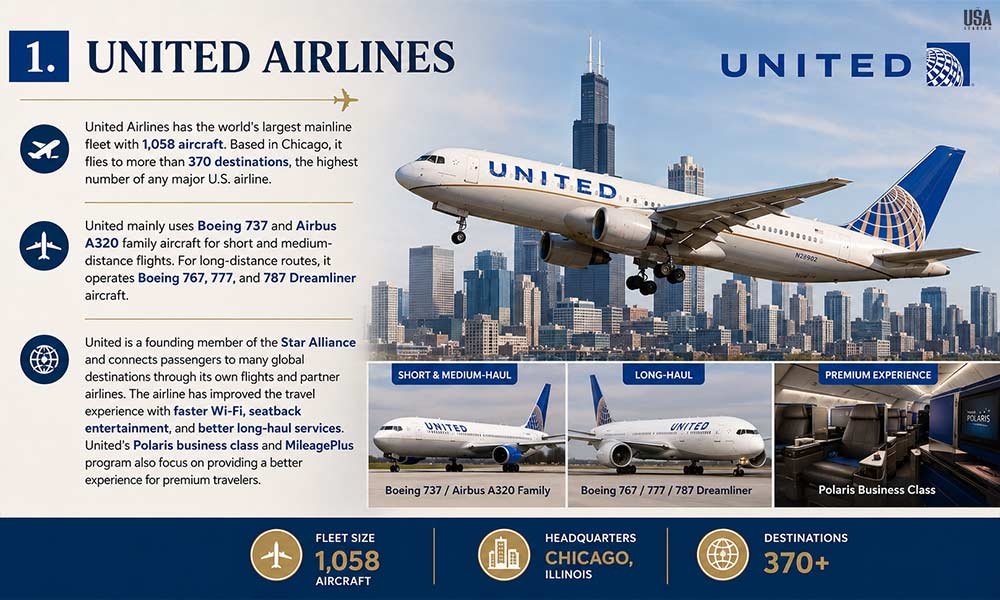
United Airlines has the world’s largest mainline fleet with 1,058 aircraft. Based in Chicago, it flies to more than 370 destinations, the highest number of any major U.S. airline.
United mainly uses Boeing 737 and Airbus A320 family aircraft for short and medium-distance flights. For long-distance routes, it operates Boeing 767, 777, and 787 Dreamliner aircraft.
United is a founding member of the Star Alliance and connects passengers to many global destinations through its own flights and partner airlines. The airline has improved the travel experience with faster Wi-Fi, seatback entertainment, and better long-haul services. United’s Polaris business class and MileagePlus program also focus on providing a better experience for premium travelers.
- Fleet size: 1,058 aircraft
- Headquarters: Chicago, Illinois
- Destinations: 370+
2. American Airlines
American Airlines ranks second worldwide in mainline fleet size, with 1,013 aircraft. Including regional partners operating under the American Eagle brand, its total fleet exceeds 1,500 aircraft.
The airline operates major hubs across North America, including Dallas/Fort Worth and Charlotte. According to industry data from OAG Aviation, American Airlines carries more passengers annually than any other airline worldwide.
- Fleet size: 1,013 aircraft
- Headquarters: Fort Worth, Texas
- Destinations: 350+
3. Delta Air Lines
Delta Air Lines is the third-largest airline by fleet size, with 989 aircraft. It is also the world’s largest airline by revenue, operating more than 5,500 daily flights across 52 countries.
Delta’s widebody fleet uses only Airbus aircraft, including 81 A330s and 40 A350-900s. This makes training and maintenance easier for its long-haul teams.
Delta is known for strong customer service and high satisfaction ratings among major U.S. airlines. It was the first major U.S. airline to offer free Wi-Fi to SkyMiles members, setting a new standard for travelers. Its Delta One suites and reliable on-time performance have helped it earn many service awards.
- Fleet size: 989 aircraft
- Headquarters: Atlanta, Georgia
- Destinations: 325+ in 52 countries
4. Southwest Airlines
Southwest Airlines ranks fourth globally with 810 aircraft, all Boeing 737s. It serves more than 100 destinations, mainly on short domestic routes.
Using one aircraft type helps Southwest reduce maintenance and training costs. This simple strategy has supported its low-cost business model for decades and made it one of the most well-known airlines in the U.S.
In 2026, Southwest ended its famous open-seating system and introduced assigned seats and extra-legroom options for the first time. This was one of the biggest changes in the airline’s history since it started operations in 1971.
- Fleet size: 810 aircraft
- Headquarters: Dallas, Texas
- Destinations: 100+
5. China Southern Airlines
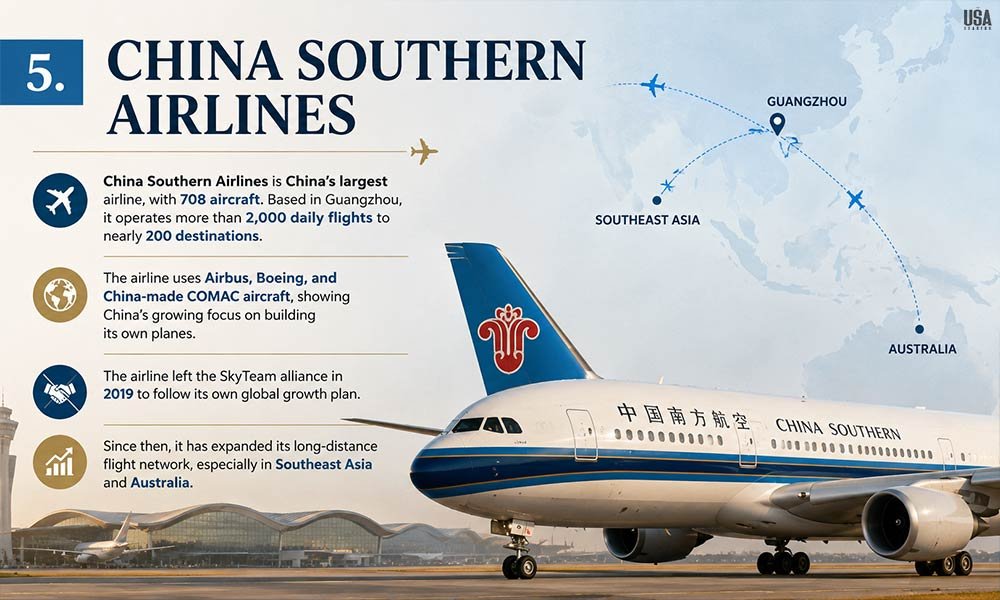
China Southern Airlines is China’s largest airline, with 708 aircraft. Based in Guangzhou, it operates more than 2,000 daily flights to nearly 200 destinations.
The airline uses Airbus, Boeing, and China-made COMAC aircraft, showing China’s growing focus on building its own planes.
The airline left the SkyTeam alliance in 2019 to follow its own global growth plan. Since then, it has expanded its long-distance flight network, especially in Southeast Asia and Australia.
- Fleet size: 708 aircraft
- Headquarters: Guangzhou, China
- Destinations: 200
6. China Eastern Airlines
China Eastern Airlines operates 679 aircraft, with its main hub in Shanghai. As a SkyTeam member, it works with global partners like Delta Air Lines to connect international routes.
The airline has more than 570 narrowbody aircraft and a growing widebody fleet for long-haul flights to Europe and across the Pacific.
- Fleet size: 679 aircraft
- Headquarters: Shanghai, China
- Destinations: 225+
7. SkyWest Airlines
SkyWest Airlines operates 600 regional aircraft, including Bombardier CRJ and Embraer jets. It flies under contract for United, American, Delta, and Alaska Airlines, covering more than 250 destinations.
Most travelers never book directly with SkyWest. Instead, they fly SkyWest aircraft under a partner airline’s flight number, a common setup among major airlines offering regional connections in the U.S.
- Fleet size: 600 aircraft
- Headquarters: St. George, Utah
- Destinations: 250+ (as a regional partner)
8. Air China
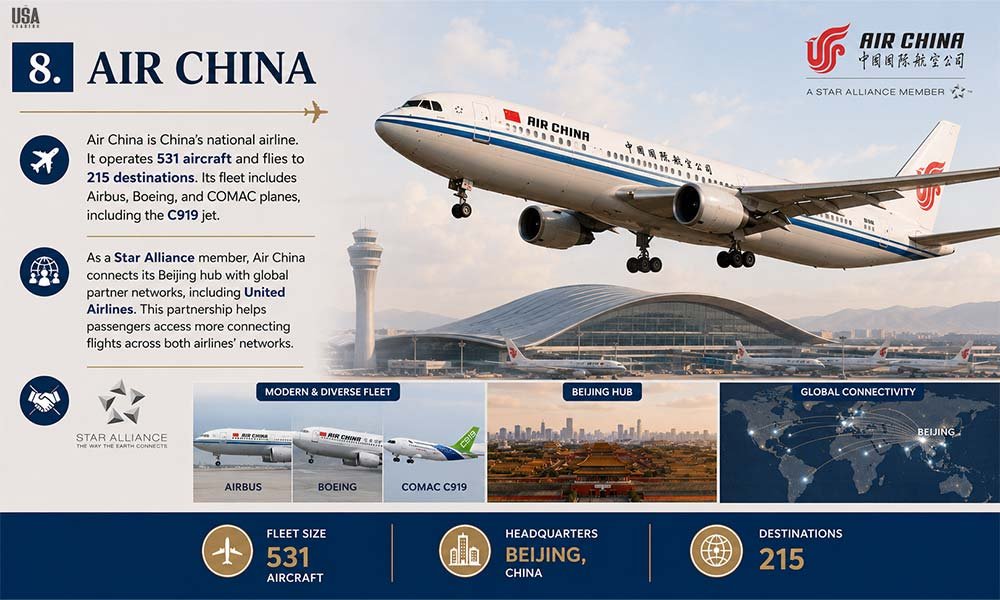
Air China is China’s national airline. It operates 531 aircraft and flies to 215 destinations. Its fleet includes Airbus, Boeing, and COMAC planes, including the C919 jet.
As a Star Alliance member, Air China connects its Beijing hub with global partner networks, including United Airlines. This partnership helps passengers access more connecting flights across both airlines’ networks.
- Fleet size: 531 aircraft
- Headquarters: Beijing, China
- Destinations: 215
9. Turkish Airlines
Turkish Airlines has 399 aircraft and flies to nearly 350 destinations in 131 countries, more than any other airline worldwide. Its biggest advantage is not its fleet size but its global reach. Based in Istanbul, the airline connects Europe, Asia, and Africa through one of the world’s most strategic locations.
Turkish Airlines has won Skytrax’s Best Airline in Europe award several times. It is also known for its large in-flight entertainment library and wide global network, making it a strong competitor among the world’s top airlines.
- Fleet size: 399 aircraft
- Headquarters: Istanbul, Turkey
- Destinations: 350 in 131 countries
10. Ryanair
Ryanair rounds out the top 10 with 349 Boeing 737 aircraft. The Irish low-cost carrier flies to 235 destinations across Europe. It carries more passengers than any other airline serving the European market.
Ryanair’s all-Boeing fleet mirrors Southwest’s strategy in the U.S. One aircraft type keeps costs low. It also keeps operations simple, which fits Ryanair’s ultra-low-cost model.
As one of Europe’s best-known cost airlines, Ryanair built its reputation on rock-bottom base fares and paid add-ons for nearly everything else, from seat selection to carry-on bags.
- Fleet size: 349 aircraft
- Headquarters: Dublin, Ireland
- Destinations: 235
Largest Airlines in the US
Four of the 10 largest airlines in the world are American: United, American, Delta, and Southwest. SkyWest also operates from the U.S., though as a regional partner rather than a mainline brand.
Our full guide to the largest airlines in the United States covers how these carriers rank domestically, including smaller U.S. airlines that don’t crack the global top 10.
Fleet size also connects to airport infrastructure. Carriers with larger fleets need larger hubs to match. Our guide to how many airports are in the USA explains how the country’s airport network supports this much air traffic. Our list of the busiest airports in the USA shows exactly where that traffic concentrates.
Comparing Airlines by Fleet, Revenue, and Passengers
Airlines can be ranked in different ways, not just by fleet size. Here is how the major airlines compare:
- Largest Mainline Fleet: United Airlines leads with 1,058 mainline jets.
- Most Passengers: American Airlines Group carries over 220 million passengers each year.
- Highest Revenue: Delta Air Lines generates more than $60 billion in annual revenue.
- Most Countries Served: Turkish Airlines operates flights to more than 130 countries.
Best Airlines vs. Largest Airlines: What’s the Difference?
Size and quality sit on two separate scales. A search for the best plane companies or the top 10 best airlines in the world usually points to service-quality rankings from groups like Skytrax, not an airline ranking based on fleet size.
Singapore Airlines and Qatar Airways regularly top best-airline rankings for service and comfort. Both operate smaller fleets than the U.S. carriers on this list. Meanwhile, size leaders like United and American compete more on route network reach than on in-flight experience scores.
Fleet size can still shape the flying experience indirectly. A recent Southwest Airlines Wi-Fi upgrade shows how a single-aircraft-type carrier can roll out cabin improvements fleet-wide faster than airlines juggling multiple aircraft types. That speed advantage matters more to passengers than raw aircraft counts.
Conclusion
Fleet size tells only part of the story. United, American, and Delta lead the world in raw aircraft numbers, but Delta leads on market value, and Turkish Airlines leads on country reach despite a much smaller fleet.
China’s three major carriers prove that scale isn’t a purely American or European story anymore. China Southern, China Eastern, and Air China now rank among the 10 largest airlines in the world, a shift that would have looked unlikely two decades ago.
For travelers, the practical takeaway matters more than any single ranking. A larger fleet usually means more flight options and backup aircraft during delays. It doesn’t automatically mean better food, more comfortable seats, or friendlier service. Choosing the right airline still depends on the trip, the route, and what kind of travel experience actually matters most to you.
FAQs
- What is the largest airline in the world?
United Airlines is the largest airline in the world by fleet size, operating 1,058 aircraft as of late 2025. By revenue, Delta Air Lines holds the top spot instead.
- Who are the top 5 airlines?
The top 5 airlines by fleet size are United Airlines, American Airlines, Delta Air Lines, Southwest Airlines, and China Southern Airlines, in that order.
- Who is the world’s biggest flight company by passengers, not fleet size?
American Airlines carries the most passengers annually of any airline, according to recent industry capacity data, even though United operates a slightly larger fleet.
- Which airline carries the most passengers?
American Airlines Group carries the most total passengers annually, boarding over 220 million travelers across its mainline and regional partner networks.