Across America, women are reshaping the business world by leading some of the country’s most influential companies. From technology and finance to healthcare, retail, and media, female CEOs are breaking barriers, making their names, and inspiring a new generation of leaders.
You might’ve heard about women making their names in every field, but today, I’ll highlight this with facts and numbers about why that is the case. Women keep reaching the highest levels of corporate leadership at a record pace. In 2026, 55 women led companies on the Fortune 500, representing 11% of America’s largest businesses by revenue, the highest share recorded in history.
This impressive figure does not represent a one-off case. It highlights a growing trend of women CEOs becoming more prevalent in leadership roles. This growth has always been gradual instead of being evenly distributed.
The Women CEOs Leading the Industry
Behind some of America’s most successful and influential companies are women who have turned ambition into leadership by guiding these companies through everyday challenges. These women CEOs are driving innovation, shaping industries, and making their names through bold and visionary leadership.
Let’s take a closer look at the stories of these women in power, responsible for leading some of the biggest industries, and their stories.
Mary Barra: Leading General Motors Through Industrial Change
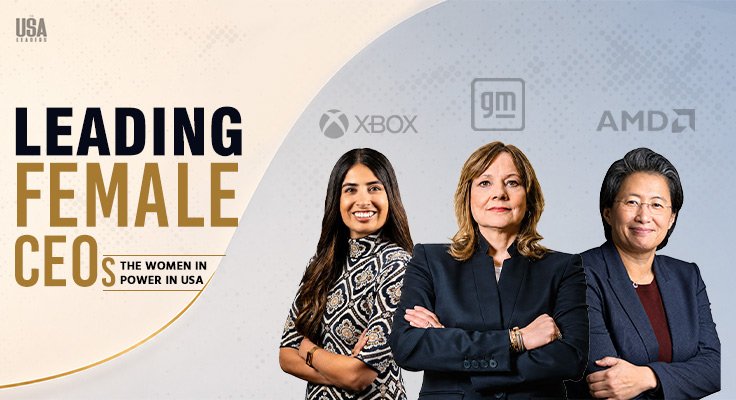
Mary Barra is considered one of the most prominent women leaders in American history, not only because she is the first woman in history to become CEO of a major automaker, but also because she was leading the company during a major transformational period.
She took the mantle as the CEO of General Motors in 2014. She is usually credited with leading the company during its transformation of personal mobility through connectivity, electrification, and autonomous driving. She leads a company that has historically been associated with male leadership, which makes her role more significant.
She leads the company’s day-to-day operations while combining long-term strategy to guide the company toward future growth. Barra’s leadership profile also reflects the changing demands placed on automotive companies. Connectivity, electrification, and autonomous driving require companies to coordinate manufacturing, software, engineering, and mobility services.
Lisa Su: Guiding the Semiconductor Giant AMD
Lisa Su, chair and chief executive officer of AMD, represents another important example of women reaching the highest levels of leadership in America’s technology industry. An electrical engineer by background, Su has led AMD since 2014 and has been associated with the company’s growth in high-performance and adaptive computing.
Her leadership is especially important because semiconductors support many technologies shaping the modern economy, including artificial intelligence, cloud computing, and advanced computing. AMD operates at the center of this changing technology landscape, requiring Su to combine technical knowledge with long-term business strategy.
Her role also involves understanding advanced processors, computing architecture, data-center demand, and the changing needs of technology customers. Her journey shows how technical and engineering expertise can become a strong foundation for leading a major American technology company.
Jane Fraser: Transforming Global Banking
Jane Fraser is the chair and chief executive officer of Citi. She became CEO in March 2021 and was named chair of the board in October 2025. Her position puts her in charge of a major global banking organization operating across international markets.
You might think leading a bank is mainly about managing money, but the role involves much more. Banking leaders oversee risk, regulation, capital, technology, customers, and complex financial operations. Citi operates across more than 100 countries and has more than 200,000 employees.
Fraser has also been associated with a period of organizational change at Citi. Her leadership has focused on building a more disciplined and confident organization. Her story shows how female CEOs are taking leadership roles at some of the largest financial institutions while guiding them through changing business environments.
Julie Sweet: Organizational and Digital Transformation
Julie Sweet serves as chair and chief executive officer of Accenture. She became CEO in September 2019 and took on the additional chair position in September 2021. Before becoming CEO, she led Accenture’s North American business, its largest geographic market.
Sweet’s leadership is closely connected to organizational change and technology adoption. Accenture operates in professional services, where success depends heavily on talent, client relationships, technology, and the ability to adapt to changing business needs.
Artificial intelligence has also become an important part of Accenture’s strategy. By February 2026, regular use of the company’s proprietary AI platforms was being considered in promotion discussions. This shows how a CEO can influence not only business strategy but also workplace culture, employee development, and the skills people need to advance.
Sweet’s journey highlights how modern CEOs have to manage people, technology, organizational structure, clients, and long-term business direction at the same time.
Carol Tomé: Strategic Leadership at UPS
Carol Tomé is the chief executive officer of UPS, one of the world’s major package-delivery and supply-chain-management companies. She became UPS’s 12th CEO after spending more than 16 years on the company’s board.
Her career shows why long-term institutional experience can be valuable when leading a large organization. During her years on the UPS board, Tomé developed a detailed understanding of the company, its customers, operations, and strategic challenges.
That experience became useful as UPS continued to evaluate its delivery network, customer base, profitability, and relationships with major clients. In a 2025 interview, Tomé discussed reducing UPS’s reliance on Amazon while focusing more closely on profitable growth.
Such decisions show the different factors a logistics CEO has to balance. Delivery volume, customer relationships, transportation costs, technology, labor, and profit margins all play a role. Tomé’s career demonstrates how strategic thinking and institutional knowledge can shape leadership at a major American company.
Mary Callahan Erdoes: Leadership in Asset and Wealth Management
Mary Callahan Erdoes is the chief executive officer of JPMorganChase’s Asset & Wealth Management business, one of the major divisions in the financial services industry.
Her position highlights the growing role of women in financial services beyond traditional commercial banking. Asset and wealth management requires knowledge of investments, client relationships, risk management, capital allocation, and long-term financial planning.
Erdoes works with a wide range of clients, including individuals, institutions, corporations, and major investors. This requires understanding different financial goals and levels of risk tolerance.
Although she is not the CEO of the entire bank, leading such a major business division places Erdoes among the influential executives in America’s financial sector. Her career demonstrates that leadership at a large corporation can take many forms.
Her story also shows how female executives are building careers in highly specialized areas of finance and taking responsibility for businesses that serve a wide range of customers and investors.
Asha Sharma: A New Leadership Chapter at Xbox
Asha Sharma became CEO of Microsoft Gaming in February 2026, with Microsoft later identifying the division as Xbox. Before taking the position, she served as president of product for Microsoft’s AI tools and application infrastructure. Her earlier experience also includes leadership roles at Meta and Instacart.
Her move to Xbox marked an interesting change because her background was primarily in technology and digital products rather than traditional video-game leadership. She stepped into the role following Phil Spencer’s retirement.
One of Sharma’s first areas of focus was reorganizing Xbox’s leadership structure. She brought in executives with experience across engineering, product development, design, growth, subscriptions, and cloud services.
She also made changes to product direction, including cancelling a Copilot project for consoles that had started before her arrival. She later adjusted Game Pass pricing, with prices varying by region.
Sharma’s journey shows how leadership experience in technology and digital products can transfer into different industries. Her move from AI infrastructure to gaming adds another example of the changing paths women can take to reach senior leadership positions.
Women Business Leaders Guiding the Future
The story of these women serves not only as inspiration for women around the world but also highlights the leadership qualities these individuals bring to their companies. These women have demonstrated their vision by guiding companies through periods of change and transformation with strong leadership.
Every woman mentioned in this blog has made a significant contribution to her respective company and continues to lead by example. Their journeys show how women chief executive officers are increasingly taking responsibility for major businesses and shaping the future of their respective industries.
The rise of female CEOs in America reflects the changing face of corporate leadership. From automotive and semiconductors to banking, professional services, logistics, and gaming, women are leading organizations across a wide range of industries.
As more women reach senior leadership positions, the role of women business leaders continues to evolve. The journeys of these female CEOs in America offer a look at the leadership, experience, and expertise shaping the future of corporate America.
People Also Ask
Who is the most powerful female CEO?
There is no single measure of the “most powerful” female CEO. Among the women highlighted in this article, Mary Barra, Lisa Su, Jane Fraser, Julie Sweet, and Carol Tomé are influential leaders of major American companies across different industries.
Who are the top 10 female CEOs?
The answer depends on how CEOs are ranked, such as by company size, industry influence, revenue, or leadership role. This article highlights several top female CEOs, including Mary Barra, Lisa Su, Jane Fraser, Julie Sweet, Carol Tomé, Mary Callahan Erdoes, and Asha Sharma.
Who are the most powerful women in America?
America has influential women across business, technology, finance, government, media, healthcare, and other fields. In the corporate world, female business leaders such as Mary Barra, Lisa Su, Jane Fraser, and Julie Sweet are among the prominent names.
How many female CEOs are there in the USA?
The number varies depending on how CEOs are counted and which companies are included. In 2026, 55 women led companies on the Fortune 500, representing 11% of the companies on the list.
Who are some female CEOs of major companies?
Some prominent female CEOs of major companies highlighted in this article include Mary Barra of General Motors, Lisa Su of AMD, Jane Fraser of Citi, Julie Sweet of Accenture, and Carol Tomé of UPS.
Neelmani Yadav