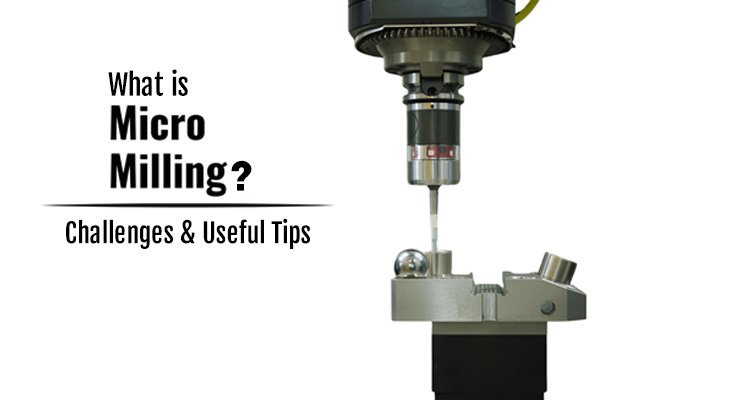
Machining tiny, detailed feature parts and smooth surfaces can be tricky with standard tools. Hard metals, plastics, and ceramics are challenging to work with. Regular tools wear out quickly, surfaces need extra finishing, and materials are often wasted.
Micro milling effectively solves these problems. Tiny, high-speed cutters remove material in careful and controlled passes. Diamond or carbide tips produce uniform surfaces and precise features. It creates smoother part surfaces and allows the removed material to be reused. It is fast, accurate, and reliable, ideal for manufacturing prototypes.
What Is CNC Micro Milling at Small Sizes
Small Tolerance Micro Parts Milling
Micro milling is not like standard machining. The cutting edge radius is comparable to the chip thickness at lower tool diameters of less than 2.5 mm (0.100″). The tool usually scribes or punches through the material at this scale instead of slicing it off. This increases cutting forces beyond what conventional calculations suggest by 2 to 20 times.
Moreover, chips are formed intermittently during micro-sized part cutting in different sizes. Small-diameter tools are actually more prone to deflection. Their lower stiffness makes them bend and break more easily.
The best ways of avoiding these issues are to ensure that the following parameters are in the correct ranges.
- Feed Rates
- Spindle Speeds
- Chip Loads Per Tooth
The smallest possible chip thickness should never be neglected, as the cutter will not cut; it will rub, and as a result, both the tool and the workpiece will be damaged.
At these scales, carbide and diamond micro-endmills are the best to use. They keep their edges sharp and provide uniform and accurate surfaces when subjected to challenging conditions.
With a comprehensive knowledge of such scale-related issues and adhering to appropriate cutting techniques, engineers can produce micron-level features, uniform surface finishes, and predictable outcomes in micro milling processes.
Key Factors for Successful Micro Milling Process
Precision Micro Milling
Micro milling is carried out on a tiny scale (usually in the order of 0.001″). Several factors need to be taken into account to obtain precise and reliable results.
- Precision: Micro Machining is extremely precise. Features on this scale require tolerances of 0.0001″ to be guaranteed to fit and provide acceptable surface quality.
- Minimal Runout: Runout is when cutting flutes are not perfectly aligned along the spindle axis. This makes some flutes cut deeper than desired. This puts delicate micro-cutters under increased stress and reduces tool life.
- Tool Deflection and Cutting Forces: Small tools are easy to bend, and cutting forces are 2-20 times greater than expected of standard models. Deflection is minimised by using the shortest tool possible and optimising toolpaths. Combined roughing and finishing passes may be needed to produce thin features.
- Chip Load and Feed Rates: On a micro scale, cutting-edge radius and chip load are similar. The cutter is inclined to be negative raked, and safe loaded chip ranges are limited. Any little more or less would be catastrophic to the tool and influence its life.
- Quick Spindle RPMs: High spindle RPMs are crucial to maintain the feed rates within a range at a safe chip load. This slices easily and does not strangle the cutter unnecessarily.
- Software and Toolpaths: Appropriate software feeds, speeds, and tool paths help reduce the occurrence of tool breakages and allow consistent final results.
- Inspection and Measurement: Standard micrometers are often not adequate at this micro scale. To check measurements and quality control, CNC shops need microscopes, machine vision, and accuracy probes.
Micro Milling Machines and Requirements
Micro Mill Machine
Micro milling needs precise machines because minor errors can ruin tiny parts. Stiff frames, reasonable vibration control, and accurate motion systems keep cuts consistent.
Machine Requirements
Micro milling requires meticulous precision on all the machine’s components. The wrong setting or weaker part brings down the performance. All machine parts must be accurate and consistent since micro milling is more precise than regular milling.
Machine Structure
The machine frame influences the stiffness, precision, and stability. These include the C-frame and the bridge frame.
- C-frame: It is lighter and stiffer, and moves only by the Z-axis. It increases accuracy and is superior with small and delicate components.
- Frame Bridge: The X and Z planes are overhead of the frame bridge. It is lighter and more efficient on larger parts with long travel.
Small parts are often prone to vibration. More dampened machines cut down vibrations and safeguard minute details. Most of these frames are made of iron and welded steel to provide stability.
Drive and Motion
Ball screws do micro milling with servo motors. They provide smooth, accurate movement and assist the miniature tools in cutting well.
Multi-Axis Micro Milling
Multi-axis machines, particularly 5-axis CNC machines, allow the small tools to tilt and reach intricate angles. These eliminate the use of various tools. Small parts like miniature impellers and optical components also need the additional flexibility afforded by 5-axis mills to follow small features accurately at a micro scale.
What are the Leading Causes of Micro-Endmill Breakage?
Breakage of Micro-Mills
Micro-endmills are critical and delicate tools. Their miniature aspects cause them to be more prone to failure. Knowledge of these helps you avoid common breakages.
The first issue is related to runout. Any spindle, tool holder, or flute misposition will result in uneven cutting. Even tiny misalignments easily overload a micro-endmill, and reducing runout.
Moreover, small cutters experience increased stress in proportion to their size and, when overstrained, may bend and break. The short tools and cautious tool paths minimize this risk.
Another issue is chip clogging. Chips can easily block the cutter, and small flutes don’t have as much space. The number of flutes or soft materials, such as HSS, may be reduced to control the chips, and it is also essential to maintain a smooth flow of chips.
Lastly, built-up edge is a material that clings to the cutter. This puts strain on the tool and renders it prone to breaking. Small stepovers, shallow cuts, and correct lubrication can prevent this issue.
How G-Wizard Supports Micro Milling Machining?
G-Wizard Estimator
G-Wizard is also micromachining oriented and manages cutters less than 0.125″ in size. It determines optimum spindle rates, feed rate, and chip loads to minimize the chance of tool breakage without compromising accuracy.
Micro-cutters are sensitive, and any slight bending will ruin a part. G-Wizard holds the tool constant and offers an excellent cutting performance.
When it comes to stickout, only the cutting component of the tool is necessary. This exaggerated tapered shank does not impact rigidity, and the shorter cutting section should be maintained. Typically, a stickout of about 3 times the cutter diameter offers a fair balance of reach and stiffness. The longer tools are not so sharp and must be used when needed.
The cut optimizer allows optimum calculation of depth, width of cut, and feed rate within the safe deflection limits. This makes micro-milling highly accurate, giving surfaces a smooth finish and much longer life, even on fragile items.
Final Verdict
Micro milling provides small, delicate, and smooth quality parts. It cuts metals, plastics, ceramics, and other hard-to-machine materials. The trick lies in keeping the tools even, fast, the feeds in the correct position, and the machine vibration-free.
Issues such as tool bending, chip loading, or imprecise cutting can damage the part, and are prevented by proper setup and tools like G-Wizard. When done with expertise and attention to detail, micro milling provides high-quality results without extra finishing. Work with professional partners like Proleantech, their engineers and advanced CNC milling centers ensure each micro-milled part meets quality standards. Experienced processing companies handle everything with care, from rapid prototyping to mass production, and ensure quality results without requiring additional finishing.
Also Read: What CNC Machinery Means for Innovation in Manufacturing Today