Introduction
In today’s manufacturing landscape, industrial leaders face relentless challenges from supply chain disruptions, quality fluctuations, and budget overruns, particularly in the realm of precision components where minute errors can trigger entire assembly line shutdowns. The root cause lies in traditional manufacturing methods’ inability to deliver micron-level precision stability due to a lack of systematic engineering controls, leading to repetitive rework and delayed deliveries.
This article delves into how advanced CNC precision turning, through a holistic engineering approach, transforms precision control into a competitive advantage, mitigating potential losses. By dissecting the core elements of high-precision manufacturing, we provide industrial leaders with a actionable framework for resilience.
What Defines True Precision in CNC Turning Beyond Basic Dimensional Accuracy?
True precision in CNC turning encompasses multidimensional standards that go far beyond simple dimensional checks. It integrates geometric accuracy, surface integrity, and material consistency to ensure parts perform reliably under demanding conditions.
1. Geometric Tolerances and Their Impact on Performance
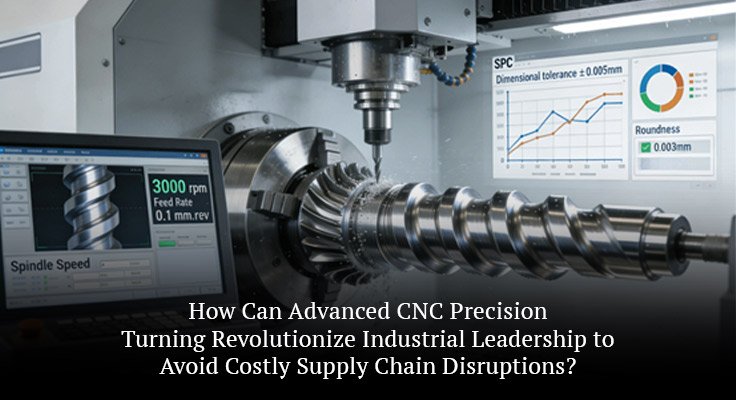
Geometric precision, such as roundness within ≤0.003mm, is critical for components like aerospace bearings, where even slight deviations can cause system failures. Referencing the ASME Y14.5 standard, which emphasizes geometric dimensioning and tolerancing, it becomes clear that focusing solely on basic dimensions overlooks essential factors like flatness and cylindricity. For instance, in producing high-reliability CNC precision turning parts, adherence to these standards ensures seamless integration into larger assemblies, avoiding costly fit issues.
2. Surface Finish Requirements for Durability and Function
Surface integrity, measured by parameters like Ra ≤0.4μm, directly influences part longevity and performance. A smooth surface reduces friction and wear, which is vital for applications like hydraulic systems. Techniques such as fine finishing and optimized tool paths achieve this, but it requires a deep understanding of material behavior and cutting dynamics. Case studies show that neglecting surface quality can lead to premature failure, underscoring the need for comprehensive standards.
3. Material Homogeneity and Its Role in Consistency
Material consistency ensures uniform mechanical properties throughout the part, preventing weak points. In precision turning, variations in hardness or microstructure can lead to unpredictable performance. By implementing strict material certification processes, manufacturers guarantee that each batch meets specifications, supporting zero-defect goals. This holistic view of precision — combining geometry, surface, and material — forms the foundation of advanced manufacturing.
How Does a Data-Driven Quality Control System Ensure Zero-Defect Manufacturing?
A robust quality control system leverages data analytics to preempt defects, integrating statistical process control (SPC), real-time monitoring, and predictive models for unparalleled reliability.
- Statistical Process Control for Proactive Management: SPC involves collecting and analyzing data from production processes to detect variations before they become defects. For example, in medical bone screw manufacturing, real-time SPC charts track key dimensions, enabling immediate adjustments. This approach reduces scrap rates to below 0.1% by maintaining process stability, demonstrating how data-driven insights translate into tangible quality improvements.
- In-Process Measurement and Feedback Loops: Advanced sensors and on-machine probes provide continuous feedback during machining. Systems like closed-loop control compensate for tool wear or thermal drift in real time, ensuring tolerances within ±0.01mm. This automated inspection minimizes human error and accelerates production, as seen in high-volume automotive parts where every second counts.
- Predictive Maintenance for Sustained Accuracy: By monitoring tool life and machine conditions through IoT sensors, manufacturers predict maintenance needs, avoiding unplanned downtime. For instance, tracking spindle load and vibration patterns allows for timely replacements, sustaining micron-level consistency. Coupled with ISO 9001 certification, which enforces rigorous documentation, this data-driven framework builds a culture of continuous improvement.
What Key Processes Enable Micron-Level Consistency in High-Volume Production?
Achieving consistent precision at scale requires innovative processes like hard turning, temperature control, and multi-axis integration, which enhance efficiency without sacrificing accuracy.
1. Hard Turning as an Alternative to Grinding
Hard turning, using advanced tool materials, replaces grinding for certain applications, offering faster cycle times and comparable surface finishes. With cutting speeds up to 800m/min, it achieves roughness values of Ra 0.2μm, ideal for high-volume turned components. This process reduces energy consumption and setup times, aligning with sustainable practices endorsed by standards like ISO 14001.
2. Thermal Stability Management for Precision
Temperature fluctuations are a major source of error in precision machining. Enclosed machines with coolant systems maintain constant conditions, ensuring dimensional stability. For example, in producing semiconductor parts, active thermal compensation negates expansion effects, guaranteeing batch-to-batch uniformity. This attention to environmental controls is a hallmark of IATF 16949 certified facilities.
3. Multi-Axis Turning and Milling Integration
Combining turning and milling in a single setup allows for complex geometries without repositioning errors. Five-axis systems enable intricate features like undercuts and threads in one operation, boosting efficiency by over 30%. This integrated approach is crucial for industries requiring intricate designs, such as aerospace, where every micron matters.
How Can Manufacturers Optimize Costs Without Compromising Precision?
Cost optimization in precision turning involves a lifecycle perspective, leveraging design for manufacturability (DFM), material substitution, and process innovations to cut expenses by 20-30% while maintaining quality.
- DFM Analysis for Waste Reduction: DFM reviews identify opportunities to simplify designs, reduce material waste, and minimize machining time. By collaborating early with engineers, manufacturers suggest alterations that maintain function but lower costs, such as using standard tolerances where possible. This proactive engineering avoids over-specification and streamlines production.
- Material Selection and Substitution Strategies: Substituting materials — like opting for 304 stainless steel over 316L where corrosion resistance is less critical — can significantly lower costs without affecting performance. Supported by National Institute of Standards and Technology (NIST) data on material properties, these decisions are data-backed, ensuring compliance with application requirements. This strategy is particularly effective in high-volume runs, where small savings per part add up.
- Process Consolidation and Automation: Automating repetitive tasks, such as loading and unloading, reduces labor costs and increases throughput. For instance, robotic integration in turning cells cuts handling time by 50%, making low-volume prototyping more economical. By adopting professional CNC turning services, manufacturers tap into expertise that balances cost and precision, driven by ISO 9001 principles.
What Are the Critical Differences in Precision Requirements Between Aerospace and Medical Industries?
Precision standards vary significantly across sectors, with aerospace focusing on high-strength alloys and dynamic balance, while medical prioritizes biocompatibility and sterile surfaces.
1. Aerospace Demands for High-Temperature Performance
Aerospace components, such as turbine blades made from IN718, require tolerance to extreme temperatures and stresses. Standards like AS9100D mandate rigorous testing for fatigue resistance and balance, where geometric precision is non-negotiable. Suppliers must demonstrate full traceability, as any failure could have catastrophic consequences.
2. Medical Emphasis on Biocompatibility and Surface Quality
Medical devices, like implants from Ti-6Al-4V, demand surfaces free of contaminants and precise geometries to ensure biocompatibility. Regulations under ISO 13485 enforce strict cleanliness and documentation, making surface integrity a top priority. The absence of micro-imperfections is critical to prevent immune responses.
3. Cross-Industry Solutions and Certification Alignment
While requirements differ, a unified approach using advanced CNC turning can serve both sectors. For example, suppliers with cross-industry expertise, certified under AS9100D, ensure that processes adapt to specific needs, highlighting how standardized methodologies support diversification without compromising quality.
How to Select a Reliable Partner for Sustainable Supply Chain Resilience?
Choosing the right manufacturing partner involves evaluating technical capabilities, certification frameworks, and digital integration to build a resilient supply chain.
1. Technical Capabilities and Measurement Infrastructure
A reliable partner should possess state-of-the-art equipment, such as CMMs for accurate inspection, and demonstrate expertise in precision machining quotes. Evaluating their machine portfolio and measurement tools ensures they can meet tight tolerances consistently.
2. Certification Systems and Quality Culture
Certifications like ISO 9001 and ISO 13485 indicate a commitment to quality management. These frameworks enforce process controls and audits, reducing risks. A partner with a strong quality culture will have lower defect rates and better traceability, essential for regulated industries.
3. Digitalization and Supply Chain Transparency
Partners leveraging digital twins and IoT for real-time monitoring offer greater transparency. This enables predictive scheduling and quick responses to disruptions, enhancing supply chain resilience. By selecting a partner with these capabilities, leaders future-proof their operations.
Conclusion
Advanced CNC precision turning, through systematic integration of process controls, quality systems, and cost optimization, transforms manufacturing risks into competitive advantages. It provides industrial leaders with measurable ROI by ensuring reliability, reducing disruptions, and fostering innovation. As industries evolve, this approach will be pivotal in navigating global challenges.
FAQs
Q1: What is the maximum tolerance achievable with CNC precision turning?
A: CNC precision turning can consistently hold tolerances as tight as ±0.005mm for critical dimensions, with roundness controlled within 0.003mm. This is achieved through advanced machine tools and real-time compensation systems, ensuring compliance with standards like ASME Y14.5.
Q2: How does CNC turning quality control prevent defects in mass production?
A: By implementing SPC monitoring and in-process inspections, quality deviations are detected early. For example, automated probes measure key dimensions every 50 parts, reducing scrap rates to below 0.1% while maintaining CPK values above 1.67.
Q3: What materials are suitable for high-precision turned components?
A: Materials range from aluminum and stainless steel to titanium alloys (e.g., Ti-6Al-4V) and engineering plastics. Selection depends on application needs, such as corrosion resistance for medical devices or high strength for aerospace, guided by ISO material standards.
Q4: Can CNC turning services handle both prototypes and large-scale production?
A: Yes, modern CNC turning offers flexibility from rapid prototyping (3-5 days) to high-volume runs. Batch optimization techniques group similar parts to reduce setup times, ensuring cost-effectiveness for orders from 10 to 10,000 units.
Q5: How do certifications like ISO 9001 impact CNC turning reliability?
A: Certifications enforce rigorous process documentation and traceability, ensuring consistent quality. For instance, ISO 9001 requires full material certification and audit trails, which minimizes risks in critical industries like automotive and aerospace.
Author Bio
This article is written by the precision manufacturing expert team at LS Manufacturing. The company helps global industrial clients solve high-precision part challenges in sectors like aerospace and medical, holding certifications such as ISO 9001 and AS9100D to ensure delivery reliability. For a customized solution, visit their CNC turning services page for a free project review.
Also Read: What CNC Machinery Means for Innovation in Manufacturing Today