The USA Leaders
August 10, 2026
Quick Facts: July 2026 Jobs Report
| Metrics | July 2026 Figure |
| Nonfarm payroll change | -23,000 jobs (vs. +83,000 expected) |
| Unemployment rate | 4.1% (down from 4.2% in June) |
| Government jobs | -53,000 |
| Private payrolls | +30,000 |
| Average hourly earnings (12-month) | +3.2% (lowest since May 2021) |
| May/June revisions | Combined -103,000 jobs |
| Labor force participation rate | 61.4% |
| Next Fed decision | September 2026 FOMC meeting |
| CPI report (next data point) | August 12, 2026 |
The U.S. Bureau of Labor Statistics released new jobs data on Friday, surprising economists. They expected the U.S. to add jobs in July, but the report showed a decline instead.
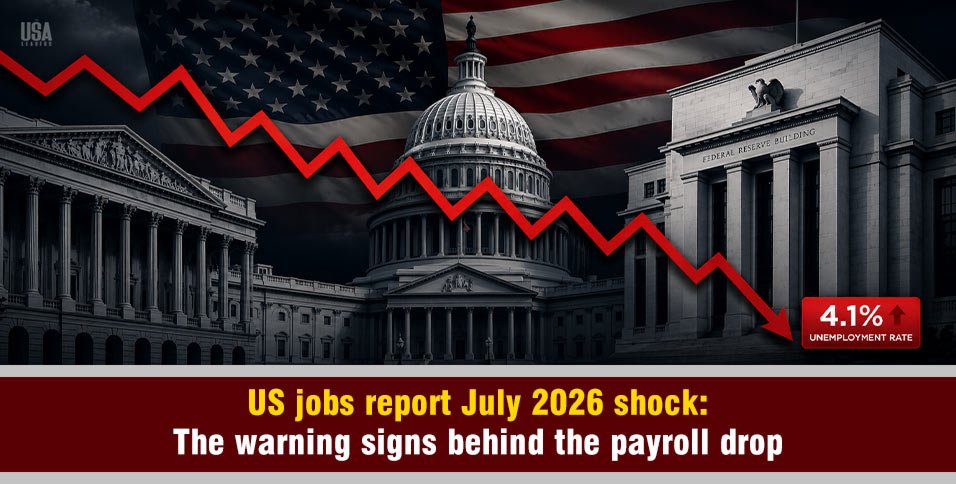
U.S. employers cut 23,000 jobs in July, while economists expected 83,000 new jobs. The unemployment rate fell to 4.1%, showing that the U.S. job market is giving mixed signals.
Why the Headline Number Is Misleading
The Bureau of Labor Statistics said nonfarm jobs changed little in July. However, the economy actually lost 23,000 jobs, a sharp change from the steady job growth seen earlier in 2026.
The unemployment rate also fell, but this does not mean the job market improved. Fewer people were working or looking for jobs, which reduced the labor force participation rate.
A smaller labor force can lower the unemployment rate even when a few jobs are added. That is why investors are viewing the July jobs report with caution.
Who’s Cutting and Who’s Hiring?
Government Jobs Take the Hit
The biggest job losses came from the public sector. Government jobs fell by 53,000, mainly in local education and retail. Federal agencies also cut staff, adding to job losses at the state and local levels.
Leisure and hospitality jobs also declined in July, showing weaker consumer spending. Private-sector jobs still grew by 30,000, while government job losses pulled down overall employment. Most job losses remained in the public sector.
Healthcare Keeps Growing (Just More Slowly)
Healthcare was a bright spot in the July report. Jobs in the sector continued to grow while hiring slowed in other industries.
Healthcare hiring has slowed compared with earlier this year. Still, it remains a steady source of job growth, giving employers some confidence.
Retail and Hospitality Cool Off
Retailers shed 19,000 positions in July, while leisure and hospitality hiring cooled noticeably. This slowdown comes at a sensitive time as retailers prepare for the upcoming back-to-school and holiday shopping seasons.
Your Paycheck Isn’t Keeping Up
Beyond raw job numbers, U.S. job growth in 2026 is being dragged down by slowing wage gains.
- Average Hourly Pay: Changed by just 2 cents in July.
- Annualized Wage Growth: Softened to 3.2% year-over-year, the lowest rate recorded since May 2021.
- Production Workers: Hourly wages for non-supervisory workers edged up to $32.40.
With stubborn inflation continuing to erode purchasing power, real wage growth remains under severe pressure.
Heavy Revisions Reveal a Weaker Spring Trend
The Bureau of Labor Statistics jobs report did not just highlight July’s weakness; it also heavily revised prior months downward:
- May 2026: Revised down from +129,000 to +63,000.
- June 2026: Revised down from +57,000 to +20,000.
These revisions erased 103,000 jobs from previous estimates, proving that labor market cooling has been underway for several months rather than being an isolated July anomaly.
How Markets and the Federal Reserve Reacted
Financial markets reacted quickly to the report. Treasury yields fell after the data was released. The 10-year Treasury yield dropped to about 4.64%, while the 2-year yield fell to its lowest level in weeks.
The main question is what the Federal Reserve will do next. Before the report, traders expected a possible rate hike in September. After the data, those expectations changed quickly, with the chance of a September rate hike falling below 50%.
Prediction markets shifted even further. Several platforms now show a clear majority expecting the central bank to hold rates steady rather than raise them, marking a meaningful shift in expectations.
Just weeks earlier, several members of the Federal Reserve’s policy committee had pushed to raise rates rather than hold steady. That stance signaled a hawkish lean heading into this report. A single weak jobs report has changed that debate.
The Strategic Pivot – Where the Investment Is Actually Going
One trend is clear: traditional jobs are shrinking, but investment in AI infrastructure is growing. Data center construction has become a major investment area as companies look for land and power across the country.
The contrast is clear. Government offices are cutting jobs, and some retail stores are seeing fewer customers. At the same time, construction crews are building new data centers in several states.
In consulting, companies now care more about efficiency than “synergy.” This shift helps explain why AI spending is rising while traditional job growth is slowing.
Companies are increasing their spending on AI and automation while reducing jobs in other areas.
This pattern has appeared in other recent layoff waves across the tech and services sectors, including Oracle’s recent workforce reductions.
What’s Next – CPI Report and the September Fed Decision
Inflation data is the next major focus for investors and the Federal Reserve. The Consumer Price Index for July is due on August 12. Forecasts point to annual inflation easing slightly to around 3.4%.
That report will matter enormously for the central bank’s next move. If inflation continues to cool alongside a weakening job market, the case for the Federal Reserve to hold rates – or even cut them – grows stronger. If inflation does not ease, the Federal Reserve will face a difficult choice between fighting inflation and protecting a labor market that is showing real cracks.
Heather Long, chief economist at Navy Federal Credit Union, said the labor market is stalling again. She noted that this trend makes job searches harder for workers while complicating the Federal Reserve’s balancing act between inflation and employment.
Conclusion
This report shows a mixed picture. The unemployment rate fell, but it may point to a weaker job market rather than a stronger one. Wage growth is stuck near a five-year low, even as the federal minimum wage debate continues in Washington. The Federal Reserve now faces real pressure to rethink its next move.
For professionals and investors, the key point is simple: one number does not show the full picture. Government cuts, flat wages, and lower estimates show the true state of the U.S. economy in mid-2026.
Also Read– Meta Layoffs 2026: Biggest Job Cuts Begin May 20 with 8,000 Roles at Risk