
The 2026 layoff wave has become one of the most severe workforce contractions since the global financial crisis. By May 26, 2026, more than 212 tech-sector layoff events had affected over 134,600 workers, according to industry layoff trackers. When finance, retail, media, and consulting are included, total job cuts crossed 217,000 in the first quarter alone.
Major companies behind these cuts include Spirit Airlines (14,000 jobs), Amazon (30,000 roles), Meta (8,000 planned), Oracle (20,000–30,000 at risk), and PayPal (4,760 jobs). Companies like Disney, KPMG, Nike, Accenture, and Microsoft are also deeply impacted.
The main reasons? Heavy AI investment, post-pandemic workforce correction, and economic uncertainty linked to trade policies. This guide explains the companies involved, the real reasons behind the layoffs, and their human and economic impact.
Why Are So Many US Companies Laying Off Workers in 2026?
Understanding why companies are cutting jobs is more important than just naming who is doing it.
These layoffs are driven by deeper, connected issues that are often easy to miss. They are not one-off decisions; most follow the same underlying reasons.
1. AI investment is reshaping payroll structures faster than job creation.
Amazon, Meta, Microsoft, and Alphabet together plan to spend roughly $725 billion on AI infrastructure in 2026, a 77% jump year-over-year, according to Invezz. Employee salaries are the quickest expenses companies can cut or shift. Meta spends about $27 billion a year on payroll, while its AI investments could reach $145 billion. The contrast is clear.
2. The pandemic hiring binge is still being corrected.
Tech companies hired rapidly between 2020 and 2022, with many doubling their staff. The expected business growth never fully happened, and in 2026 the industry is still dealing with the impact of that overconfidence.
3. Tariffs and trade policy are squeezing margins.
Analysts widely attribute a significant share of white-collar cuts to President Trump’s aggressive tariff policies, which are compressing corporate margins and pushing companies into preemptive cost reduction mode, according to Wikipedia’s 2026 US corporate mass layoffs tracker.
4. Offshoring is hiding inside the AI narrative.
Bloomberg data shows that about half of AI-related layoffs lead to the same jobs being rehired overseas or at lower pay within the country. In many cases, what is called “automation” is really companies shifting work to cheaper workers, not replacing people with AI.
5. Each industry has its own structural crisis.
Legacy media is losing audiences to streaming. Retail is being reshaped by automated logistics. Professional services are seeing AI reduce the value of billable consulting hours. The challenges differ, but the result is the same: fewer people are needed.
The Real-World Impact of Mass Layoffs 2026
Layoff headlines focus on numbers. But the impact stretches far deeper across individuals, communities, and the broader US economy.
Impact on Workers
In 2026, jobs disappearing the fastest include customer support, content moderation, quality assurance, recruiting, and mid-level management. These roles were once seen as secure, long-term white-collar careers. Many experts now believe the AI-driven job crisis is already happening, as automation spreads rapidly across corporate America.
Studies show that job losses often lead to long-term unemployment, lower income, and serious mental health issues like depression and anxiety. The main issue is a growing skills gap—many laid-off workers do not have the skills needed for new AI-related jobs, and this gap continues to widen each month. The big tech layoffs of 2025 set the conditions for this moment, and 2026 is where those structural cracks fully show.
Impact on the Broader Economy
US-based employers announced 60,620 job cuts in March 2026, up from 48,307 in February, with AI explicitly cited as the cause for 25% of all announced cuts that month, per Challenger, Gray & Christmas. The ripple effects include weakened consumer confidence, rising unemployment insurance claims, slower retail spending, and a hollowing-out of mid-income white-collar work. Meanwhile, the same companies filing the layoff notices are posting record AI capital expenditures and shareholder buybacks, a gap between corporate health and worker security that is growing wider every quarter.
US Layoffs 2026: Top 10 Companies Cutting the Most Jobs
To provide a clear view of the market, the following list breaks down the top ten companies leading workforce reductions, ranked in descending order to match current data tracking models.
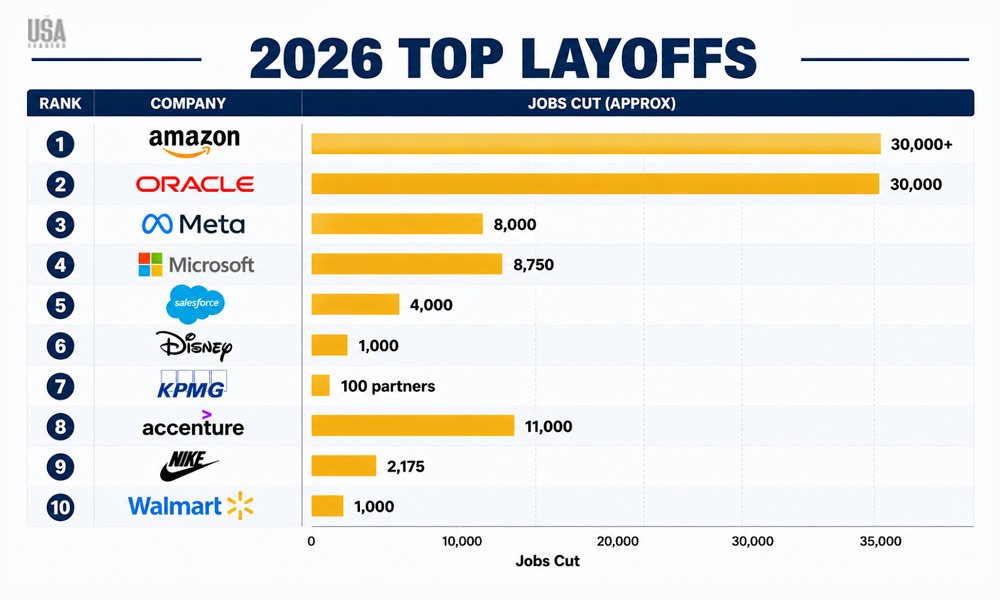
1. Amazon — 30,000+ Corporate and Warehouse Roles
Amazon is the largest contributor to the 2026 layoff wave, both in scale and in the clarity of its strategy.
In January, Amazon announced plans to cut about 16,000 corporate jobs worldwide. This followed another round in October, when 14,000 roles were eliminated. Senior VP Beth Galetti said the layoffs are meant to reduce internal bureaucracy. In total, more than 30,000 jobs were cut in less than six months. At the same time, Amazon committed $200 billion to AI spending in 2026 and increased its investment in Anthropic to as much as $25 billion, clearly showing its priorities.
A WARN notice in Florida also revealed that Amazon will lay off over 600 workers at a Homestead logistics facility, starting in early July through September. The cuts affect corporate teams, Amazon Go, and Amazon Fresh. The workforce reductions coincide with Amazon’s accelerated AI and infrastructure spending.
Also Read – (Amazon vs Walmart: A New Era in the Retail Wars) How retail giants are competing amid massive restructuring.
2. Oracle — Up to 30,000 Jobs, One of the Biggest Single-Round Cuts in Tech History
Oracle’s March 2026 layoffs were both enormous and jarring in their delivery.
Oracle has cut up to 30,000 jobs worldwide, including thousands in the U.S. and India, to free up money for major investments in AI data centers and cloud infrastructure. This is one of the largest layoffs in the company’s history.
The job cuts started in late March and continued into April, often without warning. Many employees learned they were laid off through early-morning emails on March 31, with no clear explanation. Per the SkillSyncer Layoffs Tracker, Oracle’s 30,000-job cut was the biggest single layoff of 2026, driven mainly by Oracle’s shift toward AI spending, a trend seen across the tech industry this year.
3. Meta — 8,000 Employees, 10% of Its Entire Workforce
Meta is preparing to cut around 8,000 jobs starting May 20, 2026, wiping out roughly 10% of its global workforce in one of the company’s biggest layoffs yet. This follows earlier reductions in Reality Labs, where Meta cut about 10% of employees (roughly 1,000 workers) in January 2026.
For more details on Meta’s cutting strategy, read our in-depth analysis of the Meta layoffs 2026 strategy, which breaks down the company’s AI-driven restructuring plans and what they mean for workers.
Here are the critical facts:
| Metric | Detail |
| Jobs cut (planned) | ~8,000 (10% of workforce) |
| Previous cuts | 1,000+ in Reality Labs (January 2026) |
| Primary reason | AI infrastructure investment, restructuring around AI |
| Profit last year | Over $60 billion, with $200+ billion revenue |
Meta employed nearly 79,000 people at the end of 2025, meaning thousands more could soon be replaced as the company shifts money into AI, automation, and data centers.
4. Microsoft — Up to 8,750 Voluntary Buyouts, First in Company History
Microsoft’s 2026 approach is structurally different from its peers’, but the outcome is the same: a shrinking headcount.
Microsoft confirmed that it will offer voluntary buyouts, a first for the 51-year-old software giant. About 7% of U.S. employees are eligible, which, with approximately 125,000 U.S. employees, could add up to around 8,750 cuts. The “voluntary” framing softens the optics but doesn’t change the direction. Microsoft CFO Amy Hood confirmed the company expects its workforce to shrink further in the next fiscal year, underscoring a broader industry trend toward tighter headcount management amid rising AI investment.
Microsoft’s calendar-year 2026 AI capex sits at $190 billion. The company is investing in the future, and workforce costs are the variable being trimmed to fund it.
5. Salesforce — 4,000 Customer Support Roles Eliminated
Salesforce is a textbook case of AI directly replacing the jobs a company’s own products were designed to do.
CEO Marc Benioff offered one of 2026’s most memorable corporate lines when explaining the 4,000 customer support eliminations: “I need fewer heads.” The roles of targeted customer support, ticket routing, and account verification are precisely the functions that Salesforce’s own AI tools now handle at scale. Nikkei Asia attributed 47.9% of Q1 tech layoffs to AI and automation, and Salesforce runs even hotter than that average. For the company’s current and former employees, the irony is sharp: they built the tools that replaced them.
The cuts signal a broader shift across enterprise software. As AI-native workflows replace human-operated service desks, every SaaS company faces the same pressure: automate the customer-facing layer or watch margins compress.
Key Companies Leading Tech Reductions: #6 Through #10
The following five companies may have generated fewer front-page headlines than Amazon or Meta, but their cuts carry real weight across consulting, entertainment, finance, manufacturing, and retail. Each gets two paragraphs of real-time data.
6. Disney — 1,000 Roles Across Studios, ESPN, and Marketing
Disney is eliminating about 1,000 roles, primarily as a result of Disney’s formation of a consolidated enterprise marketing division under the leadership of Asad Ayaz, chief marketing and brand officer. The cuts span marketing functions across Disney’s studios, TV networks, ESPN, product and technology, and corporate groups. CEO Josh D’Amaro, only weeks into his role, told staff the layoffs were necessary to “foster a more agile and technologically enabled workforce.” High-profile names affected include digital marketing SVP Dustin Sandoval, who ran campaigns for Avatar and Avengers franchises.
Disney has laid off over 8,000 workers since Bob Iger returned as CEO in 2022, saving up to $7.5 billion in costs through previous restructuring efforts. Streaming pressure, a reduced Marvel production slate, and rising competition are driving the strategy. For a full picture of the company’s ongoing restructuring, read our in-depth coverage of Disney layoffs 2026. This is not a one-off; it’s the next chapter of a years-long transformation that’s reshaping one of America’s most iconic media companies.
7. KPMG — 100 Audit Partners Exiting, 10% of the Division
KPMG is reducing about 10% of its U.S. audit partners after a long-running voluntary retirement plan did not meet its target. Around 100 partners will leave, with some choosing early retirement and others being asked to step down for business reasons. The firm said these cuts are not due to performance, sending a clear and unsettling message: long service and past success no longer guarantee job security.
What’s driving the pressure at the top? Succeeding within auditing today is no longer solely about years of experience but increasingly about tech fluency and the ability to leverage AI-driven platforms. The Big Four model is evolving rapidly, and KPMG’s partner-level cuts signal that even the highest rungs of professional services are not immune. For a detailed breakdown of what this means for the accounting sector, see our full coverage of KPMG US layoffs 2026.
8. Accenture — 11,000 Jobs, $865M Restructuring Around AI
Accenture laid off over 11,000 employees globally as part of an $865 million restructuring program. CEO Julie Sweet cited rapid adoption of artificial intelligence and declining demand for conventional consulting as the reasons. The company’s workforce dropped from 791,000 to 779,000 employees over three months. Employees who could not be retrained for AI-focused delivery roles were laid off, a policy the company stated explicitly during its earnings call. Accenture simultaneously committed to upskilling 70,000 staff in AI technologies, making it one of the few companies pairing cuts with visible reskilling investment.
At 750,000 employees, Accenture’s 11,000 cuts represent about 1.5% of its workforce, modest by percentage. But the signal to the consulting industry is clear: if Accenture believes AI reduces the need for human consultants, clients will expect fewer consultants on their projects too. The cascading effect across professional services will be felt for years. Our full breakdown of Accenture layoffs explores what this AI-driven pivot means for the consulting industry’s future employment model.
9. Nike — 775 Distribution Jobs + 1,400 Tech and Operations Roles
Nike confirmed layoffs of 775 workers primarily at distribution centers in Mississippi and Tennessee, marking the third year in a row that Nike has cut jobs. The cuts equate to around 1% of its workforce of approximately 77,800. Nike framed the move as “sharpening the supply chain footprint” and accelerating automation language that reflects a broader industry pivot toward robotic warehousing and reduced human logistics labor.
Nike also announced plans to cut about 1,400 roles in its global technology and operations teams as part of its ongoing “Win Now” restructuring, with efforts to simplify supply chains, centralize tech in Oregon and India, and increase automation across manufacturing. Combined, the two rounds represent a significant workforce reduction for a brand that has already cut thousands of jobs since 2024. For full context on Nike’s multi-year job reduction strategy, see our coverage of Nike layoffs.
10. Walmart — 1,000 Corporate Roles, Relocation Pressure on Remote Workers
Walmart is cutting approximately 1,000 corporate roles and requiring many remote workers to relocate to central hubs as part of a push for “simplified and efficient operations.” In a memo released May 12, the company stated it is consolidating its global tech and product design teams to eliminate redundant work across its U.S., Sam’s Club, and international divisions. The retailer noted that some affected employees would be offered relocation or internal opportunities, but for remote workers who built their lives around flexible arrangements, relocation mandates carry their own form of pressure.
This is Walmart optimizing around AI-driven retail strategy, not Walmart struggling. The company is investing heavily in AI-powered speed, inventory management, and customer convenience, and the corporate restructuring removes the overhead of duplicate functions built across separate business units. For workers in remote-friendly corporate roles, the message is blunt: centralize or exit.
The AI Paradox: New Roles Are Growing — But Not for Laid-Off Workers
Here is the tension every layoff announcement leaves unaddressed: AI is creating jobs and eliminating jobs at the same time, and the two groups barely overlap.
Companies report a 92% increase in hiring for AI-related positions in 2026, with a 56% wage premium attached to the most in-demand roles. Machine learning engineers, AI safety researchers, and data infrastructure specialists are actively sought. Meanwhile, customer support reps, QA testers, content moderators, and mid-level managers are being shown the door. Bloomberg data suggests roughly half of AI-attributed layoffs will result in the same roles being rehired offshore at lower salaries, meaning a significant portion of the “automation” story is actually labor repricing wearing a futuristic label.
AI job growth is real, but it is not absorbing displaced white-collar workers at the same pace.
What Workers Can Do Right Now: 4 Actionable Steps
The landscape of US layoffs 2026 is uncomfortable, but it is not without options. Preparation is the most powerful tool available.
1. Upskill Toward AI-Adjacent Roles
Data analysis, prompt engineering, AI product management, and machine learning operations are hiring aggressively with premium pay. Even one relevant certification can shift your job market positioning.
2. Quantify Your Impact Before Restructuring Hits
Document your contributions with numbers: cost saved, revenue generated, and processes improved. Titles are easy to cut; demonstrated results are harder to dismiss.
3. Build Your Network During Stability, Not Crisis
Professional relationships formed before a layoff are the ones that open doors during one. LinkedIn, alumni communities, and industry events all matter far more than most people invest in them.
4. Build Financial Resilience Now
An emergency fund covering three to six months of expenses, reduced fixed costs, and a diversified income stream are the practical buffer between a layoff notice and a controlled next step.
FAQs
Which company has cut the most US jobs in 2026?
Amazon leads with over 30,000 roles eliminated across corporate and logistics functions. Oracle follows with up to 30,000 global cuts concentrated in March and April.
Are US layoffs 2026 driven mainly by AI?
Yes. AI is the leading stated reason for job cuts, accounting for 47.9% of Q1 tech layoffs, according to Nikkei Asia
Which sectors beyond tech are affected by upcoming layoffs 2026?
Finance (KPMG, Citi), entertainment (Disney), consulting (Accenture), retail (Nike, Walmart), and semiconductor manufacturing (Intel) have all announced significant cuts in 2026. This wave is not limited to Silicon Valley.
What is the worst layoff month in 2026?
March 2026 was the worst layoff month in two years, with 60,620 job cuts announced, and AI accounting for 25% of all the cuts.
How many jobs have been cut in US layoffs 2026 so far?
Over 217,000 jobs in Q1 2026 alone, with 134,600 tech jobs cut across 212 layoff events by May 26, 2026.