The USA Leaders
April 7, 2026
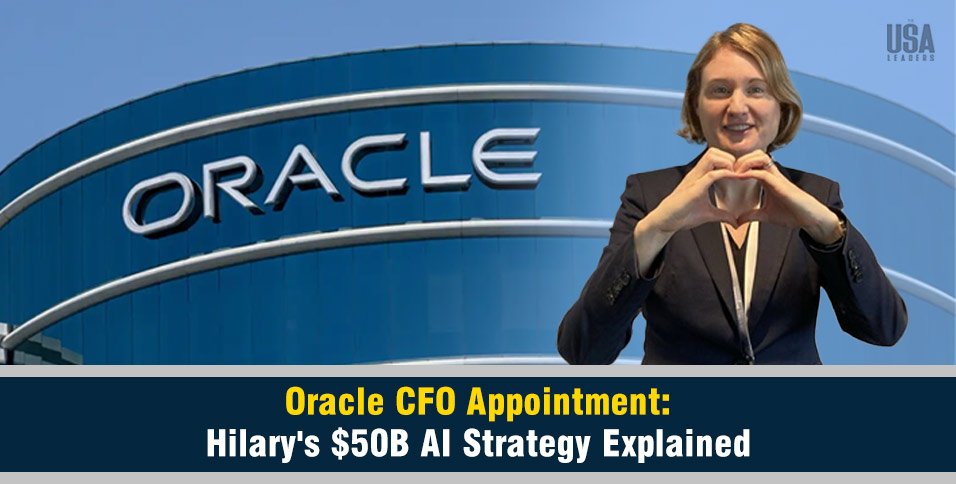
Oracle Corporation appointed Hilary Maxson as Chief Financial Officer on April 6. The Oracle CFO appointment comes as the company accelerates a $50 billion investment in artificial intelligence infrastructure.
The timing created immediate tension. Oracle recently announced thousands of layoffs as part of a restructuring plan tied to its AI expansion.
At the same time, the company hired a CFO with a $950,000 base salary and a potential $2.5 million bonus.
Oracle leadership framed the move as necessary for a capital intensive transformation under founder Larry Ellison as the company pushes deeper into artificial intelligence infrastructure.
Oracle CEO Clay Magouyrk said Maxson’s background in infrastructure and industrial finance will help the company manage large-scale investments.
“Hilary’s experience spans industrial, infrastructure, and software businesses where capital intensity and execution excellence are critical to success.”
Who is Hilary Maxson?
- Former CFO of Schneider Electric
- More than 20 years of infrastructure and finance leadership
- Previously held senior roles at AES Corporation
- MBA and an undergraduate degree from Cornell University
Her background signals a clear shift in Oracle’s priorities.
Why the Oracle CFO Appointment Focuses on Energy Expertise
Oracle no longer operates only as a software provider. The company now builds massive AI data centers that require huge energy capacity.
This shift explains the decision to hire a CFO from Schneider Electric. The company focuses on industrial electrification, energy management, and data center efficiency.
AI infrastructure consumes extraordinary power. Large training clusters can require hundreds of megawatts of electricity.
Power availability has become a major constraint for data center expansion, which explains why governments are increasing U.S. AI and energy investment policies to support next generation computing infrastructure.
Therefore, Oracle needs financial leadership that understands both infrastructure and energy costs.
Maxson highlighted this focus when she accepted the role.
“Oracle has built extraordinary momentum at the intersection of cloud and AI. We will invest with discipline to create durable long-term value.”
This statement suggests Oracle will prioritize efficient infrastructure expansion rather than uncontrolled spending.
Financial Forensic: The $2.1 Billion Restructuring
Oracle recently announced a restructuring plan that could cost about $2.1 billion. Many observers initially viewed the move as traditional cost-cutting.
However the financial data tells a different story.
Oracle’s layoffs free capital for AI infrastructure investments. Reports suggest the company cut thousands of roles from a workforce of roughly 162,000 employees as it redirects spending toward data center development.
At the same time Oracle plans to spend up to $50 billion on cloud and AI infrastructure during fiscal 2026.
The shift reflects a broader industry trend. Companies now move capital from labor-intensive services toward automated cloud infrastructure powered by AI chips and specialized hardware.
In simple terms, Oracle trades human capital for silicon capital.
Market Sentiment and the “Cash Pressure” Narrative
Despite the aggressive strategy, investors remain cautious.
Oracle’s stock has fallen roughly 25% this year as markets react to the company’s massive capital spending plan.
The company also reported a free cash flow deficit in 2025 while preparing for major infrastructure spending.
To fund the expansion, Oracle plans to raise to $50 billion through debt and equity financing. Analysts see the Oracle CFO appointment as part of a financial stabilization strategy.
Investment bank Mizuho said the leadership change supports Oracle’s ability to manage capital-intensive projects while maintaining investor confidence.
The message from Wall Street is clear. Oracle must prove that its AI infrastructure spending can generate long-term revenue growth without damaging its balance sheet.
Competitive Pressure in the AI Cloud Market
Oracle’s strategy also reflects intense competition in cloud computing.
The company competes directly with hyperscale providers such as Amazon Web Services, Microsoft Azure, and Google Cloud.
However, Oracle follows a slightly different approach. Instead of competing purely on software platforms, it focuses on enterprise workloads and specialized AI infrastructure.
Demand for these services continues to grow quickly. Oracle reported cloud infrastructure demand that currently exceeds supply.
This gap explains why the company accelerates its data center expansion despite investor concerns about cost.
Maxson’s role will involve balancing this growth with financial discipline.
Conclusion: Oracle Is Transforming Into an AI Infrastructure Utility
Oracle’s layoffs and leadership transition reflect a deeper transformation. The Oracle CFO appointment signals the company’s shift toward capital intensive AI infrastructure.
The company is moving away from legacy enterprise software services and toward large scale AI infrastructure.
Hilary Maxson’s background in energy management and infrastructure finance aligns directly with that goal. Her experience could help Oracle control the rising costs of powering AI data centers while managing billions in new investment.
The success of the strategy will depend on disciplined capital allocation and efficient energy use.
If Oracle executes well, the company could reposition itself as a major AI infrastructure provider in the global cloud market.
Neha Shekhawat