The USA Leaders
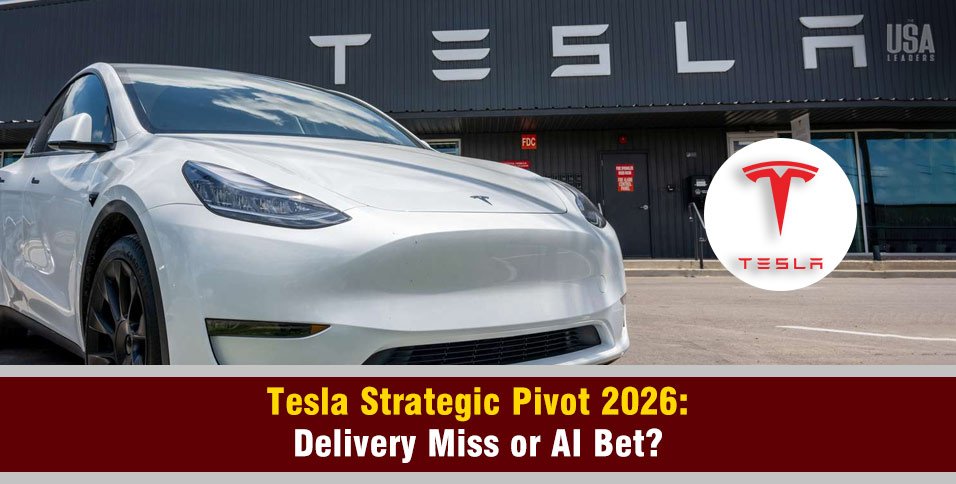
The Tesla Strategic Pivot 2026 narrative begins with a paradox.
Shares of Tesla have dropped nearly 27% after the company reported weaker than expected first quarter deliveries. At the same time, Tesla has reclaimed the global EV sales crown from Chinese rival BYD.
Tesla delivered 358,023 vehicles in Q1 2026, below analyst forecasts. However, the company still surpassed BYD in global EV sales as the broader electric vehicle market slowed.
For corporate leaders and investors, the real question is not whether Tesla missed delivery estimates. The key question is whether the company is transitioning from an automotive manufacturer into an AI infrastructure platform.
This is the central idea behind the Tesla Strategic Pivot 2026.
The Data Breakdown: Production vs Delivery
According to data released through Tesla Investor Relations, Tesla’s Q1 data reveals a noticeable gap between production and customer deliveries.
Tesla Q1 2026 Snapshot
- Vehicles Produced: 408,000
- Vehicles Delivered: 358,023
- Inventory Difference: About 50,000 vehicles
The difference suggests a short-term inventory buildup rather than a reduction in manufacturing capacity.
However, analysts debate what this gap really means.
Some analysts argue that rising inventory may indicate softening consumer demand rather than strategic patience. A buildup of unsold vehicles can occur when production outpaces actual orders.
If this pattern continues across multiple quarters, Tesla may need to rely on price adjustments or incentives to stimulate demand.
Investors will watch upcoming delivery reports closely to confirm whether the inventory buildup reflects a temporary transition or a deeper demand slowdown.
The Model Shift
Tesla has also reshaped its vehicle lineup.
Production of Model S and Model X has gradually declined as the company prioritizes high-volume platforms and autonomous technologies.
Instead, leadership has shifted focus toward:
- Lower-cost mass-market EV platforms
- Autonomous vehicle software
- Artificial intelligence infrastructure
This operational shift aligns with the broader Tesla Strategic Pivot 2026, where software and automation receive greater investment than legacy vehicle programs.
Macro Economic Headwinds
Tesla’s delivery slowdown also reflects wider economic pressure across the EV industry.
- U.S. Regulatory Changes
The removal of the federal EV tax credit in 2025 increased the effective purchase cost of electric vehicles for many American consumers.
As a result, EV adoption growth slowed across several markets. Tesla is not alone in facing this challenge.
- Global EV Market Weakness
Global competitors have also reported weaker sales momentum.
Chinese manufacturer BYD recorded a 25.5% decline in EV sales during the same period. The decline suggests Tesla’s delivery slowdown reflects broader industry cooling rather than company-specific issues.
However, the competitive environment remains intense.
BYD dominates the Chinese EV market with vertically integrated battery manufacturing and strong domestic demand.
China represents the largest EV market in the world, which gives Chinese automakers significant advantages in scale and cost efficiency.
If Tesla’s autonomous mobility strategy experiences delays, the company may again face pressure to compete primarily on vehicle pricing and production efficiency, areas where Chinese manufacturers continue to strengthen their position.
The global EV supply chain also faces broader industrial challenges, including resource constraints such as the helium shortage 2026, which continues to impact several advanced manufacturing sectors.
What Could Drive The Tesla Strategic Pivot to AI
The more important strategic story lies beyond vehicle deliveries.
Leadership at Tesla increasingly positions the company as an AI-driven mobility and robotics platform, not just a car manufacturer.
Two initiatives define this shift:
- Cybercab and Autonomous Mobility
Tesla’s planned autonomous ride-hailing platform, the Tesla Cybercab, represents a major pillar of the company’s long-term strategy.
The concept involves a fully autonomous vehicle network capable of operating without human drivers.
If deployed successfully, the platform could generate recurring transportation revenue rather than one-time vehicle sales.
This approach could transform Tesla into a mobility platform business, similar to digital ride sharing networks, but with lower operating costs due to automation.
- The Optimus Robotics Program
Tesla also continues development of the Tesla Optimus humanoid robot.
Executives describe Optimus as a long term solution for automation across manufacturing, logistics, and service industries.
However, humanoid robotics remains one of the most difficult challenges in modern engineering.
Industry experts estimate that commercial-scale humanoid robots may require five to ten years of development before broad adoption becomes practical.
This timeline introduces substantial execution risk if investors expect near term revenue from robotics platforms.
Wall Street Perspective
Analysts at Wedbush Securities continue to support Tesla’s long-term growth thesis.
Technology analyst Dan Ives maintains a $600 price target for Tesla shares. The valuation reflects the belief that Tesla will generate revenue from:
- Autonomous ride-hailing networks
- Full Self Driving software subscriptions
- Artificial intelligence training infrastructure
- Robotics automation platforms
In this model, Tesla transitions from a traditional automaker into a software-driven technology company, where recurring service revenue replaces one-time vehicle sales.
Executive Summary: The Leader’s Take
Key insights for C-suite leaders
- Agility Over Volume
Tesla appears willing to sacrifice short-term delivery growth to accelerate the development of AI and robotics technologies.
- Market Resilience
Despite weaker deliveries, Tesla still maintains the global EV leadership position in a cooling market environment.
- Strategic Risk Management
The company must adapt to the removal of EV subsidies in the United States while investing heavily in future technologies.
Conclusion
The Tesla Strategic Pivot 2026 signals a fundamental shift in how Tesla measures success.
The company no longer defines performance only through vehicles delivered.
Tesla’s long-term vision reflects the same technology-driven shift seen in other companies led by Elon Musk, including developments surrounding the SpaceX IPO in 2026.
Leadership increasingly focuses on intelligence deployed through autonomous systems and robotics platforms.
Whether this strategy succeeds will depend on execution. If Tesla delivers fully autonomous mobility and scalable robotics, the company could evolve into one of the most influential AI technology platforms in the global economy.
However, if those innovations face delays, Tesla may once again compete primarily on vehicle production and pricing in an increasingly crowded EV market.