The USA Leaders
March 30, 2026
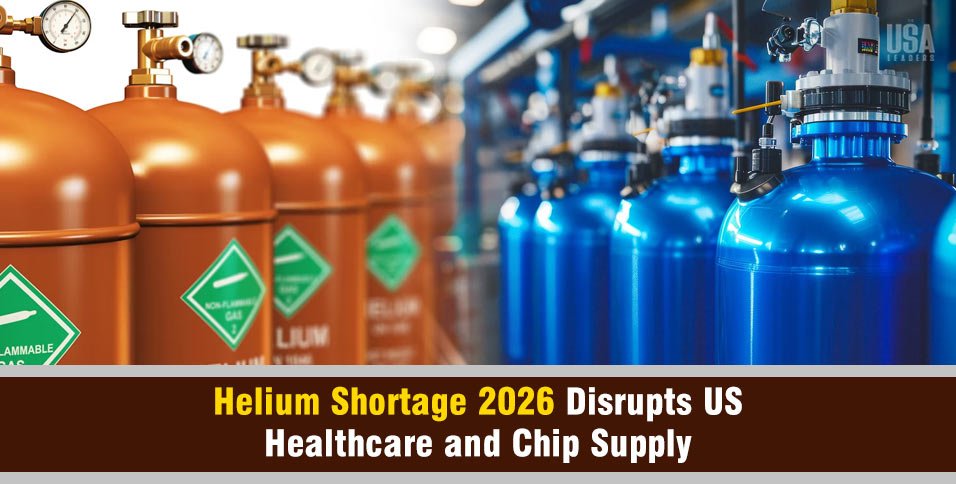
The global helium market faces sudden disruption after strikes on energy infrastructure in Qatar on March 2, 2026, which forced production shutdowns at the Ras Laffan industrial complex.
Qatar typically supplies about 30 to 38% of the world’s helium, meaning the event removed nearly one-third of global capacity overnight.
Analysts warn the disruption could trigger the Helium Shortage 2026, with direct consequences for US hospitals that rely on MRI scanners and technology companies that depend on helium for semiconductor manufacturing.
What Triggered the Helium Shortage 2026
The crisis traces back to early March attacks on energy facilities in Qatar, including the Ras Laffan industrial complex.
Energy infrastructure damage forced production disruptions and halted some exports. According to industry analysts and energy reports, Qatar normally supplies roughly one-third of global helium production.
When production stopped, a major portion of the world’s supply disappeared almost overnight. According to reporting on helium supply chains, transport delays can trigger significant ‘boil-off’ losses during shipping disruptions.
Reuters and other outlets report that the conflict has already begun affecting technology supply chains. Semiconductor manufacturers say helium shortages are becoming a growing operational concern.
At the same time, shipping disruptions near the Strait of Hormuz have slowed global transport routes, adding further strain to deliveries.
Hospitals Face Rising MRI Supply Risks
Healthcare is one of the largest consumers of helium.
MRI scanners rely on liquid helium to cool superconducting magnets that generate the magnetic fields used for medical imaging.
Industry data shows that a conventional MRI system requires around 1,700 liters of liquid helium to operate its cooling system.
Without helium, MRI scanners cannot maintain superconductivity and must shut down.
Radiology experts warn that supply disruptions could raise operating costs for hospitals.
Earlier helium shortages forced some hospitals to delay maintenance or postpone scanner installations. Industry analysts say a prolonged disruption could repeat those problems.
Semiconductor Supply Chains Feel the Pressure
Helium also plays an important role in semiconductor manufacturing.
Chip fabrication plants use the gas for wafer cooling, leak detection, and precision processing during advanced chip production.
Industry executives say supply constraints could slow manufacturing if shortages deepen.
“A helium shortage is an absolute concern,” said supply chain consultant Cameron Johnson at the Semicon China conference, according to Reuters.
The warning matters because companies like Nvidia and Apple depend on highly specialized fabrication processes to produce next-generation AI processors.
If helium deliveries tighten further, chipmakers may need to ration supply across production lines.
Industrial Gas Companies Seek Alternative Supply
Major industrial gas suppliers are already responding.
Executives at Air Liquide said the company plans to reallocate helium shipments from other regions to offset disruptions caused by the Middle East conflict.
However, analysts say the helium market has limited spare capacity.
Helium production mainly comes from natural gas processing in a small number of countries,
including the United States, Qatar, and Algeria.
Because the market is small and specialized, replacing lost supply quickly can be difficult.
Could Technology Reduce Helium Dependence
Some technology companies are trying to reduce reliance on helium.
MRI manufacturers have begun introducing new systems that use sealed magnet technology and drastically lower helium consumption.
For example, newer scanners can operate with only a small fraction of the helium used by older machines.
Researchers are also exploring helium-free MRI systems that rely on alternative cooling technologies.
However, most of the roughly 50,000 MRI scanners currently operating worldwide still depend on conventional helium cooling systems.
That means any prolonged supply disruption could affect healthcare infrastructure for years.
What Happens Next
Industry experts say the immediate impact may take weeks to appear because helium already loaded in shipping containers continues to move through global supply chains.
But if production outages in Qatar continue, the shortage could tighten later this year.
For the United States, the crisis highlights a long-running strategic question.
Helium may be invisible to most consumers. Yet it remains a critical resource for healthcare systems, semiconductor manufacturing, and the infrastructure powering artificial intelligence.
The current Helium shortage 2026 shows how quickly disruptions in one region can ripple across the global economy, as detailed in recent reports on how the Iran war disrupts commodities far beyond the energy sector.
Neha Shekhawat