The USA Leaders
Artificial intelligence is changing how companies operate. However, many global leaders are not resisting the shift. Instead, they are actively preparing their organizations for it.
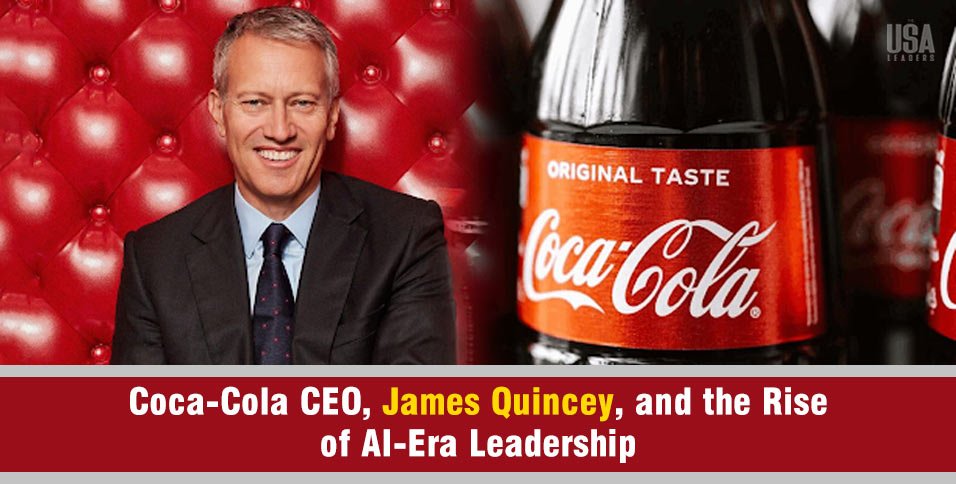
One example is James Quincey, the long-time CEO of Coca-Cola. After nearly a decade leading the beverage giant, James Quincey announced plans to step down in 2026 as part of a leadership transition designed to accelerate the company’s next phase of digital growth.
Rather than signaling disruption, this transition reflects a broader trend. Experienced executives are preparing their companies for the AI-driven business landscape by building new leadership structures that combine industry knowledge with technological expertise.
Coca-Cola Begins a New Leadership Chapter After James Quincey
In March 2026, Coca-Cola confirmed that James Quincey will step down as chief executive after almost ten years in the role. The company shared the transition plan in an official announcement that several business outlets reported.
James Quincey became CEO in 2017 and guided Coca-Cola through major modernization efforts. During his leadership, the company expanded its beverage portfolio, strengthened global marketing strategies, and focused on data-driven consumer insights.
Coca-Cola’s market value reached about $260 billion in early 2026, according to Bloomberg market data.
Meanwhile, Forbes estimates James Quincey’s net worth at roughly $60 million, built largely through executive compensation and stock awards.
Looking ahead, Coca-Cola appointed Henrique Braun as the next CEO. Braun’s mandate includes expanding the use of artificial intelligence across supply chain forecasting, marketing analytics, and customer engagement tools.
This transition reflects a tactical shift toward deeper digital capabilities rather than a response to leadership pressure.
Leadership Evolution Across Global Companies
Coca-Cola’s leadership transition appears alongside similar shifts across several large corporations.
A similar leadership transition is unfolding at Adobe. The company announced that CEO Shantanu Narayen will step down once a successor is appointed, ending an 18-year tenure while remaining chair of the board.
Executive turnover has increased in recent years as companies prepare for new technological challenges. According to Challenger, Gray & Christmas, 2,221 CEOs announced their departures in 2024, the highest total on record since the firm began tracking CEO changes in 2002.
Several industries are adapting leadership structures to match AI-driven innovation.
| Company | Leadership Transition | Planned AI Focus |
| Coca-Cola | James Quincey to Henrique Braun | AI in supply chains and marketing insights |
| Walmart | Expanded AI leadership roles | Automation and predictive logistics |
| Adobe | Planned AI investments | Generative tools within creative software |
These changes show how organizations are aligning leadership with emerging technologies.
Experience and AI Literacy Now Go Together
Artificial intelligence has become a critical business tool. Yet industry experience still plays a major role in leadership.
Many companies now look for executives who combine deep operational knowledge with strong digital understanding.
Modern executives now combine traditional management experience with technological insight.
This shift reflects the evolving definition of leadership in today’s business environment, where strategy, innovation, and digital understanding work together.
Experienced leaders understand global markets, supply chains, and customer behavior. At the same time, AI literacy helps leaders deploy new technologies effectively.
Consulting firms such as McKinsey and Deloitte have highlighted this combination in recent leadership reports. They note that successful executives increasingly blend traditional management skills with technology strategy.
As a result, the modern CEO profile continues to evolve rather than disappear.
Investor Perspective on Leadership Transitions
Investors often watch leadership transitions closely.
Market reactions can be mixed. For example, technology companies such as Adobe have seen stock volatility during periods when investors evaluate AI competition and leadership strategy.
Despite short-term fluctuations, many analysts believe companies that invest in digital capabilities can strengthen long-term growth.
Leadership transitions that emphasize innovation often signal that companies are preparing for the next phase of global competition.
What the AI Transition Means for Employees
The shift toward AI leadership also affects employees and middle management.
Companies adopting AI frequently redesign internal workflows. Automation tools now assist with tasks such as data analysis, demand forecasting, and marketing optimization.
This does not eliminate human roles. Instead, many employees move toward more strategic responsibilities that involve interpreting data and guiding decision-making.
Workers who develop digital and analytical skills will likely find new opportunities as AI systems expand across industries.
The Next Phase of Leadership
Artificial intelligence will continue to influence how companies design their leadership teams.
Future CEOs will likely combine strong industry experience with digital strategy skills. They must understand both traditional business models and emerging technologies.
The transition involving James Quincey illustrates how companies can manage this shift through thoughtful succession planning.
Rather than replacing experience, the AI era is expanding the leadership toolkit.
Conclusion
The leadership transition involving James Quincey highlights how global companies are preparing for the next phase of innovation.
Artificial intelligence is reshaping strategy, operations, and customer engagement. In response, many organizations are aligning leadership roles with the technologies shaping the future.
Executives like James Quincey are helping guide this evolution by building companies that combine strong leadership experience with the growing power of artificial intelligence.
Neha Shekhawat