The USA Leaders
February 20, 2026
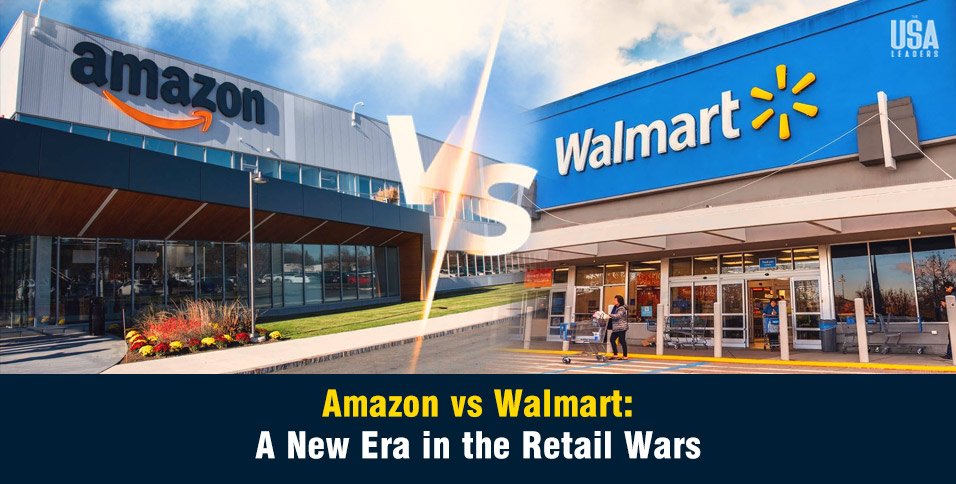
Amazon has officially overtaken Walmart in annual revenue, closing one of the most important gaps in modern business history. In 2025, Amazon generated $716.9 billion in revenue, surpassing Walmart’s$713.2 billion.
This result ended Walmart’s 13-year run as the world’s largest retailer and confirmed a structural shift toward cloud computing, AI, and automated logistics.
This change did not happen overnight. It came from fifteen years of aggressive reinvestment, technology expansion, and infrastructure control.
The Revenue Shift Happened Faster Than Expected
The scale of Amazon’s rise becomes clear when you compare long-term revenue data.
In 2010, Walmart produced $422 billion in revenue. Amazon generated just $34.2 billion. Walmart held a lead of nearly $388 billion.
By 2025, Amazon erased that gap completely and moved ahead. This growth represents a 21-fold revenue increase for Amazon over fifteen years. Walmart grew only 69% over the same period. Despite Walmart’s tries to strategically fight back with their “Walmart Flash Deals”.
Amazon achieved this result by expanding into high-margin technology sectors instead of relying only on retail sales.
Why Amazon Won the Amazon vs Walmart Revenue Race
Amazon’s advantage comes from a powerful differentiator: cloud computing.
Its cloud division, Amazon Web Services (AWS), fundamentally changed Amazon’s business model.
Key AWS impact:
- AWS accounts for approximately 18% of Amazon’s total revenue
- Amazon retail revenue without AWS: $588 billion
- AWS generates significantly higher profit margins than retail
Without AWS, Walmart would still lead in pure retail sales. However, AWS provides Amazon with massive cash flow, which it reinvests into:
- Robotics and warehouse automation
- Global logistics infrastructure
- Third-party seller platforms
- Artificial intelligence development
This reinvestment cycle allows Amazon to scale faster than traditional retail models built around physical stores.
Walmart’s Response: Turning a Retail Giant into a Tech Competitor
Despite losing the revenue crown, Walmart remains a formidable competitor in the Amazon vs Walmart battle.
Walmart market valuation recently reached a $1 trillion, becoming the first traditional retailer to achieve this milestone. It also moved its stock listing to Nasdaq, reinforcing its transformation into a technology-driven company.
Walmart’s strengths include:
- 15 consecutive quarters of double-digit e-commerce growth
- 4,700 U.S. stores functioning as fulfillment hubs
- Industry-leading grocery delivery and curbside pickup
This hybrid model, combining physical infrastructure with digital capabilities, gives Walmart a major advantage in last-mile delivery and grocery logistics.
Amazon vs Walmart: The AI Arms Race Begins
Both companies are investing heavily in artificial intelligence, but they are taking fundamentally different approaches to get there.
Walmart’s AI Strategy: Partner-Driven Innovation
Walmart has chosen speed through partnership. By integrating tools from OpenAI and Google directly into its shopping experience, it has improved:
- Customers using Sparky spend 35% more per order
- AI improves personalization, search, and recommendations
- Faster deployment through external partnerships
All this without building the underlying technology itself.
Amazon’s AI Strategy: Building Proprietary Infrastructure
Amazon is betting on control instead. CEO Andy Jassy has committed to massive investment in:
- Planned $200 billion investment in AI, robotics, and custom chips
- Proprietary AI infrastructure integrated with AWS
- Automation across warehouses and logistics
Prioritizing long-term infrastructure ownership over the speed that partnerships can offer.
Retail headcount will continue to grow in absolute terms, but the composition is shifting, away from warehouse and fulfillment roles, toward engineers, data scientists, and technical operators.
The trajectory is clear: the companies that win the next decade of retail will become more than sellers; they will learn to think more efficiently.
Automation and the Workforce Shift
Automation is reshaping employment across both companies. Amazon has cut approximately 16,000 jobs as it prioritizes AI-driven operations and robotics. Walmart is also automating warehouses to improve efficiency and maintain competitive pricing.
This reflects a broader trend in the Amazon vs Walmart rivalry: the future of retail will rely more on machines, algorithms, and software than human labor.
The Grocery Battlefield: Walmart Still Leads
Despite Amazon’s revenue victory, Walmart continues to dominate the grocery sector, a critical component of retail spending.
Amazon has struggled to scale its physical grocery footprint. It recently closed several Fresh and Go locations and is converting some spaces into Whole Foods Market stores.
Meanwhile, Walmart benefits from:
- Established nationwide store infrastructure
- Strong curbside pickup adoption
- High customer loyalty in grocery shopping
This gives Walmart a powerful advantage in everyday consumer spending.
Revenue vs Market Value: Investors See a Bigger Tech Story
Although Amazon dethroned Walmart in revenue, the market places even greater value on AI infrastructure companies.
For example, Nvidia holds a market value of approximately $4.5 trillion, far exceeding both retail giants.
This highlights an important reality: investors increasingly value companies that power AI, not just companies that sell products.
Key Takeaways from the Amazon vs Walmart Rivalry
- Digital Infrastructure Beat Physical Scale
Amazon’s cloud computing and logistics network enabled it to surpass Walmart’s store-based model.
- Retail and Technology Are Converging
Amazon is expanding into physical retail, while Walmart is building digital and AI platforms.
- Artificial Intelligence Will Decide the Next Winner
Both companies are investing heavily in AI to improve efficiency, logistics, and customer experience.
- Consumers Benefit Most
The Amazon vs Walmart competition drives faster shipping, lower prices, and better services.
Conclusion: Amazon vs Walmart Is No Longer Just a Retail War
Amazon’s revenue victory marks a historic turning point in the Amazon vs Walmart rivalry. However, the competition is far from over.
Walmart still leads in grocery and physical retail reach. Amazon dominates cloud computing, logistics, and AI infrastructure.
The next decade of the Amazon vs Walmart battle will be defined by one critical factor:
Which company best combines artificial intelligence, logistics, and global scale into a seamless retail ecosystem?
Neha Shekhawat
Also Read: Top 5 Biggest Supermarket Chains in the US