
Walmart alone captures about 20.3% of all US grocery spending. That is Numerator’s figure for the 12 months ending September 30, 2026, reported by Supermarket News.
Put simply, about one in every five grocery dollars in the country goes through a Walmart checkout. The next two biggest supermarket chains, Costco and Kroger, each hold about 8%.
The US grocery market is also shifting. In 2026, Costco passed Kroger for second place in grocery spending share. Amazon and Whole Foods keep gaining ground. And Kroger, after its failed Albertsons merger in 2024, is back to making acquisitions.
This blog ranks the biggest supermarket chains in the US by grocery spending share. It then covers who runs each company and how private label, e-commerce, and consolidation shape their plans. It is written for business readers who want the numbers and the strategy behind them.
What Are the Biggest Supermarket Chains in the US in 2026?
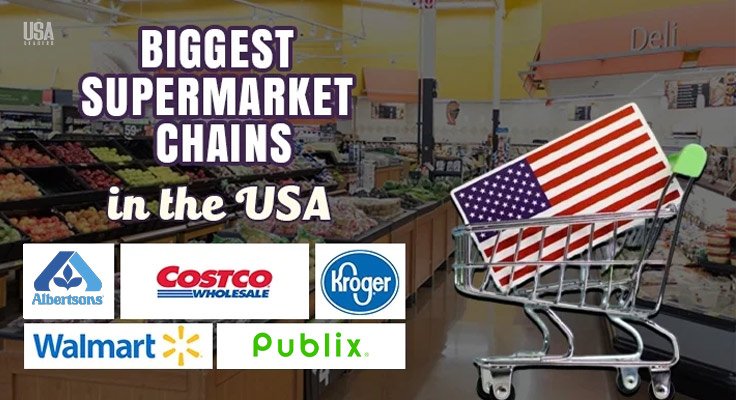
Walmart, Costco, Kroger, Albertsons, and Publix are the biggest supermarket chains in the US by share of grocery spending. Numerator’s data for the 12 months ending September 30, 2026, shows Walmart leading with 20.3% of the market, followed by Costco at 8.4%, Kroger at 8.2%, Albertsons at 4.5%, and Publix at 4.1%.
Together, they are the big 5 supermarkets in this ranking and hold about 45.5% of US grocery spending.
We use grocery spending share as the metric because it keeps the comparison fair. A supermarket sales ranking based on total revenue also includes fuel, pharmacy, and other products, making it harder to see how much each company earns from grocery sales.
| Rank | Biggest Supermarket Chains in the US | Headquarters | Founder | CEO | US grocery share (Numerator, 2026) | Latest sales | US stores |
| 1 | Walmart | Bentonville, Arkansas | Sam Walton | John Furner | 20.3% | $285.5B US grocery category (Walmart FY2026, ended Jan 31, 2026) | 4,611 Walmart U.S. stores, incl. Puerto Rico and excl. Sam’s Club (Walmart FY2026) |
| 2 | Costco | Issaquah, Washington | Jeffrey Brotman, James Sinegal | Ron Vachris | 8.4% | $297.2B worldwide net sales (Costco FY2026, ended Aug 30, 2026) | 647 warehouses, US and Puerto Rico (Costco, 2026) |
| 3 | Kroger | Cincinnati, Ohio | Bernard Kroger | Greg Foran | 8.2% | $147.6B total sales (Kroger FY2025, ended Jan 31, 2026) | 2,697 stores (Jan 31, 2026) |
| 4 | Albertsons | Boise, Idaho | Joe Albertson | Susan Morris | 4.5% | $83.2B net sales and other revenue (FY2025, ended Feb 28, 2026) | 2,244 stores (Feb 28, 2026) |
| 5 | Publix | Lakeland, Florida | George Jenkins | Kevin Murphy | 4.1% | $62.7B sales (Publix FY2025, ended Dec 27, 2025) | About 1,430 stores in 8 states (Publix, 2026) |
Sales figures use each company’s own reporting period, so they are not like-for-like. Walmart’s figure is grocery only. Costco’s is worldwide net sales and includes fuel and non-food items. Kroger, Albertsons,s and Publix report total company sales. Source: Perishable News.
Why Does Walmart Lead the Biggest Supermarket Chains in the US?
Walmart leads because of scale. Walmart U.S. sold $285.5 billion in groceries in the year ended January 31, 2026, according to its annual filing. That is almost double Kroger’s total company sales. John Furner became CEO in early 2026, taking over from Doug McMillon.
The World’s Largest Retailer: Walmart is the largest retailer in the world and one of the largest grocery chains in the US. It had 10,955 stores and other retail units in 19 countries at the end of fiscal 2026.
Core Features
- Walmart is famous for its commitment to offering low prices on various products.
- Walmart supercenters carry a massive selection of products, including groceries, electronics, apparel, home goods, and more.
- Consumers can save time and effort by finding nearly everything they need in one location.
- Its Great Value store brand and fast-growing online business add to that appeal. Global e-commerce sales hit $150.4 billion in fiscal 2026, up 24% (Walmart FY2026 results).
Achievements
Revolutionized Shopping. Walmart revolutionized shopping by combining a grocery store with a discount department store under one roof. This innovative model has become a standard in the retail industry.
Global Reach. Walmart now operates across 19 countries, which gives it buying power that few rivals can match.
Optimized Supply Chain Management. Walmart has optimized its supply chain management, resulting in lower costs and faster product turnover. This efficiency has contributed to its ability to offer low prices to customers. Capital spending reached $26.6 billion in fiscal 2026, mostly on supply chain automation and technology (Walmart FY2026 results).
How Did Costco Move Into Second Place Among US Grocery Chains?
Costco grew faster than its rivals. It captured 8.4% of US grocery spending in the 12 months ending September 30, 2026, against Kroger’s 8.2%. Two years earlier, Kroger led Costco by a full percentage point. Ron Vachris is CEO.
Membership Model: Costco operates on a membership-based model, offering discounts on bulk purchases and products beyond groceries. Its net sales were $297.2 billion in fiscal 2026, ended August 30, 2026, up 10.1%. That figure covers fuel and non-food items worldwide. Costco had 647 warehouses in the US and Puerto Rico (Costco FY2026 results).
Core Features
- Costco primarily sells products in bulk quantities, allowing customers to purchase larger amounts at discounted prices.
- Unlike traditional supermarkets, Costco carries a limited selection of items, focusing on high-quality, popular products. This streamlined approach helps them maintain low prices.
- To shop at Costco, customers must become members and pay an annual fee. This membership model helps the company keep prices low while earning extra revenue and building customer loyalty.
Achievements
Loyal Membership Base. Paid executive members, who pay a higher fee, reached 42.3 million in fiscal 2026, up 9.4% (Costco FY2026 results). That steady fee income is the base of the company’s model.
Warehouse Club Model. Costco’s club model has been copied by many competitors. Circana’s 2026 research found that club stores drove nearly half of US private label growth, and Kirkland Signature is a big reason why.
Digital Growth. Costco’s online sales exceeded $33 billion in fiscal 2026, growing more than 20%, with delivery partners like Uber Eats and DoorDash supporting growth.
Is Kroger Still a Top Grocery Chain After Costco Passed It?
Yes. Kroger is still the largest traditional supermarket operator and the third-largest by spending share at 8.2%. It reported $147.6 billion in total sales for fiscal 2025, which ended January 31, 2026. It leads traditional supermarket chains with 2,697 stores across 35 states and Washington, D.C. (Kroger annual report, 2026).
Greg Foran became CEO in February 2026, after interim CEO Ron Sargent. Foran previously ran Walmart U.S. In July 2026, Kroger agreed to buy Giant Eagle for $1.65 billion. Giant Eagle has about $9 billion in annual sales and 197 supermarkets. The deal is expected to close in 2027, pending regulatory review (Kroger announcement, July 2026).
Diverse Regional Brand: Kroger runs stores under regional names like Ralphs, Fred Meyer, and King Soopers to serve local customers.
Core Features
- The company sells a wide range of products, including fresh food, meat, dairy, groceries, household goods, and personal care items. This comprehensive selection makes it a one-stop shop for many customers.
- Kroger often carries products from local suppliers, emphasizing fresh and regional items. This approach connects with customers who value supporting local businesses and enjoying fresh produce.
- Its loyalty program offers rewards, discounts, and personalized offers based on shopping habits. Kroger also pairs that data with private label grocery lines such as Simple Truth.
Achievements
Scale in Traditional Grocery. No other conventional supermarket company runs as many stores. Still, Numerator shows Kroger and Albertsons losing share while clubs and Amazon gain.
Private Label Push. Kroger added two dozen new protein products to Simple Truth in January 2026 (FoodNavigator, 2026).
Price Cuts and Digital. Kroger told Reuters in July 2026 that it plans price cuts on thousands of items. It will fund them partly through direct imports and better technology.
How Does Albertsons Compete With Larger Grocery Rivals?
Albertsons competes through local banners, digital sales, and loyalty data. It is the fourth-largest by spending share at 4.5%, and that share is slipping. Susan Morris became CEO in May 2025, promoted after the failed Kroger merger.
Albertsons reported $83.2 billion in net sales and other revenue for its 53-week fiscal 2025, ended February 28, 2026. It ran 2,244 stores in 35 states and Washington, D.C., under banners such as Safeway, Vons, Jewel-Osco, and ACME (Albertsons annual results, 2026).
Core Features
- Digital sales grew 21% in fiscal 2025 and passed 10% of sales (Albertsons Q4 results, April 2026).
- Loyalty members grew 12% to 51.2 million (Albertsons Q4 results, April 2026).
- Own brand penetration was flat, and Morris called it a top priority for 2026 (Albertsons Q4 earnings call, 2026).
Challenges
Albertsons guided to identical sales growth of only 0% to 1% for fiscal 2026. Pharmacy headwinds are part of the reason. Grocery Dive called 2026 a “make or break” year for the company.
What Makes Publix Stand Out Among Regional Grocery Chains?
Publix is the largest employee-owned company in the US and the biggest regional chain on this list, accounting for 4.1% of US grocery spending. It reported $62.7 billion in sales for fiscal 2025, which ended December 27, 2025. Kevin Murphy is CEO.
It operates around 1,430 stores in eight Southeastern states: Florida, Georgia, Alabama, Tennessee, South Carolina, North Carolina, Virginia, and Kentucky. More than 260,000 associates work there. Pharmacy is a growing part of the model, with more than 1,350 in-store pharmacies (Chain Drug Review, 2026).
For business readers, Publix shows that a tight regional footprint and strong service can compete with national scale.
How Do the Biggest Supermarket Chains Compete on Private Label, E-Commerce and Consolidation?
They compete on three fronts. Store brands protect margins, delivery wins convenience, and deals add scale. Walmart and Costco lead on the first two. Kroger is betting on the third.
| Chain | Biggest lever | Evidence |
| Walmart | E-commerce and advertising | $150.4B global e-commerce sales, fiscal 2026 (Walmart) |
| Costco | Membership and Kirkland Signature | 42.3M paid executive members; $33B+ digitally enabled sales (Costco, 2026) |
| Kroger | Acquisition and loyalty data | Giant Eagle deal, $1.65B, expected to close in 2027 (Kroger, 2026) |
| Albertsons | Digital and loyalty | Digital sales up 21%; 51.2M loyalty members (Albertsons, 2026) |
| Publix | Regional service model | About 1,430 stores in 8 Southeastern states (Publix, 2026) |
Is Private Label Grocery Winning?
In units, yes. Store brands reached a record 23.7% unit share in the 10 months ending November 1, 2026. Their dollar share was 21%.
Private label grocery gives retailers better margins and products that shoppers can only buy in their stores. Walmart’s Great Value, Costco’s Kirkland Signature and Kroger’s Simple Truth are examples.
How Big Is E-Commerce for Grocery Chains?
Big enough to matter. Walmart U.S. e-commerce sales were $99.6 billion in fiscal 2026, up from $79.3 billion a year earlier. Costco’s digitally enabled sales topped $33 billion. Albertsons is above 10% digital penetration. These are the numbers that smaller grocery store chains struggle to match.
Is Grocery Consolidation Coming Back?
Yes, but in smaller steps. The $24.6 billion Kroger and Albertsons merger collapsed in December 2024 over antitrust concerns. Kroger’s Giant Eagle deal is a regional add-on, not a national merger. Both Kroger and Giant Eagle expect to sell a limited number of stores to win approval.
Numerator estimated in July 2026 that the deal could lift Kroger’s share to 8.7%, above Costco’s 8.3% at the time. For the wider grocery industry, the lesson is that size now decides who can fund lower prices.
Where Do Amazon and Target Fit in the US Grocery Market?
Both sit just outside the top five by grocery spending share. Amazon plus Whole Foods holds about 3.9% (Numerator, 2026). Target reported $24.1 billion in food and beverage sales for fiscal 2025, ended January 31, 2026, a small slice of its total sales (Target annual report, via GourmetPro). Our old draft ranked them by total company revenue, which overstated their grocery role.
Amazon (CEO Andy Jassy) has changed its plan. In January 2026, it said it would close Amazon Fresh and Amazon Go stores and open more than 100 new Whole Foods stores. It also offers same-day perishable delivery in more than 2,300 US cities and towns (Amazon, 2026). Jason Buechel runs Worldwide Grocery Stores and Whole Foods. For more on its growth, see our history of Amazon and top e-commerce companies.
Target, led by CEO Michael Fiddelke since February 2026, relies on its own brands, such as Good & Gather, which are part of a portfolio worth about $30 billion.
Who Are the Largest Supermarket Chains in the World?
By total retail revenue, the world’s largest chains are Walmart, Amazon, Schwarz Group (Lidl and Kaufland), Aldi, Costco, Ahold Delhaize, and Carrefour (NRF Top 50 Global Retailers, 2026). Because that metric includes non-food and e-commerce sales, filtering for pure grocers puts Schwarz Group and Aldi on top.
The next five major US grocery chains after the top five are Ahold Delhaize USA, ALDI, H-E-B, Amazon (including Whole Foods), and Target. Ahold Delhaize USA reported $59.8 billion in US net sales for 2025 (GourmetPro, 2026).
Conclusion
The biggest supermarket chains in the US are led by Walmart, with Costco, Kroger, Albertsons, and Publix behind it. The 2026 ranking changed because Costco passed Kroger, and the Kroger, Walmart, and Costco grocery race is now tighter than it looks.
Walmart wins on scale. Costco wins on growth and membership. Kroger is betting on acquisitions, while Albertsons and Publix defend their regions. Across all of them, private label and delivery are taking more of the grocery industry each year.
Watch three things: Giant Eagle’s review, Amazon and Whole Foods’ growth, and whether store brands keep their market share. Any of them could reshape this ranking again.
FAQs
Which grocery chain has the most stores in the US?
Walmart U.S. had 4,611 stores at the end of fiscal 2026, not counting Sam’s Club. Among grocery-focused chains, Kroger has 2,697 and Albertsons 2,244. ALDI plans nearly 2,800 stores by the end of 2026, but that is a plan, not a verified count.
Is Costco bigger than Kroger?
Costco leads in grocery spending share, 8.4% to 8.2%. Its sales are also higher at $297.2 billion compared to $147.6 billion, but Costco’s total includes fuel and non-food items sold worldwide. Kroger still has far more stores.
Which big supermarket chain is employee-owned?
Publix. It is the largest employee-owned company in the US, with more than 260,000 associates.
How much of US grocery spending do the top five chains control?
About 45.5%. Adding Numerator’s shares for Walmart (20.3%), Costco (8.4%), Kroger (8.2%), Albertsons (4.5%), and Publix (4.1%) gives that total.
Will Kroger and Albertsons try to merge again?
Public reporting shows no new deal. Their $24.6 billion merger collapsed in December 2024, and Kroger is now focused on the Giant Eagle purchase.