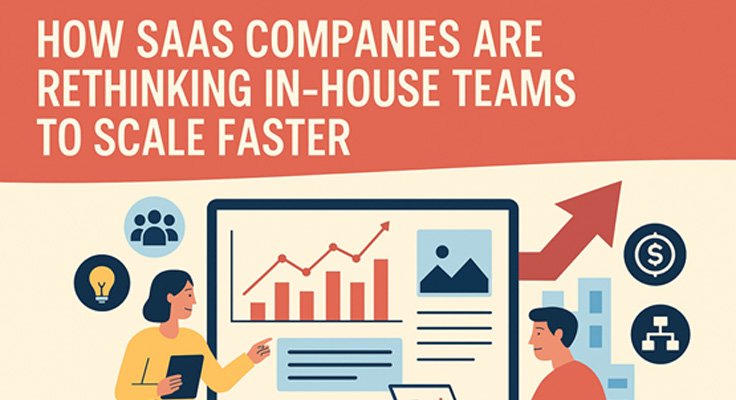
In the early stages of a SaaS company, building everything in-house often feels like the safest strategy. Founders want full control over product, marketing, sales, and operations. Internal teams move quickly, share context easily, and stay closely aligned with the company vision. But as the business grows, this model starts to show its limits.
Scaling introduces new pressure. Customer acquisition becomes more competitive, brand positioning demands higher quality, and partnerships require stronger data validation. At that point, many SaaS leaders realize that in-house teams alone cannot sustainably manage every growth lever. Instead, the companies scaling fastest today are combining internal execution with specialized external platforms to grow without increasing headcount at the same pace.
The Shift from Vertical Control to Strategic Leverage
Traditional SaaS growth relied heavily on centralized internal teams. Designers built assets, marketers handled distribution, analysts generated reports, and sales teams managed partnerships. This structure worked when growth channels were limited and competition was moderate.
Today, growth happens across multiple ecosystems at once, including content creators, influencers, affiliate partners, and community networks. Each channel requires speed, real-time data, and constant optimization. Relying exclusively on internal resources introduces friction, delays, and rising costs.
Instead of trying to vertically integrate everything, SaaS companies are now choosing strategic leverage. They keep core product, data, and strategy in-house while offloading execution-heavy or distribution-focused functions to specialized tools.
Creator Partnerships Are No Longer Experimental
One of the clearest areas where this shift is visible is creator and influencer partnerships. What was once seen as experimental marketing is now becoming a structured growth channel for both B2B and B2C SaaS companies.
However, scaling creator partnerships internally is operationally demanding. Teams must source creators, evaluate audience quality, verify performance data, track campaigns, and report results. Doing all of this manually inside a marketing department quickly becomes a bottleneck.
This is why many SaaS companies no longer manage creator partnerships entirely in-house. Instead, they rely on standardized presentation systems that allow creators to share transparent performance data in a structured way. High-performing creators now operate with public profiles that clearly showcase their audience and performance, such as those found in these real-world kit showcases. These give SaaS teams instant access to metrics, past collaborations, and performance proof without long email exchanges or manual verification.
For SaaS leaders, this removes a major layer of friction in partner evaluation and onboarding.
Why Influencer Infrastructure Is Becoming a SaaS Category of Its Own
As creator-driven acquisition matures, the tools around it are evolving into a full infrastructure category. Just as CRM platforms standardized sales operations, influencer infrastructure platforms are now standardizing creator partnerships.
From the creator perspective, a modern digital creator profile used for brand partnerships now functions as a live media kit and business presence at the same time. It centralizes verified metrics, content assets, audience demographics, and collaboration history into a single shareable link. For SaaS companies, this eliminates the need for manual audits, spreadsheet comparisons, or screenshot-based validation. A growing number of creators now rely on platforms that offer this type of digital creator profile for partnerships as their primary collaboration interface.
The result is a faster, more reliable procurement cycle for partnerships. Instead of allocating internal resources to data verification, SaaS growth teams can focus on alignment, creative direction, and distribution strategy.
Internal Teams Focus on Strategy, Not Data Chasing
What separates high-scale SaaS organizations from the rest is not how many tasks they perform in-house, but how intelligently they allocate internal talent.
Marketing teams are shifting away from operational work such as data collection, asset formatting, and manual reporting. These tasks are increasingly handled by automated systems. Internal teams instead focus on partnership strategy, funnel design, brand positioning, and long-term storytelling.
This division of labor increases output without expanding payroll at the same rate and significantly reduces burnout across growth teams.
External Platforms Do Not Replace Teams, They Multiply Them
A common concern among founders is that using external platforms weakens internal teams. In practice, the opposite is happening. The strongest SaaS companies use automation to multiply the impact of their in-house talent.
Instead of hiring additional analysts to prepare campaign reports, they use platforms that deliver live data. Instead of building internal tooling for partner onboarding, they adopt standardized creator profiles. Instead of manually reviewing weekly campaign results, they leverage dashboards that update continuously.
This model preserves ownership while removing operational drag.
The Economic Logic Behind Hybrid Execution
From a financial viewpoint, the hybrid model is also becoming hard to ignore. Expanding internal teams increases fixed costs, slows decision making, and raises long-term risk. External platforms operate on variable cost structures, scale automatically, and can be adjusted as growth phases change.
When SaaS leaders compare the cost of building internal automation versus adopting proven platforms in non-core areas, the total cost of ownership consistently favors external solutions. This is particularly true for creator partnerships, audience distribution, and performance tracking.
What This Shift Means for SaaS Leaders
For executives and founders, this transformation is not about outsourcing to cut costs. It is about structural efficiency. The future of SaaS growth is neither fully in-house nor fully outsourced. It is modular.
Core product development, vision, and intellectual property remain internal. Distribution, influence, and data-heavy execution increasingly rely on specialized platforms that move faster than internal development cycles.
Leaders who adopt this modular approach earlier gain speed, reduce operational risk, and unlock growth levers that would otherwise require much larger teams.
Final Thoughts
SaaS companies that scale efficiently today are not doing more work. They are doing different work. They focus internal talent on strategy, product, and brand while leveraging external platforms for automation and execution.
Creator partnerships, once managed through spreadsheets and PDFs, now operate on real-time infrastructure. Creator data that once required internal validation is now structured through live media kits. This evolution reflects a broader truth about modern SaaS growth. The companies that win are not the ones that build everything internally, but the ones that assemble the smartest operational stack.
As the ecosystem grows more specialized, combining in-house expertise with platform-powered execution is no longer a trend. It is becoming the default operating model for scalable SaaS organizations.
Also Read: How SaaS Companies Combine In-House and Outsourced Support Teams