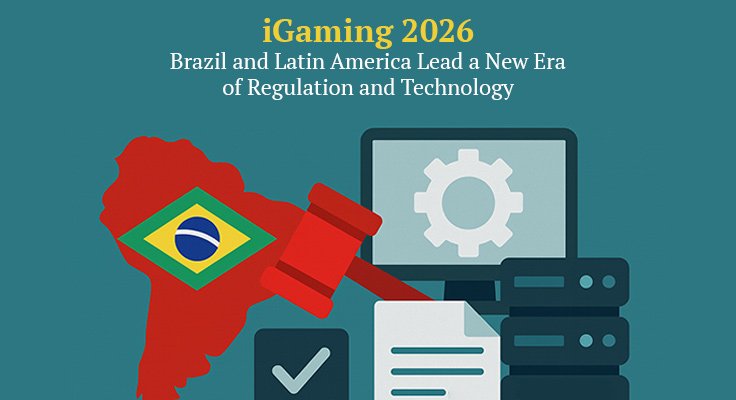
Did you know that the iGaming industry is entering 2026 in a new phase of maturity, where compliance and responsible growth have become the true indicators of success?
According to the SOFTSWISS 2026 iGaming Trends Report, created in partnership with NEXT.io, Latin America — with Brazil at the forefront — is emerging as a model of regulated expansion and technological innovation in the online gaming industry.
From fiscal reforms to artificial intelligence and cybersecurity, the research highlights how the region is reshaping the global iGaming landscape.
The Definition of Market Maturity
“Efficiency, compliance, and long-term sustainability are the new benchmarks of leadership,” the report states.
Across 105 pages, SOFTSWISS identifies a structural transformation: the iGaming sector has moved beyond its “growth-at-all-costs” era into a stage defined by operational discipline and trust.
In 2024, rapid expansion was the main goal. By 2026, the focus has shifted toward measurable profitability, resilience, and credibility. For Latin America, this change aligns perfectly with Brazil’s 2025 regulatory breakthrough, when Law No. 14,790 officially established a licensing framework for online betting and gaming — a milestone that repositioned the country as a leader in the global market.
Understanding Casino Regulation and Localisation
Regulation is no longer seen as a limitation — it is now a competitive advantage.
In Brazil, the new licensing and payment control mechanisms implemented in 2025 created one of the world’s largest regulated markets. By the end of that year, 78 licensed operators were serving more than 17.7 million players, representing a fundamental shift from informal activity to institutionalised governance.
A closer look at the Brazilian bettor profile helps explain this rapid market evolution. According to a recent research led by an online casino in Brazil, 59% of bettors are men and 41% are women, with the majority aged 25 to 40 years (42.1%), followed by 41 to 56 years (24.6%). The socioeconomic base is predominantly middle and upper-middle class — classes C1 and B1 together represent 47% of all online bettors in the country.
In terms of behavior, most Brazilian players are occasional bettors, with 27.5% wagering only a few times a year and 20.4% betting one to two times per month. Their main motivations are entertainment (72%), supplemental income (38%), and social connection (19%). This data shows that, within Brazil’s regulated market, betting has become a mainstream leisure activity rather than an exclusive niche — a key insight for companies entering the segment.
Other countries are following the same path:
- Chile advanced a bill to regulate online betting and establish a clear taxation model with a 19% VAT.
- Peru opted for gradual fiscal increases, balancing public revenue with market stability.
- Colombia integrated esports betting into its legal system, reinforcing its position as a regional leader in compliance and responsible play.
This new approach highlights a growing trend: governments are not only opening markets but also enforcing accountability through advertising restrictions, anti-money laundering (AML) protocols, and responsible gambling initiatives.
Technology, AI, and Responsible Gaming
Artificial Intelligence has evolved from an experimental tool into a core driver of transformation.
In the SOFTSWISS industry survey, over 56% of respondents ranked AI among the top two forces shaping iGaming’s future. In Latin America, operators increasingly use machine learning to detect high-risk behaviour, automate fraud detection, and enhance the user experience — all while strengthening compliance.
“AI will help design loyalty and VIP experiences that feel more personal, but always within clear ethical and regulatory limits,” explains Fellipe Fraga, CBO at EstrelaBet.
At the same time, cybersecurity has become a structural priority. More than half of surveyed companies listed it as a top business concern due to the rise in phishing, identity theft, and deepfake-based fraud. Operators are now investing in biometric verification, behavioural analytics, and real-time monitoring to ensure data integrity and player trust.
This convergence of AI and cybersecurity defines a new business equation for iGaming: innovation and protection must evolve together.
Brand and Business Consolidation
As regulatory standards strengthen, brand reputation has replaced bonuses as the leading growth engine.
The report identifies “brand-centric marketing” as a defining trend — companies that communicate transparency, responsibility, and reliability achieve higher retention and lower acquisition costs. This is especially true in Latin America, where advertising restrictions are pushing operators to develop stronger brand identities and owned communities instead of relying on paid visibility.
Simultaneously, mergers and acquisitions (M&A) continue to reshape the industry. Global transactions such as Flutter’s EUR 2.3 billion acquisition of Snaitech and Tipico’s expansion into Austria show how companies are consolidating to gain scale, technology, and local expertise.
In Latin America, similar movements are taking shape through strategic alliances and diversification. Firms are evolving into multi-vertical ecosystems that combine gaming, fintech, and marketing operations — signaling the region’s transition from growth to maturity.
Latin America’s Compliance Advantage
The report’s regional outlook defines Latin America’s unique edge as the “Compliance Advantage.”
While Europe focuses on advertising restrictions and North America experiences uneven online casino regulation, Latin American markets are gaining recognition for balancing structure with innovation.
Brazil stands out not only for its regulatory advances but also for its well-defined player base, which provides valuable insights for operators seeking stability. The predominance of middle-class players and the emphasis on entertainment-driven behavior reduce volatility and encourage sustainable engagement. This social pattern reinforces Brazil’s position as a mature, data-informed market — one that prioritizes compliance and responsible play.
Brazil’s tax reform — raising the Gross Gaming Revenue (GGR) rate from 12% to 18% — demonstrates how fiscal discipline can coexist with market growth. Peru’s gradual taxation and Colombia’s consistent enforcement of responsible gaming laws reinforce a pragmatic governance model that prioritizes long-term stability.
As SOFTSWISS experts note, “Payments and marketing compliance are now as decisive as licensing itself.” For operators, this means that sustainable success in 2026 will depend not only on technology and user engagement, but on the ability to prove credibility through transparent and compliant operations.
Conclusion
The 2026 SOFTSWISS report makes one point clear: Latin America is no longer a peripheral market — it is a central force shaping global iGaming.
Brazil’s regulatory maturity, combined with the region’s fast adoption of AI, cybersecurity, and responsible gambling standards, positions Latin America as a model of sustainable digital growth.
For business leaders, the next challenge will be to align technological innovation with credibility — transforming compliance from a legal requirement into a competitive asset.
By 2026, companies that master this balance will not only grow — they will define the future of iGaming software development worldwide.
Also Read: Beyond crypto: Smart investors back the entire ecosystem – And you?