The USA Leaders
April 3, 2026
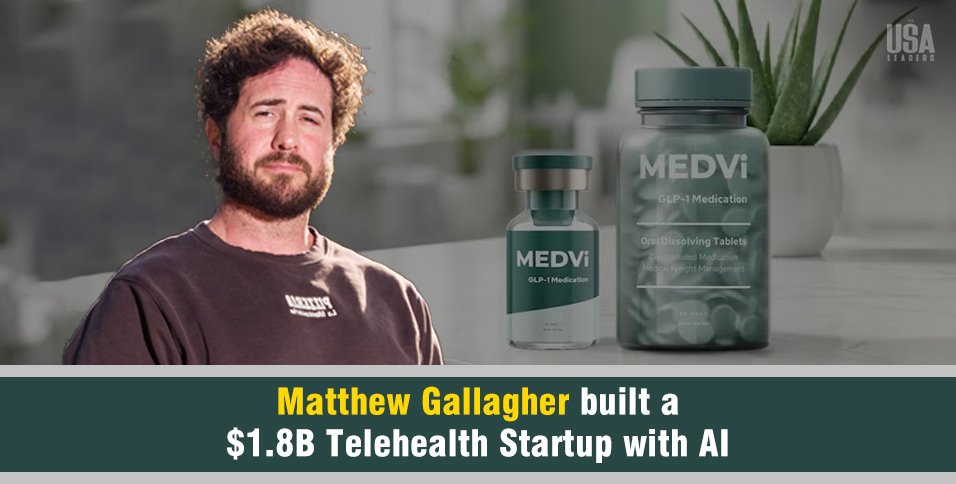
Matthew Gallagher Built a $1.8B Telehealth Startup With AI
The rise of AI startups has created a new type of founder. Instead of large teams and heavy venture funding, some entrepreneurs now build companies using software tools and small budgets.
One of the clearest examples is Matthew Gallagher, the founder of MedVi. By April 2026, the company reached a $1.8 billion valuation while operating with only two full-time employees.
Gallagher launched the business with $20,000 of his own capital. Instead of building a full healthcare organization, he created a digital platform and connected it to existing medical infrastructure.
As a result, MedVi generated $401 million in revenue in 2025 with a 16% net profit margin.
The story highlights a new technology trend. Founders now use AI to replace entire teams.
The $12,000 AI Workforce Behind MedVi
The core of the business was not a large engineering team. It was an AI workflow.
Matthew Gallagher relied on multiple AI tools to write code, generate marketing assets, and automate operations, according to an AI-powered telehealth startup analysis.
These tools included ChatGPT, Claude, and Grok. Each tool handled a different function.
AI systems generated most of the platform’s code. Marketing content, such as landing pages, advertisements, and product videos, was also generated by AI tools. In addition, an automated chatbot handled early-stage customer support.
The entire AI technology stack reportedly costs between $3,000 and $12,000 per year. Traditional startup teams often spend millions on salaries for engineers, marketers, and operations staff.
This cost gap created a new model for lean startups.
The Three-Entity Business Model
MedVi did not attempt to operate as a full healthcare provider. Instead, Matthew Gallagher designed a three-part system that distributed responsibilities across specialized partners.
The model included three main entities:
- MedVi
The website acts as the customer interface. It handles patient onboarding and telehealth consultations, primarily for GLP-1 weight loss treatments.
- OpenLoop Health
This partner provides licensed physicians through a telehealth-as-a-service model.
- Compounding Pharmacies
Independent pharmacy partners manufacture and ship medications directly to patients.
This structure allows MedVi to focus on digital marketing and user experience while medical and regulatory responsibilities remain with licensed providers.
When AI Hallucinates Medicine
However, the AI-first strategy created risks.
According to Gallagher, AI systems sometimes generated incorrect information about medication pricing and support details. These issues became more serious as the company scaled.
As revenue grew, Matthew Gallagher replaced some AI functions with human experts in sensitive areas such as legal compliance and accounting.
This change shows an important limit of AI automation in healthcare. High-risk decisions still require human oversight.
The Rise of the AI Solopreneur
MedVi reflects a larger shift in the startup economy.
This shift reflects a broader transformation in leadership, where founders increasingly rely on algorithms to make business decisions instead of traditional management structures.
Recent startup data shows that 38% of seven-figure businesses are now led by solopreneurs who rely heavily on AI tools instead of full teams.
In 2019, solo-founded startups represented 23% of new ventures. By 2026, the number has increased to more than 36%.
The change comes from falling technology costs and the rise of AI development tools. Natural language coding also allows founders to build software platforms without large engineering teams.
As a result, leadership roles are changing. Instead of managing departments, founders increasingly manage AI systems and external partners.
Conclusion
The story of Matthew Gallagher and MedVi shows how AI is reshaping entrepreneurship.
With $20,000 in startup capital, a small AI tool stack, and a partner-based healthcare model, Gallagher built a telehealth platform valued at $1.8 billion according to a New York Times report.
The company generated $401 million in annual revenue with only two full-time employees.
However, the experiment also shows the limits of automation in regulated industries. Healthcare platforms still require human expertise in legal, compliance, and patient safety.
For startup founders in 2026, the lesson is clear. The next generation of leaders may not build large teams. Instead, they will orchestrate AI systems and specialized partners to scale businesses faster than ever before.
Neha Shekhawat