The USA Leaders
February 23, 2026
Imagine getting a performance review with no complaints, then losing your job anyway.
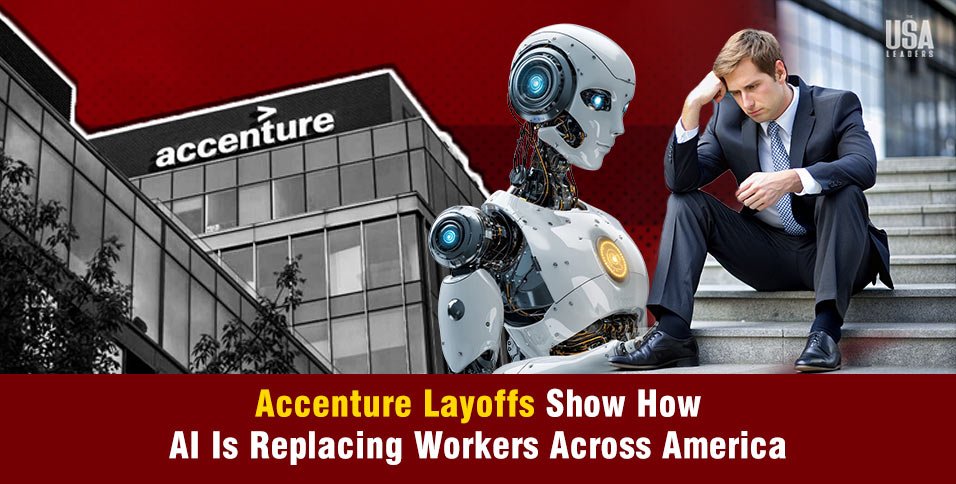
That is what happened to thousands of Accenture employees in 2025.
Accenture CEO Julie Sweet explained the company’s direction during an earnings call. She said Accenture would exit employees for whom reskilling was not a viable path.
Workers who could not learn AI skills fast enough would leave. She described the process as exiting employees on a compressed timeline.
The workforce numbers confirmed the policy. Accenture reduced its global headcount from 801,000 in February 2025 to 779,000 by August 2025. That equals 22,000 jobs lost in six months.
At the same time, the company’s financial performance improved. Accenture reported $69.7 billion in fiscal 2025 revenue, a 7% increase year over year. Julie Sweet credited AI demand as a key driver of that growth.
The Accenture layoffs did not happen because the business was struggling. They happened because it was winning.
The Strategy Behind the Accenture Layoffs
Accenture formalized this shift through an $865 million restructuring program. Leadership projected more than $1 billion in savings from the initiative. Executives described the program as business optimization.
According to Accenture’s official Q4 FY2025 earnings call transcript, performance did not drive the decision. Leadership identified what it called a strategic skills mismatch. In practical terms, certain roles no longer justify their labor cost compared to AI alternatives.
Accenture’s internal workforce data shows the full substitution effect:
- The company retrained 550,000 employees in generative AI fundamentals
- Its AI and data specialist workforce grew from 40,000 in 2023 to 77,000 in 2025
- Roles with declining economic value were removed
- Roles aligned with AI delivery were expanded
The company reduced traditional labor and increased AI-aligned labor in parallel.
Other Global Companies Are Executing the Same Shift
Accenture represents one example of a broader corporate pattern. Companies across industries followed the same approach throughout 2025. Outplacement firm Challenger, Gray and Christmas reported nearly 55,000 planned U.S. layoffs directly linked to AI in 2025.
Total job cuts in the United States reached 1.17 million during the year, the highest level since the COVID-19 period.
- Amazon: Infrastructure Investment, Headcount Reduction
Amazon eliminated 14,000 corporate roles in October 2025. CEO Andy Jassy stated that AI and automation reduce the number of employees required for certain functions. Amazon now invests more than $100 billion in AI infrastructure. The layoffs and the investment move in the same direction.
- Microsoft: When AI Writes the Code, Fewer Coders Get Hired
Microsoft cut approximately 15,000 jobs in 2025. CEO Satya Nadella described the company’s transition into an intelligence engine. Internal data showed AI tools now generate roughly 30% of new company code. This increase reduces developer labor demand per project.
- Salesforce: A Public Promise and a Three-Week Reversal
CEO Marc Benioff stated publicly that AI would not cause mass layoffs. Three weeks later, Salesforce cut 4,000 customer support roles after deploying its Agentforce platform. The company reduced the team from 9,000 employees to 5,000. Benioff later confirmed the cuts and referred to the reduced headcount using the word “heads.”
- IBM, Intel, SAP, and the Broader Pattern
IBM replaced hundreds of human resources roles with its internal AskHR chatbot. Intel, SAP, Workday, and CrowdStrike also reduced headcount while increasing AI investment. More than 35 CEOs publicly confirmed that AI efficiency gains drove workforce reductions in 2025.
The sequence now follows a consistent pattern. Companies invest in AI. Companies reduce labor costs. Investors reward the resulting margin improvement.
White Collar Roles Now Face Direct Replacement Risk
Automation historically affected manufacturing jobs first. White-collar roles remained relatively protected. That protection no longer exists.
Researchers at the Massachusetts Institute of Technology estimated that AI could replace work equivalent to nearly 12% of the global workforce. Administrative, financial, and professional services roles face the highest exposure.
These roles previously offered stability because they required education and specialized expertise. AI systems now perform parts of that work faster and at lower cost.
Accenture built its global consulting business on human expertise. AI now performs portions of consulting, analysis, and implementation work.
This reduces the economic need for certain human roles. Human labor has shifted from a core asset to an adjustable cost variable.
The Financial Incentives Behind Workforce Reduction
The numbers explain the decision directly. Accenture spent $865 million on restructuring and severance. The program returns more than $1 billion in savings. That is a net financial gain from cutting 22,000 people.
Julie Sweet received $29.6 million in total compensation the same year. Executives get rewarded for margin improvement. AI delivers margin improvement by cutting labor costs. The incentive structure does the rest.
Labor represents one of the highest operating costs. AI reduces that cost. Leadership executes the transition. Workers absorb the impact.
The New Employment Equation Is Already Active
Companies now execute workforce transitions faster than in previous technology cycles. Earlier automation waves unfolded over decades. The AI transition unfolds within quarters.
What the data confirms:
- Challenger, Gray, and Christmas tracked nearly 55,000 AI-linked U.S. layoffs in 2025
- MIT quantified AI exposure risk at nearly 12% of the global workforce
- Accenture retrained 550,000 employees and still eliminated 22,000 roles
- Microsoft expanded AI training programs and still cut thousands of jobs
Retraining increases opportunity. It does not guarantee protection.
The dual path corporate strategy now follows:
- Companies expand AI capabilities
- Companies reduce traditional roles in parallel
What this means for workers:
- Workers who develop AI-aligned skills increase their market value
- Workers who do not face a direct and growing replacement risk
The Accenture layoffs are not an outlier. They are a preview. The transition has already begun.
Neha Shekhawat
Also Read : Amazon vs Walmart: A New Era in the Retail Wars