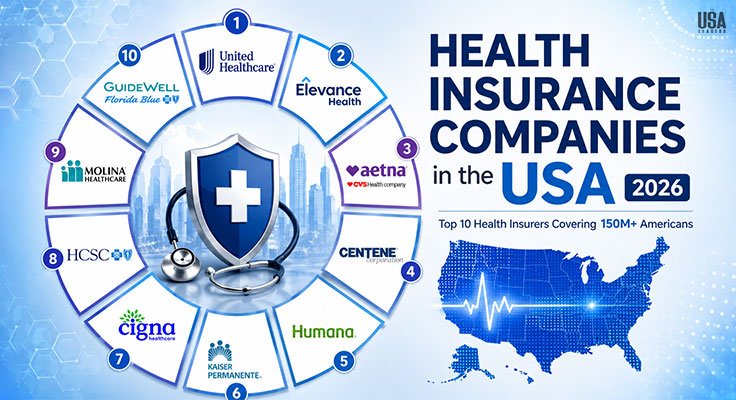
UnitedHealthcare leads the top health insurance companies in the USA 2026. It holds roughly 16% of the national market. Elevance Health and Aetna, owned by CVS Health, round out the next two spots.
Together, these top 10 health insurance companies in the USA 2026 cover well over 150 million Americans. They sell employer plans, Medicare Advantage, Medicaid, and Health Insurance Marketplace coverage across the United States.
This blog focuses only on health insurers, not hospitals or drug distributors. All ten companies below act as health coverage providers under the same ACA rules on essential benefits. Rankings combine market share, direct written premiums, and enrollment data, drawing on NAIC-style figures and recent healthcare industry trends coverage.
We’ll also cover Medicare Advantage, the Health Insurance Marketplace, HMO versus PPO plans, and how customer satisfaction compares to sheer size.
Top 10 Health Insurance Companies in the USA 2026
Here are the top 10 health insurance companies in the USA 2026, ranked by market share and enrollment:
| Rank | Company | Est. Market Share | Members / Premiums |
| 1 | UnitedHealthcare | ~16% | $269.45 billion in premiums |
| 2 | Elevance Health | #2 by enrollment | Tens of millions of members |
| 3 | Aetna (CVS Health) | 7.22% | 36+ million members |
| 4 | Centene Corporation | 6.74% | $113.19 billion in premiums |
| 5 | Humana | 6.59% | 14.8 million medical members |
| 6 | Kaiser Permanente | 6.01% | 12.5+ million members |
| 7 | Cigna Healthcare | N/A | 15+ million medical members |
| 8 | HCSC | 3.82% | $64.07 billion in premiums |
| 9 | Molina Healthcare | 2.14% | 5.8 million members |
| 10 | GuideWell (Florida Blue) | 1.83% | $30.71 B in premiums |
Note: Figures reflect 2024-2025 premium and enrollment data, the most recent full-year numbers available as of mid-2026.
1. UnitedHealthcare
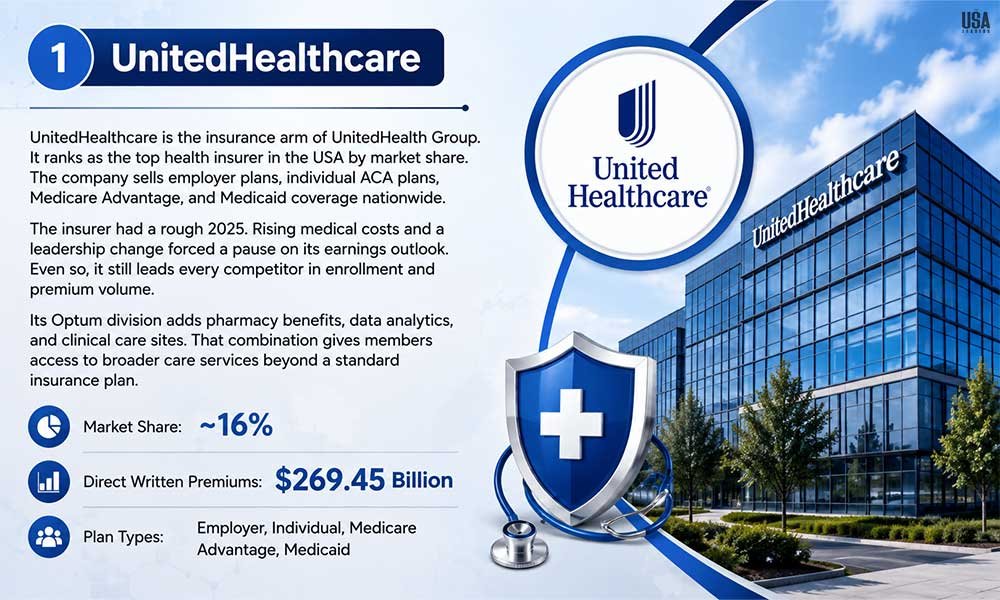
UnitedHealthcare is the insurance arm of UnitedHealth Group. It ranks as the top health insurer in the USA by market share. The company sells employer plans, individual ACA plans, Medicare Advantage, and Medicaid coverage nationwide.
The insurer had a rough 2025. Rising medical costs and a leadership change forced a pause on its earnings outlook. Even so, it still leads every competitor in enrollment and premium volume.
Its Optum division adds pharmacy benefits, data analytics, and clinical care sites. That combination gives members access to broader care services beyond a standard insurance plan.
- Market share: Approximately 16%
- Direct written premiums: $269.45 billion
- Plan types: Employer, individual, Medicare Advantage, Medicaid
2. Elevance Health
Elevance Health, formerly known as Anthem, operates Blue Cross Blue Shield plans in more than a dozen states. It ranks second nationally by total enrollment, according to AMA-based market share data.
The company built its reputation on broad commercial coverage. It also runs large Medicare and Medicaid programs through state contracts. Its Carelon division adds behavioral health and pharmacy services on top of standard plan offerings.
- Market position: #2 by enrollment
- Plan types: Commercial, Medicare, Medicaid, BCBS specialty programs
3. Aetna (CVS Health)
CVS Health acquired Aetna in 2018. The deal paired pharmacy and retail health services with a nationwide insurance business. Aetna now covers more than 36 million people.
Members can fill prescriptions, get vaccines, and see a nurse practitioner at CVS MinuteClinic locations. That retail network gives Aetna an edge for members who want care close to home.
- Market share: 7.22%
- Premiums written (2024): $121.24 billion
- Members: 36+ million
4. Centene Corporation
Centene focuses heavily on government-sponsored coverage. It sells Health Insurance Marketplace plans under the Ambetter brand. The company also serves Medicaid members across dozens of states.
Centene started small, as a single nonprofit Medicaid plan in Milwaukee founded in 1984. Today, it insures roughly one in 15 Americans through some form of government-backed coverage.
- Market share: 6.74%
- Direct written premiums (2024): $113.19 billion
- Focus areas: Medicaid, ACA Marketplace (Ambetter)
5. Humana
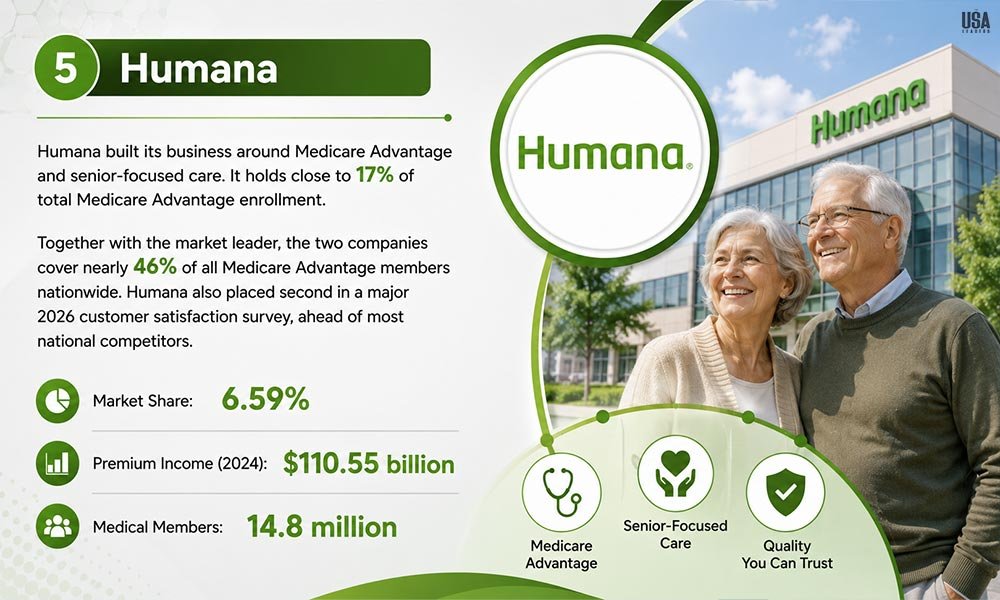
Humana built its business around Medicare Advantage and senior-focused care. It holds close to 17% of total Medicare Advantage enrollment.
Together with the market leader, the two companies cover nearly 46% of all Medicare Advantage members nationwide. Humana also placed second in a major 2026 customer satisfaction survey, ahead of most national competitors.
- Market share: 6.59%
- Premium income (2024): $110.55 billion
- Medical members: 14.8 million
6. Kaiser Permanente
Kaiser Permanente combines insurance with its own hospitals, clinics, and physician groups. Few competitors match that integrated model.
The company operates in only eight states plus Washington, D.C. Even with that limited footprint, it earned the top spot in a major 2026 satisfaction survey for the second year running.
Kaiser’s average Silver plan premium runs about $595 a month before subsidies, based on 2026 marketplace data. That places it among the more affordable health insurance options for members who qualify for tax credits.
- Market share: 6.01%
- Members: 12.5+ million
- Coverage area: 8 states plus Washington, D.C.
7. Cigna Healthcare
Cigna brings a strong international presence into the U.S. market. It serves both domestic employers and global companies with operations abroad.
Its Evernorth division adds pharmacy benefits and behavioral health services. Evernorth expanded mental health access in 2026, closing a gap many employer plans still struggle with.
- Medical members: 15+ million
- Dental members: 16+ million
- Focus areas: Employer-sponsored plans, chronic disease management
8. HCSC
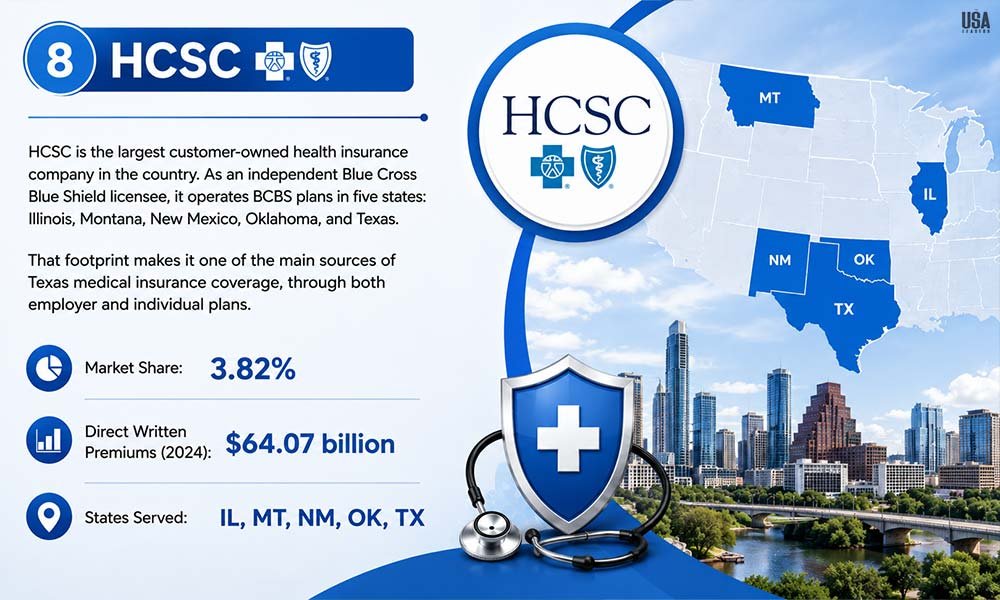
HCSC is the largest customer-owned health insurance company in the country. As an independent Blue Cross Blue Shield licensee, it operates BCBS plans in five states: Illinois, Montana, New Mexico, Oklahoma, and Texas. That footprint makes it one of the main sources of Texas medical insurance coverage, through both employer and individual plans.
- Market share: 3.82%
- Direct written premiums (2024): $64.07 billion
- States served: IL, MT, NM, OK, TX
9. Molina Healthcare
Molina Healthcare was built specifically to serve government-sponsored programs. It focuses on Medicaid, Medicare, and subsidized ACA plans for lower-income and underserved populations.
Molina also earns strong marks for affordability. It offers some of the cheapest Silver-tier plans on the Health Insurance Marketplace, according to 2026 pricing data.
- Market share: 2.14%
- Direct written premiums (2024): $35.84 billion
- Members: 5.8 million
10. GuideWell (Florida Blue)
GuideWell operates as a nonprofit mutual holding company. It is the parent of Florida Blue, one of the best-known Blue Cross Blue Shield brands in the Southeast.
Its plan offerings stay concentrated in Florida and nearby states, rather than competing nationwide like the larger names on this list.
- Market share: 1.83%
- Direct written premiums (2024): $30.71 billion
- Coverage area: Florida and the Southeast
Health Insurance Companies Ranked by Customer Satisfaction
Market share and customer satisfaction rarely line up. A major 2026 satisfaction survey ranked Kaiser Permanente first overall for the second year in a row. Humana took second place, and Horizon BCBS of New Jersey, a regional insurer, claimed third.
UnitedHealthcare told a different story. The largest insurer by market share dropped from first to 12th place in that same survey, the steepest fall of any company measured. Blue Shield of California and Molina Healthcare tied for last.
The takeaway: the best and worst health insurance companies rarely match the biggest and smallest ones. Size buys network reach. It doesn’t guarantee smooth claims handling or friendly customer service.
Medicare Advantage: Who Leads in 2026?
UnitedHealthcare and Humana dominate Medicare Advantage enrollment. Combined, the two companies cover nearly 46% of all Medicare Advantage members nationwide.
Elevance Health and Kaiser Permanente also offer Marketplace plans. However, they are stronger in employer-sponsored and Medicare health insurance than in individual marketplace coverage.
Health Insurance Marketplace (ACA) Leaders
Centene, through its Ambetter plans, is one of the largest providers on the Health Insurance Marketplace. Aetna and Molina also serve many Marketplace customers, especially in states with fewer insurance choices.
Elevance Health and Kaiser Permanente round out the Marketplace picture too. Their strength, though, leans more toward employer and Medicare plans than individual marketplace coverage.
Most Marketplace shoppers choose between four metal tiers: Bronze, Silver, Gold, and Platinum plans. Silver, Gold and Platinum options carry higher premiums but lower out-of-pocket costs when a member needs frequent care. Many buyers also qualify for tax credits that lower their monthly premium, based on household income.
How to Compare Health Insurance Companies: Premiums, Coverage, and Claims
Choosing between health insurance providers comes down to a few practical factors. Brand size alone won’t tell you much.
- Premiums: Monthly health insurance costs range widely by age, state, and plan type, often from under $100 to more than $600.
- Coverage: Read exactly what each plan covers, including your current doctors, medications, and any planned procedures.
- Claims and customer service: Satisfaction survey data, like the 2026 rankings above, offers a better signal than company size alone.
- Provider networks: A narrower network, like Kaiser’s, can mean more coordinated care but fewer outside choices.
- Preventive care: Most ACA-compliant plans cover preventive care, like annual checkups and vaccines, at no extra cost.
Costs can shift even after an insurer approves a claim. Our guide to insurance excess in 2026 explains how deductibles and out-of-pocket costs work once an insurer pays a claim. A single unexpected medical bill can undo the savings from a low monthly premium if the deductible runs high.
Health Maintenance Organizations vs. PPO Plans
Most companies on this list sell both health maintenance organizations and PPO plans. The exact mix varies by state.
An HMO plan usually requires a primary care doctor. Members need a referral to see a specialist. That structure keeps premiums lower.
A PPO plan gives you more flexibility. You can visit specialists and doctors outside the network without a referral. However, PPO plans usually have higher monthly premiums.
Kaiser Permanente mainly offers HMO-style plans. Cigna and Aetna provide more PPO plan options, especially for employer-sponsored health insurance.
How We Ranked the Top Health Insurance Companies in the USA 2026
This list covers companies offering health insurance directly to individuals, families, and employers. It excludes hospital systems and drug distributors, which appear in separate rankings on this site.
The rankings use three main factors: market share (direct written premiums), total enrollment, and the range of plans offered, including individual, group, Medicare, and Medicaid. If different sources reported slightly different numbers, we showed the range instead of using one figure.
The best health insurance company depends on who you ask. Many people judge insurers based on their own claims experience, not the company’s overall size or market share.
Key Takeaways
- UnitedHealthcare is the top health insurer in the USA, with roughly 16% market share.
- Elevance Health ranks second nationally by total enrollment, just ahead of Aetna.
- UnitedHealthcare and Humana together control nearly 46% of Medicare Advantage enrollment.
- Kaiser Permanente topped a 2026 customer satisfaction survey. UnitedHealthcare fell to 12th place.
- Centene, Aetna, and Molina lead ACA Marketplace enrollment through Ambetter and similar plans.
- Being the biggest health insurance company and being the best-rated one are often two different things.
Conclusion
Kaiser Permanente shows that the biggest insurer is not always the best-rated one. In health insurance, size, satisfaction, and provider network can point to different winners, so the best choice depends on what matters most to you.
FAQs
- Which health insurance company is the best?
No single health insurance company works best for everyone. Kaiser Permanente rates highest for satisfaction. The largest national insurer leads in size and network reach as the top health insurer overall. The right choice depends on location, budget, and health needs.
- Is there a health insurance plan that covers everything?
No plan covers every service at zero cost. Even comprehensive plans include deductibles, copays, and network limits, so check the details before assuming full health insurance coverage.
- What are the top 5 health insurance companies in USA?
Based on market share and enrollment, the top 5 health insurance companies in USA rankings are UnitedHealthcare, Elevance Health, Aetna, Centene, and Humana, though the exact order shifts slightly depending on the metric used.
- What are the best health insurance companies for employers?
Cigna, Aetna, and Elevance Health all compete heavily for large employer contracts. Broad provider networks and strong pharmacy-benefit integration help each company win business.