

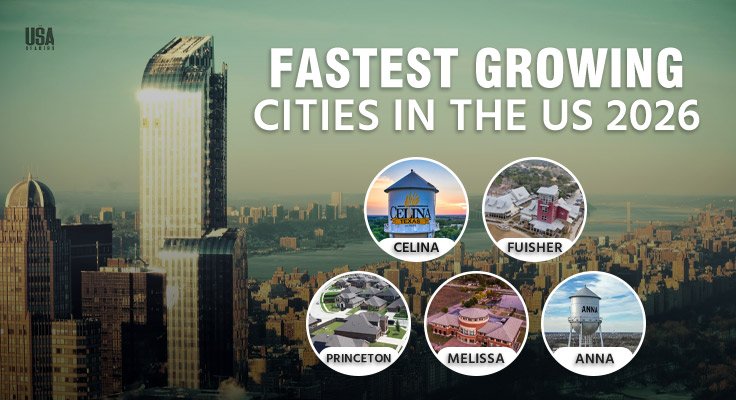
Americans are increasingly untethering from expensive metros like New York City or Los Angeles. Hybrid work, lower taxes, and relative affordability continue to drive relocation decisions as professionals and families seek more space, lower housing costs, and secondary suburban hubs
This shift is reshaping the fastest growing cities in the US. Developers are building aggressively, but supply and demand do not match everywhere. Some markets still face tight housing, while others are seeing apartment supply catch up with demand.
Short-Term Growth vs. Sustained Long-Term Growth
Not all growth lasts. The difference between temporary booms and genuine expansion matters significantly.
- Short-term growth happens fast but often collapses just as quickly. Cities that depend on one industry face this risk constantly.
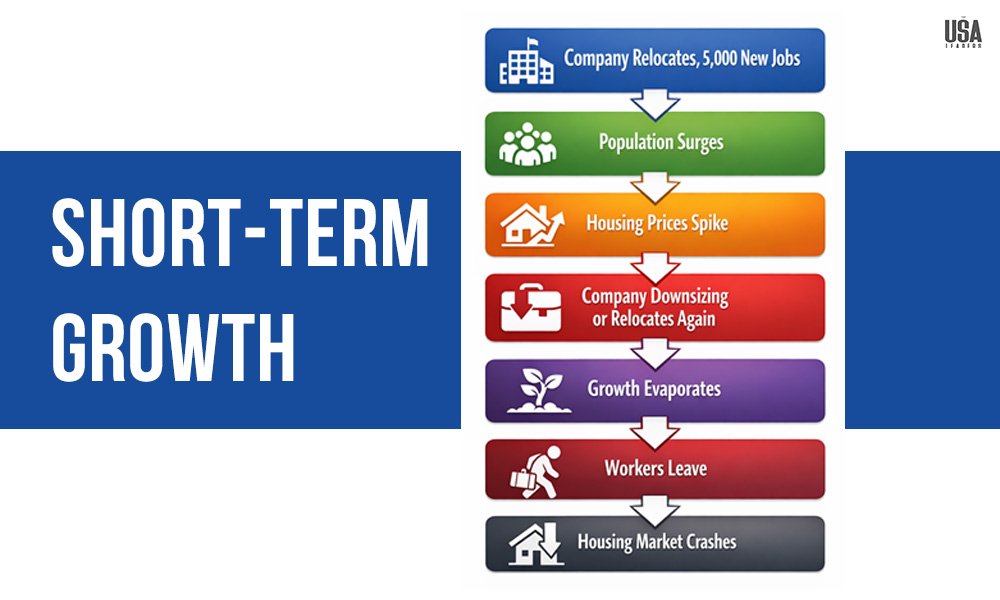
Cities that depend on one industry face this risk constantly.
- Sustained long-term growth builds on diverse foundations.
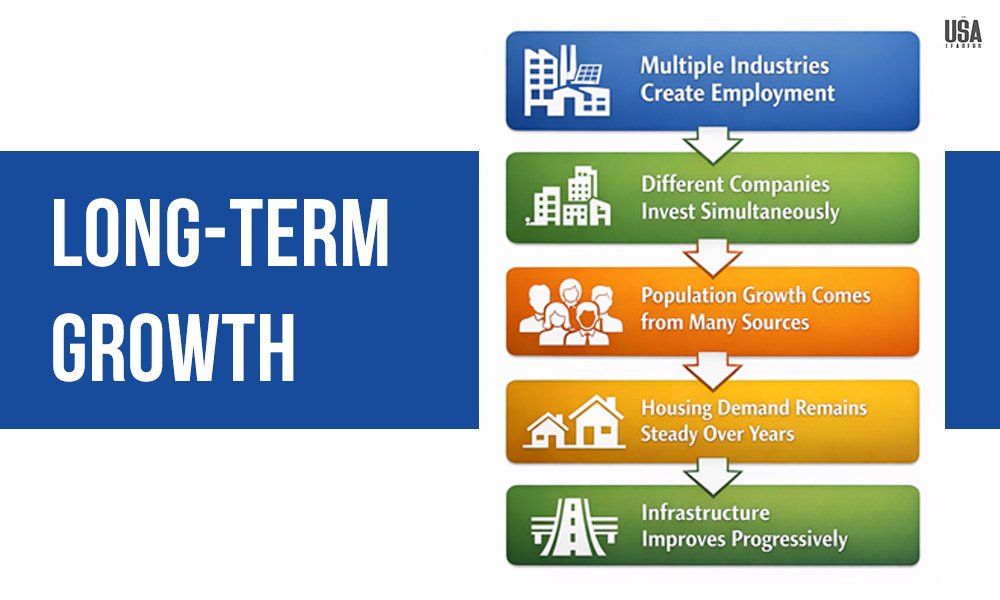
These cities develop resilience because no single factor drives all growth. The fastest growing cities in the US that matter most are those with sustained growth.
Charlotte’s banking sector, Austin’s tech jobs, and Dallas’s strong economic ranking create diversified growth that can last through economic cycles. Oxford Economics places Dallas 17th among the world’s 1,000 largest cities in its 2026 index.
This staying power attracts serious investors, relocation companies, and families planning to settle for decades.
The Identification of the Fastest Growing Cities in the US
To identify the fastest growing cities in the US that are positioned for future expansion, we combined three data sources.
First, the Census Bureau’s Vintage 2025 estimates show which cities grew fastest between July 2024 and July 2025. Second, U.S. News & World Report ranks places by net migration. Third, we reviewed five development indicators from Cotality, a leading real estate data provider.
While Census and migration metrics establish where demand momentum is already heading, the Cotality indicators verify whether housing supply is actively scaling up to meet it.
These indicators include new construction properties sold over the past two years, new construction built over the past three years, land use changes over the past two years, builder and developer-owned land parcels, and new construction permits issued over the past two years.
These indicators reveal where developers are actively investing, acquiring land, and expanding housing supply.
How We Identified Future Growth Cities
To identify the fastest-growing cities positioned for future expansion, we analyzed five key indicators from Cotality, a leading real estate data provider.
These indicators include new construction properties sold over the past two years, new construction built over the past three years, land use changes over the past two years, builder and developer-owned land parcels, and new construction permits issued over the past two years.
These indicators reveal where developers are actively investing, acquiring land, and expanding housing supply.
These are not indicators of past growth; they are signals of future development.
What the Latest Census Data Says About the Fastest Growing Cities in the US
Celina, Texas, is America’s fastest growing city among places with 20,000 or more residents. The Census Bureau’s Vintage 2025 estimates show it grew 24.6% between July 2024 and July 2025, reaching 64,427 residents. Celina also led the list in 2023, so this is a trend and not a one-year spike.
The top five fastest growing cities in the US are all in Texas. Fulshear grew 21.0%, Princeton 18.1%, Melissa 14.5%, and Anna 10.2%. Four of the five sit in the Dallas-Fort Worth area, and Fulshear sits outside Houston. Haines City, Florida, comes next at 10.0%, followed by Waukee, Iowa, at 9.3%.
Here are the top 10 fastest growing cities in the US by percentage growth (Census, cities with 20,000+ residents):
- Celina, Texas: 24.6%
- Fulshear, Texas: 21.0%
- Princeton, Texas: 18.1%
- Melissa, Texas: 14.5%
- Anna, Texas: 10.2%
- Haines City, Florida: 10.0%
- Waukee, Iowa: 9.3%
- Forney, Texas: 8.5%
- Eagle Mountain, Utah: 8.5%
- Johnstown, Colorado: 8.4%
Cities above 500,000 residents grow more slowly in percentage terms but add more people. Charlotte gained 20,731 residents, the most of any US city, followed by Fort Worth (19,512) and San Antonio (14,359). Austin crossed 1 million residents, and Raleigh passed 500,000.
Big cities are slowing down while midsized suburbs hold up. Average growth in the largest cities fell from 0.9% to 0.3% in a year, according to the Census Bureau. New York City lost 12,196 residents, the biggest numeric drop in the country. Midsized cities held steady, which Census statistician Matt Erickson called a “Goldilocks zone.”
Among the fastest growing cities in the US Midwest, Waukee, Iowa, leads with 9.3% growth and ranks seventh nationally. Midsized Midwest cities also kept a relatively stable pace compared with other regions.
According to the reports, a median household income of $170,894 in Celina and $187,035 in Fulshear, using Census QuickFacts figures. Retailers are noticing: Walmart opened a new store in Celina this spring. Economically, the fastest growing cities in the US are adding income, not just people.
The Top 10 Fastest Growing Cities In The US (2026 RANKING)
Based on U.S. News & World Report’s net migration ranking, these are the fastest growing cities in the US:
- Wildwood, Florida
- Hilton Head Island, South Carolina
- Leander, Texas
- Palm Desert, California
- Naples, Florida
- Casa Grande, Arizona
- Zephyrhills, Florida
- San Marcos, Texas
- Conroe, Texas
- Bonita Springs, Florida
The two lists differ because they measure different things. Census ranks cities by percentage growth, while U.S. News ranks them by net migration.
The Top 5 Cities Leading Development
- Wildwood, Florida
Wildwood secures the top spot as one of the fastest growing cities in the US, powered by rapid population expansion and high housing demand.
Wildwood has a population of 36,493 and a median home value of $437,097, which attracts both retirees and working professionals. Its relatively affordable rent of $1,034 per month makes it highly accessible compared to major metros.
Wildwood benefits from its location near The Villages, one of the fastest-growing retirement communities in the United States. This creates sustained housing demand and continuous construction activity.
The practical impact is clear: Wildwood is becoming one of Florida’s newest housing expansion hubs.
- Hilton Head Island, South Carolina
Hilton Head Island makes the list due to its strong income levels and housing demand.
With a median household income of $102,307 and median home value of $695,439, the city attracts high-income professionals, retirees, and remote workers.
Its short average commute of just 14 minutes and strong quality of life make it highly attractive for relocators.
Developers continue building residential communities to support population growth, making Hilton Head a stable long-term growth market.
- Leander, Texas
Leander has one of the strongest economic profiles among fast-growing cities.
Leander has a population of 81,490 and a median household income of $140,795, showing strong earning potential and job growth. Median home values of $492,064 remain affordable compared to nearby Austin.
Leander benefits from its proximity to Austin’s technology sector, allowing workers to access high-paying jobs while living in more affordable suburban areas.
This positions Leander as one of the fastest-expanding suburban housing markets in America.
- Palm Desert, California
Palm Desert is here due to its steady population growth and rising housing demand.
Palm Desert has a median home value of $585,260 and a household income of $87,807; the city attracts both retirees and remote workers seeking a high quality of life.
Its relatively short commute time of 18 minutes and strong infrastructure support sustained residential growth.
Palm Desert continues attracting relocators seeking lifestyle improvements and housing stability.
- Naples, Florida
Naples rounds off the list with strong demand for housing in the high-income segment.
Naples has a median home value of $1,400,916, reflecting strong demand from affluent buyers relocating to Florida. The city’s median household income of $147,941 further confirms its economic strength.
Naples attracts retirees, remote professionals, and investors seeking long-term property value growth.
This positions Naples as one of the most valuable housing markets in the country.
Why the South Dominates the Fastest Growing Cities in the US
One pattern stands out clearly: the South leads. In the U.S. News ranking, four of the top 10 are in Florida, and three are in Texas. In the Census data, the South holds 10 of the 15 fastest-growing cities and 11 of the 12 largest numeric gains. Texas alone has eight of the Census top 15.
Several factors explain this migration trend:
- Lower housing costs compared to major coastal metros
- No state income tax in Florida and Texas
- Strong job growth and economic expansion
- Warmer climate attracting relocators
- Available land for housing development
- Builders keep adding supply: the nation’s housing stock grew 1.0% to 148.3 million units in 2025
These states offer a powerful combination of affordability, opportunity, and quality of life. National growth is cooling, partly because of lower international migration, but Southern cities still gain the most.
Unlike older cities with limited space, Southern cities can expand outward, supporting sustained population and housing growth. This regional shift is reshaping the future of the American housing market.
For businesses, the signal is simple: money and construction are moving to the same fastest growing cities in the US. RealPage found that 12 of the 15 fastest-growing cities from 2020 to 2024 were in Texas, and more than half were in the Dallas apartment market. Frisco’s apartment submarket grew its inventory 238% over ten years.
John F. Kennedy once said, “A rising tide lifts all boats.” Growth does lift local retailers, lenders, and builders. But timing matters, because RealPage’s latest update says apartment demand is closing in on a slowing supply wave.
Conclusion: What the Fastest Growing Cities in the US Mean for Business
The fastest growing cities in the US are not growing by accident. Developers are actively building housing, acquiring land, and preparing infrastructure for future population expansion.
The best of them show signals of sustained development, not temporary booms. But national growth is cooling, so the data matters more than the hype.
- For relocators: These cities offer opportunity, affordability, and long-term momentum. As Eleanor Roosevelt wrote, “You must do the thing you think you cannot do.”
- For investors: Development pipelines are expanding, creating opportunities in housing and infrastructure.
- For businesses: These regions continue attracting talent, investment, and economic activity.
Growth follows development. And development reveals the future.
Thomas Jefferson wrote, “I like the dreams of the future better than the history of the past.”
Watch the fastest growing cities in the US closely, because that is where America is growing next.
Also Read : The 10 Hottest Cities in the US: 2026 Power Rankings (Heat Intensity Index)
Frequently Asked Questions
Why do small suburbs grow faster than big cities?
Suburbs start from a smaller base, so each new family moves the percentage more. They also offer newer housing and lower prices. The Census Bureau found that growth in the largest cities fell sharply while midsized cities held steady.
Does fast growth always help local businesses?
Not always. More residents mean more customers and workers, but rising rents, traffic, and construction costs can squeeze margins. Businesses should check housing supply and income levels before expanding.
Why do U.S. News and Census Bureau rankings differ?
They measure different things. The Census Bureau ranks cities by the percentage change in population between two July dates. U.S. News ranks places by net migration, which tracks people moving in versus moving out.
Can a fast-growing city slow down quickly?
Yes. The Census Bureau says average growth rates in the largest cities fell by at least half in every region in one year. Even the South slowed, though it still leads the nation.
What should I check before moving a business to one of these cities?
Look at the growth trend over several years, not just one. Then compare median income, housing costs, commute times, and the pace of new construction. This is general information, not financial advice.
Neelmani Yadav