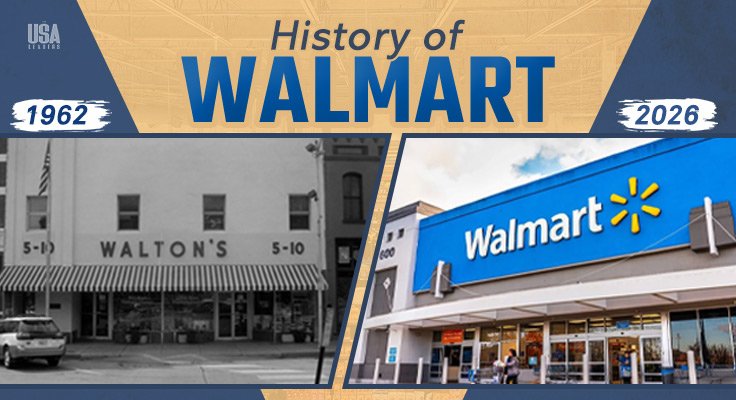
Walmart’s history began on July 2, 1962, when Sam Walton opened its first store in Rogers, Arkansas. The company focused on offering everyday low prices. From one small store, Walmart grew into the world’s largest retailer. Today, it has nearly 11,000 stores in 19 countries, employs more than 2.1 million people, and earns over $713 billion in annual revenue.
The Origin Story: How Sam Walton Founded Walmart
Sam Walton did not plan to build a global company. He started with a Ben Franklin variety store in Newport, Arkansas. He believed customers would return if prices were low and service was friendly.
After losing the lease on his first store, Walton moved to Bentonville, Arkansas. He continued trying new ways to sell products at low prices. By 1962, he had gained enough experience to open his own store.
Rogers, Arkansas – Where It All Began
On July 2, 1962, the first Walmart store opened in Rogers, Arkansas. Walmart focused on selling well-known brands at low prices and making money through high sales. Within five years, the Walton family owned 24 stores and had $12.7 million in sales.
From Ben Franklin Variety Store to a Retail Vision
Running the Ben Franklin franchise taught Walton how retail and supply chains worked. He saw that high retail markups could be avoided. Running the Ben Franklin franchise taught Walton how retail and supply chains worked. He saw that high retail markups could be avoided, and Walmart was his solution to pass those savings directly to customers. According to official corporate history, the business grew faster than almost anyone expected.
History of Walmart Timeline: Key Milestones by Decade
Walmart’s growth was not accidental. Each decade added a new capability, from public stock to satellite logistics, that competitors struggled to match.
1960s–1970s: Going Public and Going National
- 1969: The company officially incorporates as Wal-Mart Stores, Inc.
- 1970: Walmart becomes a publicly traded company for the first time. The company sells its first share of stock for $16.50.
- 1971: The first distribution center and home office open in Bentonville, Arkansas.
- 1972: Walmart begins trading on the New York Stock Exchange under the ticker symbol WMT.
1980s: Sam’s Club, Supercenters, and Rapid Growth
The 1980s helped Walmart grow from a regional chain into a national retailer. In 1980, Walmart reached $1 billion in annual sales faster than any retailer before it. In 1983, the company opened its first Sam’s Club in Midwest City, Oklahoma. In 1988, Walmart opened its first Supercenter in Washington, Missouri, combining groceries and general merchandise.
1990s: Becoming America’s Top Retailer
By 1990, Walmart had become the largest retailer in the U.S. In 1992, Sam Walton received the Presidential Medal of Freedom shortly before he died. His son, Rob Walton, became chairman. During the 1990s, Walmart also expanded internationally into Mexico, Canada, China, and the U.K. In 1998, it entered the U.K. by acquiring Asda.
2000s–2010s: Global Expansion and E-Commerce
Walmart first topped the Fortune 500 list in 2002. By 2008, its yearly sales had passed $400 billion. The company also invested in environmental efforts and online shopping. These investments helped prepare Walmart for its digital growth under CEO Doug McMillon, who took over in 2014.
2020s: Modern Innovation & CEO Transition
Walmart quickly adapted during the COVID-19 pandemic, launching Walmart+ in 2020 to expand its omnichannel presence. Doug McMillon served as CEO through January 31, 2026, after which John Furner officially took over as President and CEO on February 1, 2026. Under Furner’s leadership, Walmart continues to expand its supply-chain automation, digital networks, and drone delivery infrastructure.
Why Walmart Succeeded Where Competitors Like Kmart Failed
Walmart and Kmart started with a similar discount-store idea in the 1960s, but Walmart survived and dominated by investing early in better logistics and proprietary infrastructure.
Walmart built its own regional distribution centers, owned much of its real estate, and created a private satellite communications network. This enabled its locations to restock faster, track inventory in real time, and keep prices lower than competitors.
In contrast, Kmart leased most of its stores and underinvested in supply chain technology. When profit margins fell during the 1990s, Kmart lacked the logistical backbone to handle the pressure, leading to its bankruptcy filing in 2002.
History of Walmart International: Where Walmart Operates Today
Walmart’s international growth has had both successes and setbacks. Today, it operates stores in 19 countries, but its expansion was not always easy.
Why Walmart Has No Stores in the UK Anymore
Walmart entered the UK in 1999 by buying Asda. For more than 20 years, Asda was part of Walmart. In 2021, Walmart sold most of its stake in Asda and left the UK market. This allowed Walmart to invest more money in faster-growing markets.
Why Walmart Failed in Germany
Walmart entered Germany in 1997 by buying local stores. But it left the market in 2006 after losing more than $1 billion. Cultural differences were a major problem. German shoppers were not used to Walmart’s greeters and store chants. Also, local discounters like Aldi already offered very low prices.
Walmart in South Africa and Emerging Markets
Walmart entered South Africa in 2011 by buying a majority stake in Massmart Holdings. This helped Walmart grow to more than 10,000 stores worldwide for the first time. South Africa is still an important market for Walmart and shows the brand’s strong presence in Africa.
Walmart by the Numbers: Stock, Revenue, and Scale in 2026
Walmart closed fiscal year 2026 on January 31, 2026. The company reported total revenue of $713.16 billion, according to Britannica’s profile of Walmart. Walmart operated more than 10,900 stores worldwide and employed roughly 2.1 million associates.
Stock Split History
Walmart has executed several stock splits since going public in 1970 to keep share prices accessible for everyday investors, including a 3-for-1 stock split. These splits lowered the price of each share without changing the company’s total market value.
Fiscal Year and Annual Sales
Walmart’s fiscal year runs from February 1 to January 31. This can make it harder to compare Walmart’s results with other companies. In FY2026, Walmart’s e-commerce sales topped $150 billion. This shows how much the company has grown beyond its traditional stores.
The Walmart Name, Logo, and Slogan Through the Years
The company changed its legal name from Wal-Mart Stores, Inc. to Walmart Inc. in 2018. Its logo has changed several times. The current logo uses the yellow “spark” symbol, introduced in 2009 with the slogan “Save money. Live better.”
The Walton Family and Walmart Ownership
The Walton family remains Walmart’s largest shareholder more than 60 years after Sam Walton opened that first Arkansas store. That stake consistently places the family among the world’s richest families. Family members, including Rob Walton and Alice Walton, continue to shape the company’s direction. Their fortunes tie directly back to the retailer’s growth story.
Walmart’s scale also keeps it at the center of ongoing comparisons with other retail giants. For a deeper look at Walmart’s competition, see Walmart’s rivalry with Amazon. For context on where it ranks among grocery competitors, check out the biggest supermarket chains in America.
Lessons From Walmart’s History for Modern Businesses
Walmart’s six-decade climb offers practical lessons for any company trying to scale.
- Invest in supply chains early. A strong distribution network can give you a long-term cost advantage over competitors.
- Understand local culture. Walmart’s exit from Germany showed that a business model that works at home may not work in every country.
- Keep your brand promise. Walmart stayed focused on low prices as it grew from small stores to supercenters and online shopping.
- Invest profits in technology and logistics. Walmart invested early in systems such as satellite networks and point-of-sale technology.
- Plan for leadership changes. A smooth CEO transition helps keep the business stable and running well.
Interesting Facts About Walmart
- Walmart is the largest private employer in the United States, with more than 1.6 million U.S. associates.
- The original Rogers, Arkansas store site now houses the Walmart Museum, which preserves artifacts from the company’s early years.
- Walmart Supercenters make up the majority of the chain’s U.S. store format today, combining groceries with general merchandise under one roof.
- Sam’s Club, Walmart’s membership warehouse division, operates hundreds of locations across the United States.
- The Walton family’s stake in Wal-Mart Stores, Inc. and its successor, Walmart Inc., places them among the wealthiest families in the world.
- Walmart’s fiscal year runs from February through January, unlike most companies that report on a standard calendar year.
Conclusion
Walmart’s history shows how one small store in Arkansas became the world’s largest retailer. Its success came from strong supply chains, low prices, and the smart use of technology. Walmart also learned from mistakes, such as its failed expansion in Germany. Today, the company is growing through automation, online shopping, and global retail. Its next chapter is still being shaped.
Which part of Walmart’s journey, from the first store in Rogers to its current global scale, do you find most interesting?
Related Readings –
- The History of Amazon: From Jeff Bezos’s Garage to the World’s Largest E-Commerce Marketplace
- History of KFC: The Recipe Behind The Finger Lickin’ Taste
- Franchise Leaders
FAQs
- What is the history of Walmart as a company?
Walmart began in 1962 when Sam Walton opened the first store in Rogers, Arkansas. The company grew into the world’s largest retailer by focusing on low prices and improving its delivery and supply systems.
- What is the reason for the change from “Wal-Mart” to “Walmart”?
For many years, the company was legally called “Wal-Mart.” In 2018, it changed its legal name to Walmart Inc. to match its modern brand.
- Does the original Walmart store still operate today?
The original Walmart store in Rogers, Arkansas, is no longer open. Walmart preserves the site and its early history at the Walmart Museum in nearby Bentonville.
- Why does Walmart no longer operate stores in the United Kingdom?
Walmart entered the UK market through Asda in 1999. In 2021, it sold most of its stake in Asda to focus on other markets.