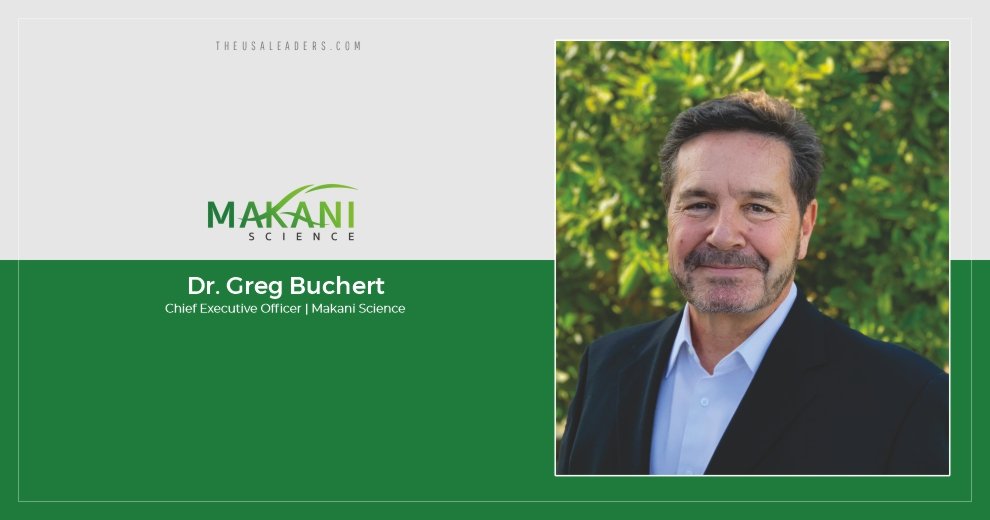
There is a particular kind of person who walks into a broken room and, rather than standing there cataloging what is wrong, quietly and methodically begins to rearrange it. Not out of restlessness. Not out of ego. But out of a deep, practiced conviction that things can and should work better than they do. Dr. Greg Buchert is that kind of person.
He is a physician and a CEO, a board member and a startup advisor, a healthcare consultant who has spent his career moving between the examining room and the executive suite with the ease of someone who stopped seeing them as separate places a very long time ago. As Chief Executive Officer of Makani Science, he now stands at the center of one of the more quietly consequential healthcare technology stories of this decade, a story that begins with a mother in a neonatal intensive care unit and ends, if all goes according to plan, with a transformation in how the world monitors breathing.
Dr. Buchert’s work, across clinical practice, health plan leadership, and medical device innovation, is animated by a single organizing principle: that healthcare must serve everyone, not merely those fortunate enough to afford the best of it. In a field where that conviction is far more common as a stated value than as an operational reality, he has spent decades making it practical.
The Making of a Systems Thinker
Dr. Buchert’s path into medicine began with the familiar ambition of a pre-med undergraduate. But something shifted early, and it shifted in the right direction.
He enrolled in what would turn out to be a genuinely formative experience: the inaugural certificate program at Tufts University, titled “Community Health and Delivery of Health Services.” It was, by his own account, an early college-level public health curriculum, and it was where he first encountered the concept of population health, not the individual patient with a single diagnosis, but the broader and far more complicated question of how entire communities receive, or fail to receive, the care they need.
That early introduction led him to the Tulane School of Public Health and Tropical Medicine, where he earned an MPH in Health Administration. Between and beyond those academic chapters, he accumulated frontline experiences that stretched from the individual to the international level, from community health settings to regional systems to global health environments.
“I enjoyed front-line experiences at the individual, community, regional, and international level,” he has reflected, “that drove me to take a systems-level approach to solving problems.”
That phrase, “systems level,” resurfaces throughout his career with a kind of quiet insistence. It is not a corporate affectation or a resume flourish. It is, for Dr. Buchert, a genuine orientation, a habit of mind that asks not only what is wrong with this patient, but what is wrong with the conditions that made this patient vulnerable in the first place. It is the difference between treating a symptom and redesigning a system.
It is also, it turns out, an extraordinarily useful lens through which to build a healthcare technology company.
A Birth, a Crisis, and the Beginning of Something New
Makani Science did not begin in a boardroom or a strategy session. It began in a neonatal intensive care unit, in the particular anguish of a mother who could not hold her son.
Dr. Michelle Khine, a Professor of Biomedical Engineering and a serial entrepreneur with six startups already to her name, found herself standing beside a hospital crib as her newborn son struggled with respiratory distress. She was surrounded by the full machinery of modern medicine: monitors, wires, screens radiating data.
And yet, for all of that technological sophistication, the “state of the art” respiratory monitoring systems in that unit failed to detect her son’s collapsed lung.
There was also the matter of the wires. A tangle of them, connecting her son to the machines that were supposed to keep him safe, and keeping her from doing the one thing a mother needs most to do: pick him up and hold him.
Dr. Khine was not someone who absorbed a failure like that and moved on. She was someone who set about solving it. As a biomedical engineer with the capacity to interrogate a medical problem at the technical level, she began to ask whether there was a better way to monitor respiration. That question became Makani Science.
Dr. Buchert, who as CEO serves on the Board of Directors alongside Dr. Khine, carries that origin story not as a marketing narrative but as a moral anchor. Every decision about what Makani Science builds, and for whom, is in some sense an answer to the question of what that mother deserved to have in that hospital room.
The Device That Changes Everything
What Makani Science has developed is, in its physical form, almost deceptively simple. A bandage-sized wireless respiratory monitor.
But the implications of what that small device can do are anything but simple.
The monitor is small enough to be placed on a premature infant, which is not a minor engineering achievement in any sense. It is comparable to the gold standard of spirometry in accuracy and faster than pulse oximetry in its measurements. Its novel stretch sensor makes it resistant to motion artifacts, a persistent and frustrating limitation of traditional respiratory monitoring technology that has long confined meaningful monitoring to stationary patients in clinical settings.
The result is something genuinely unprecedented: the only respiratory monitor that can be worn 24 hours a day, seven days a week, by ambulatory individuals going about their ordinary lives.
And what Makani Science is building with the data that flows from those monitors is equally without precedent. The company is in the process of creating the first-of-its-kind database of breathing pattern waveforms for ambulatory individuals, a resource that clinicians, researchers, and pharmaceutical companies have never had access to, because the technology to generate it has simply not existed until now.
Dr. Buchert describes the product development philosophy in terms that reflect his broader approach to healthcare as a whole:
“It is always important to start with identifying and defining the problem. Next is to understand the workflow of the provider and how a solution could be implemented. Finally, work on developing a solution that solves the problem in a realistic fashion and can be produced with an accessible price point.”
Accessible. That word matters to him more than most. It is not incidental to the Makani Science mission. It is inseparable from it.
The Uncomfortable Truth About American Healthcare
One of the most striking things about Dr. Buchert is what he is willing to say out loud, and to whom.
Ask him about healthcare innovation in America, and he will not offer the reassurances that many in his position might reach for. He will not simply endorse the familiar claim that the United States leads the world in medical progress. Or rather, he will tell you what that claim consistently and conveniently leaves out.
“The United States has the best healthcare system in the world,” he acknowledges, which is a statement many people hold firmly.
“Admittedly, we do enjoy exposure to so many new technologies,” he says, and then arrives at the part of the conversation that tends to make rooms go quiet: “But it is important to point out some glaring truths to put that statement into perspective.”
Many of the most celebrated medical innovations, he notes, are realistically available only to those who can afford them. The high cost of some innovations, with little demonstrable impact on long-term outcomes, displaces healthcare dollars that could benefit exponentially more people. And the health outcomes of the overall US population, measured against those of other developed nations, remain a cause for serious concern rather than self-congratulation.
This is not pessimism from a man who has lost faith in the system. It is precision from a man who has worked inside it long enough to understand exactly where it is failing. And it is what drives his insistence, in every venture he undertakes, that innovation must be designed with broad accessibility in mind from the very beginning, not awkwardly retrofitted for wider populations after the commercially attractive market has already been served.
“In my work,” he says, “I’ve done my best to ensure that innovations are available to as many individuals as possible.”
When Leadership Is Tested
There is a particular story from Dr. Buchert’s career that reveals more about his character than almost any credential on his professional record.
He was serving as Director of Outpatient Services at a Children’s Hospital that had no integrated Emergency Department. The Pediatric Specialty Physicians, confronted with urgent cases during clinic hours, would route them to the outpatient clinic. After hours, the same patients, many of them children carrying complex medical conditions, were sent reluctantly to the local emergency department, which was not designed or staffed to meet their particular needs.
It was a system that worked for almost no one. And it worked least of all for the children.
Dr. Buchert’s response was not to escalate the problem upward and wait. He hired Pediatric Emergency Physicians for the clinic. He temporarily expanded clinic operations to run 24 hours a day. And he went to work directly with the local emergency department, collaborating on a redesign of its facility, its protocols, and its staffing configurations so that children with complex medical issues could receive genuinely appropriate care at any hour.
Eventually, the Children’s Hospital built its own Emergency Department when a new tower was constructed.
The distance between identifying a problem and actually solving it is where most organizational failures live. It is also where leaders prove what they are made of. Dr. Buchert closed that distance through a combination of practical action, collaborative thinking, and a refusal to accept that the existing arrangement was inevitable.
Building a Model Worth Replicating
Another chapter in Dr. Buchert’s career speaks directly to those working at the intersection of healthcare access and health equity, a constituency that increasingly includes the largest medical companies and health systems in the world.
Working in a community where Medicaid beneficiaries had serious difficulty accessing care, he became a key member of the leadership team that designed and launched a Medicaid Managed Care Health Plan, one built on principles that were, at the time, far from standard practice in the field.
The outcomes were measurable and, by any objective standard, remarkable. The number of providers willing to see Medicaid members more than doubled. The plan improved the quality of care, lowered overall cost, increased provider reimbursement, and remained locally accountable, a combination that is notoriously difficult to achieve and almost never achieved all at once.
What happened next may be the most telling indicator of the plan’s real success. It became a model for both Republican and Democratic leaders, developing new healthcare delivery strategies.
In a political environment where healthcare is almost always contested terrain, building something that earns genuine respect across party lines is an achievement worth noting carefully. It suggests not only competence but a clarity of purpose that transcends the usual ideological framing.
The Art of Building High-Performing Teams
Dr. Buchert’s philosophy on the people he chooses to work with is, in its way, as carefully considered as his approach to healthcare systems design.
He is not on a search for the most credentialed candidates, though credentials have their place. What he is consistently looking for, across clinical, operational, and business functions, is something that does not appear on a résumé in quite so legible a form.
“I always look for individuals with a ‘can-do’ attitude,” he says. “That characteristic associated with a respect for teamwork is a powerful combination that spans clinical, operational, and business functions.”
It is a deceptively clean standard. But in practice, it reflects a sophisticated understanding of how organizations actually sustain performance: not through the brilliance of their most individually talented performers, but through the collective, sustained effort of people who believe that problems can be solved and who are genuinely willing to solve them together.
What Comes Next
The immediate horizon for Makani Science centers on the launch of its respiratory monitor for neonatal care, a device with the potential to revolutionize the management of babies with respiratory-associated conditions, addressing the very clinical gap that brought the company into existence.
Beyond neonatal care, the roadmap expands considerably. Dr. Buchert describes plans to leverage the monitor’s exceptionally small size to enter multiple adult markets, placing a comfortable, unobtrusive device on ambulatory individuals who can wear it continuously through the full rhythms of daily life.
The data generated by that network of wearable monitors will be unlike anything currently available to the medical community: a living, accumulating database of real-world breathing patterns, available to clinicians making treatment decisions, researchers probing the mechanisms of respiratory disease, and pharmaceutical companies developing and evaluating new therapeutic approaches.
For investors and major medical device companies assessing where the next decade of respiratory medicine is heading, this is a space that rewards close and sustained attention.
The Life Behind the Work
For all the professional scope of his career, Dr. Buchert is quietly insistent on one thing: the work has to coexist with a life that is genuinely lived.
“I learned from experience that I must make time to exercise, spend time with my family, and enjoy a great meal with friends,” he says. “The intermittent physical and mental escapes help me focus intensely on my work.”
It is not a dramatic statement, and it is not meant to be. It carries the particular weight of something arrived at through hard experience rather than borrowed from a wellness framework. He is not describing a lifestyle philosophy. He is describing a practice that keeps him functional, present, and capable of the sustained focus his work demands.
Advice for Those Who Follow
When asked what he would offer to aspiring leaders in healthcare, Dr. Buchert does not reach for grand declarations or polished aphorisms. He offers something considerably more durable.
“Be a constant learner. Seize opportunities when they present themselves. Be humble and respect the value that every member of an organization contributes to the results. Engage in work activities that make a difference and benefit people.”
Four directives. Each one is clear. None of them is easy to sustain across an entire career.
They are the values of a man who began his professional life asking how health systems could serve more people, more equitably, and more effectively, and who has spent several decades finding answers that are practical, replicable, and genuinely useful to the people who need them most.
Dr. Greg Buchert is, at his core, a physician who never stopped practicing medicine. He simply expanded his definition of what a patient could be: from a single person in an examination room, to a community waiting for care, to a population waiting for a system that finally works the way it should.
The work is not finished. It may never be finished. But in the hands of leaders like him, it is moving in the right direction.
Quotes
“I’ve never abandoned my role as one who should be doing everything in my power to help individuals obtain optimal care that will help them live their best life possible.”
“This new type of information will create an unprecedented database to be used by clinicians, researchers, and pharma companies.”
Also Read – Visionary Leaders Advancing Global Leadership 2026