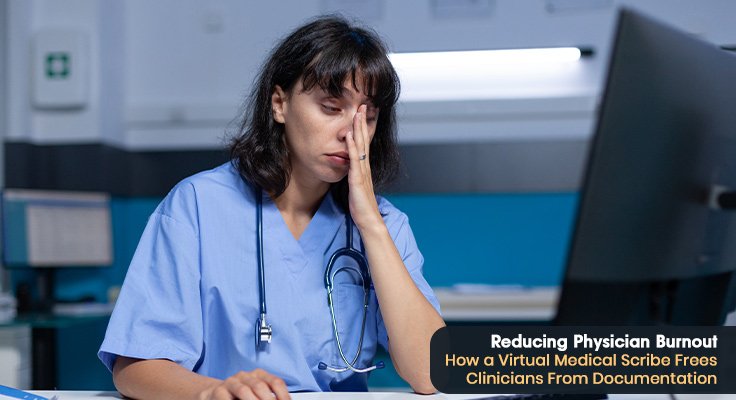
Physician burnout gets discussed as a broad systemic issue, but for many clinicians it comes down to something specific and fixable: the hours spent typing notes instead of spending time with patients or, frankly, going home on time. Survey after survey points to documentation burden as one of the top drivers of burnout in clinical practice, and a virtual medical scribe addresses that specific pain point directly.
The Real-Time Charting Problem
Electronic health records were meant to make documentation faster. In practice, many clinicians find themselves splitting attention between the patient in front of them and a screen demanding structured data entry, or pushing all the documentation to the end of the day and losing the accuracy that comes from writing things down while they are fresh. Neither outcome is good, for the clinician or for the patient experience during the visit itself.
A remote medical scribe removes this tradeoff. By capturing the clinical encounter in real time, either listening in on a live visit or reviewing a securely recorded one, the scribe produces a complete, accurate chart while the clinician stays fully present with the patient instead of half-focused on a keyboard.
HIPAA-Aware Workflows Done Right
Any role handling protected health information remotely needs a rigorous approach to privacy and security, and this is non-negotiable for scribe work. That means secure, encrypted access to recordings and records, strict data handling protocols, and scribes trained specifically on compliance requirements rather than treated as a generic transcription task. A well-run scribe program builds these protections into the workflow from day one rather than bolting them on afterward.
What Time Actually Gets Returned to Clinicians
The most immediate effect clinicians notice is the disappearance of the after-hours charting session, often called pajama time in the industry, referring to clinicians finishing notes from home late into the evening. When documentation happens during or immediately after each visit rather than piling up, that evening block of time simply goes away. For clinicians managing full patient loads, that can mean recovering several hours a week that used to disappear into charting.
The Connection to Patient Care
This is not purely a lifestyle benefit for clinicians. A physician who is not mentally splitting attention between a patient and a keyboard tends to engage more fully during the actual encounter, which patients notice and appreciate. And a clinician who is not exhausted from nightly charting sessions brings more focus and patience to each visit the next day. Burnout reduction and patient experience are more connected than they might first appear.
Choosing the Right Scribe Support
Not every scribe service is built the same way. Look for demonstrated experience with your specific specialty’s documentation style and terminology, since generalist scribes often need heavy editing when dropped into a specialized practice. Confirm the security and compliance protocols are explicit and auditable rather than a vague assurance. And ask about the onboarding period, since the best scribe relationships involve an initial adjustment window where the scribe learns a clinician’s specific preferences before output reaches full accuracy.
The Bigger Picture for Practices
Burnout is expensive for a practice in ways beyond the personal toll on clinicians. It drives turnover, increases the risk of documentation errors, and can eventually affect patient satisfaction and outcomes. Addressing the specific, well-documented driver of after-hours charting with dedicated scribe support is one of the more targeted interventions a practice can make, rather than trying to solve burnout with broad wellness initiatives that do not touch the actual source of the fatigue.
For clinics serious about protecting their clinicians’ time and focus, bringing in remote scribe support built around HIPAA-aware workflows is a practical, measurable way to give hours back to the people doing the patient-facing work that matters most.
A Realistic Timeline for Results
Clinics considering this kind of support should expect a short adjustment period rather than instant perfection. The first week or two typically involves the scribe learning a clinician’s specific phrasing, exam sequence, and level of detail, which means more review and correction than will be needed later. By the second month, most clinicians report noticeably less editing required and a documentation process that feels closer to invisible, running quietly in the background of each visit.
Making the Case Internally
For practice administrators weighing whether this investment is worth it, the clearest argument is usually retention. Recruiting and training a replacement physician costs far more than the ongoing cost of scribe support, and burnout tied to documentation burden is a well-documented driver of clinicians leaving a practice altogether. Framed that way, a virtual medical scribe is not just an efficiency tool. It is a retention strategy aimed directly at one of the most common and preventable reasons clinicians burn out and move on.