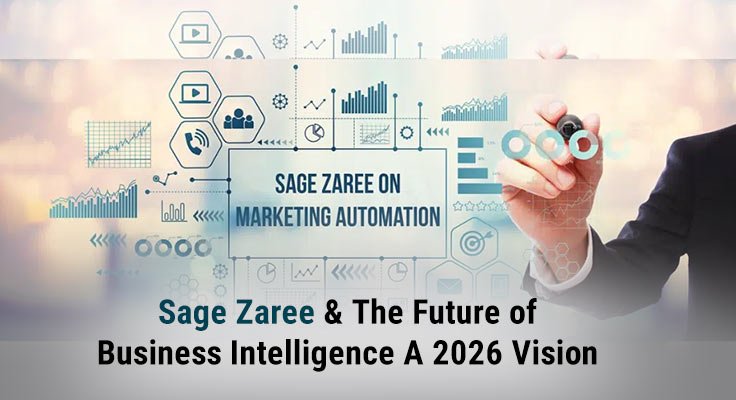
As we enter 2026, the convergence of artificial intelligence, real time data processing and predictive analytics is fundamentally reshaping how businesses understand and act on their data. We sat down with Sage Zaree, CEO/CMO of Lead Media and a recognized digital strategist with over 15 years of experience in data driven marketing and business intelligence, to explore what the BI landscape will look like in the year ahead.
The Death of Traditional Dashboard Culture
Sage, you’ve been vocal about the evolution of business intelligence beyond traditional reporting. As we look at 2026, what’s fundamentally different about how organizations are approaching BI?
In my opinion, the dashboard era is effectively over. In 2026, we should start seeing the emergence of intelligence based, narrative systems. BI platforms that don’t just show you what happened but proactively tell you what is happening, why it matters and what you should do about it. The old model of logging on a dashboard just to find insights will be completely outdated.
Organizations that will win in 2026 will move from a more reactive business intelligence approach to a more predictive one because their systems will be constantly monitoring, analyzing and alerting them to opportunities and threats in real time.
Can you give us an example of how this plays out in practice?
For example, an eCommerce business would use traditional BI to show that sales dropped by 15% last week. Modern BI in 2026 is going to alert you days before that drop happens and explain that it’s likely due to a combination of supply chain delays affecting your top selling product categories, if a competitor’s pricing strategy shift and seasonal buying pattern changes in your core demographics. It will eventually recommend specific actions: adjust your inventory allocation, modify your pricing strategy or shift your marketing spend toward higher converting product lines.
The Convergence of BI and Customer Experience
Your recent work has focused heavily on customer experience trends. How is BI transforming CX in 2026?
The lines between business intelligence and customer experience are very blurred right now. What we’re seeing is personalization at scale, powered by real time BI that processes behavioral data.
In 2026, every customer touchpoint would be a new data opportunity and every piece of intelligence would inform the customer experience. When someone visits your website, your BI system will analyze interactions and predict the user’s intent in real time.
That sounds complex, how are organizations managing this complexity?
A lof of this will be driven by AI due to the technical infrastructure that is needed to integrate customer data platforms, behavioral analytics, CRM systems and predictive models.
Business users in 2026 will interact with BI systems through natural language interfaces more and more. You don’t need to know SQL or understand data structures. You simply ask, “Why are our high value customers churning in this region?” then you get an actionable insight immediately.
The MarTech Stack Revolution
You’ve mentioned that AI could replace up to 50% of the traditional martech stack. How does this relate to BI transformation?
The martech consolidation is directly driven by advanced BI capabilities. When your business intelligence platform can handle predictive analytics, customer segmentation and real time personalization then you don’t need separate tools for each function.
In 2026, successful organizations will operate with integrated stacks where BI is the central platform where the final decision can be made. Instead of having a bunch of disconnected tools that require manual data integration, there will be 3 – 5 platforms that work together with BI behind the entire operation.
This consolidation isn’t just about cost savings but it will save costs, instead it’s about speed and accuracy. When your BI system can make real time decisions across all your marketing channels simultaneously, you can respond to market changes faster than competitors who are still manually analyzing spreadsheets.
Predictive Intelligence and Market Timing
Looking at regional business trends, from Atlantic City to the Rust Belt, how is BI helping organizations navigate economic shifts?
Regional economic intelligence has become very sophisticated. BI platforms in 2026 will integrate macroeconomic factors, local market conditions and demographic trends to provide localize business insights.
What’s particularly powerful is that predictive market timing will no longer react to economic changes after they’ve happened, organizations are using BI to anticipate shifts multiple months in the future.
Answer Engine Optimization and Search Intelligence
You’ve been pioneering work in Answer Engine Optimization. How does this connect to business intelligence strategy?
Answer Engine Optimization represents a fundamental shift in how businesses think about discoverability and customer acquisition. Traditional SEO was about ranking for keywords. AEO is about being the definitive source for answers to customer questions.
From a BI perspective, this requires sophisticated content performance analytics and competitive intelligence. Organizations need BI systems that can analyze how their content performs across different AI platforms and then understand the questions their customers are asking and optimize their content strategy accordingly.
In 2026, businesses using BI to track their answerable market share, how often they’re cited as the authoritative source when customers ask questions related to their industry. This has become as important as traditional search rankings.
Industry Specific Intelligence Evolution
How is BI evolution different across various industries you work with?
Each industry has developed specialized BI capabilities based on their unique data challenges and business models. Healthcare organizations are using BI for patient outcome predictions and treatment optimization. Financial services are implementing real time fraud detection and risk assessment. Manufacturing is leveraging BI for predictive maintenance and supply chain optimization.
But what’s interesting in 2026 will be the cross pollination of BI innovations across industries. Retail companies are adopting healthcare’s patient journey analytics for customer lifecycle management. Manufacturing’s predictive maintenance approaches are being adapted for IT infrastructure management.
The most successful organizations are those that look beyond their industry boundaries for BI innovation opportunities.
The Human AI Collaboration Model
With all this automation and AI, what’s the role of human intelligence in BI?
Human intelligence will be more critical but instead of spending time on data collection and basic analysis, professionals are focusing on strategic interpretation, ethical oversight and creative problem solving.
The most effective BI implementations in 2026 have strong human AI collaboration frameworks. Humans define the business context, set ethical guidelines and make nuanced decisions that require empathy and strategic thinking. AI handles the data processing, pattern recognition and routine decision execution.
How should professionals prepare for this evolution?
The key skills for 2026 are business acumen, strategic thinking and AI collaboration. You don’t need to become a data scientist but you need to understand how to work with AI systems effectively, ask the right questions and interpret insights in the context of broader business strategy.
Organizations need to invest in training programs that help their teams develop these human AI collaboration skills. The companies that get this right will have a significant competitive advantage.
Looking Beyond 2026
What should business leaders prepare for beyond 2026?
Since we are moving towards systems that can identify new opportunities and adapt to changing conditions with less human intervention, people can start spending more time on decision making instead of task management..
The organizations that start building these capabilities now, integrated AI systems, real time decision architectures and human AI collaboration frameworks, will be positioned to lead in this next evolution of business intelligence.
So in 2026, business intelligence isn’t a department or a tool, it’s a core competitive capability that needs to be embedded throughout your organization.
Sage Zaree is the CEO/CMO of Lead Media, a digital portfolio company focused on data driven marketing and business intelligence solutions. With over 15 years of experience in digital strategy and business intelligence, Sage has helped organizations across industries implement next generation BI capabilities.
Also Read: Transforming Business Intelligence: The Power of Embedded Analytics in Modern Applications